On this page
A Sulabh toilet needs no sewer. It treats waste on the spot, in two pits beside the house, using time, soil and a mug of water.
Who was Bindeshwar Pathak?
Bindeshwar Pathak was born in Hajipur, Bihar, on 2 April 1943, and in 1968 he joined the Bhangi-Mukti (scavengers' liberation) Cell, where he came to understand the lives of manual scavengers, the people who cleaned dry latrines by hand (Wikipedia: Bindeshwar Pathak). Sulabh says that in the same year he invented the two-pit pour-flush compost toilet (Sulabh International: Sanitation).
He founded the Sulabh International Social Service Organisation in 1970, received the Padma Bhushan in 1991 and the Stockholm Water Prize in 2009, and died in New Delhi on 15 August 2023, aged 80; the Padma Vibhushan followed posthumously in 2024 (Wikipedia: Bindeshwar Pathak).
How does a Sulabh toilet work?
Sulabh's own design notes describe four parts (Sulabh International: Technologies):
The pan and trap. A squatting pan sits on a trap that holds a 20 mm water seal, which keeps smells, flies and mosquitoes out of the house.
The flush. You pour 1.5 to 2 litres of water by hand, against 10 to 12 litres for a cistern flush.
The junction chamber. A small chamber, 250 mm by 500 mm inside, splits the pipe into two branches, one to each pit, and waste goes down only one branch at a time.
The pits. Small pits should be at least 750 mm across; Sulabh sizes pits for three years of sludge storage. Liquid soaks away into the soil through holes in the lining; the solids stay behind.
Why do the two pits take turns?
When pit A is full, the family diverts the flow at the junction chamber to pit B and leaves A closed off.
Sulabh says the contents of the first pit are digested in about 18 months, and the pit can be emptied after a rest of two years, during which pathogens are inactivated; the digested sludge is odourless and a good manure and soil conditioner (Sulabh International: Sanitation). If pit B is sized for about three years of use, as Sulabh's pit tables assume, pit A gets its full two-year rest before it is needed again.
How do pathogens die in a resting pit?
Nothing is added to kill the germs: cut off from fresh waste, they die off with time, at a rate that depends on the germ.
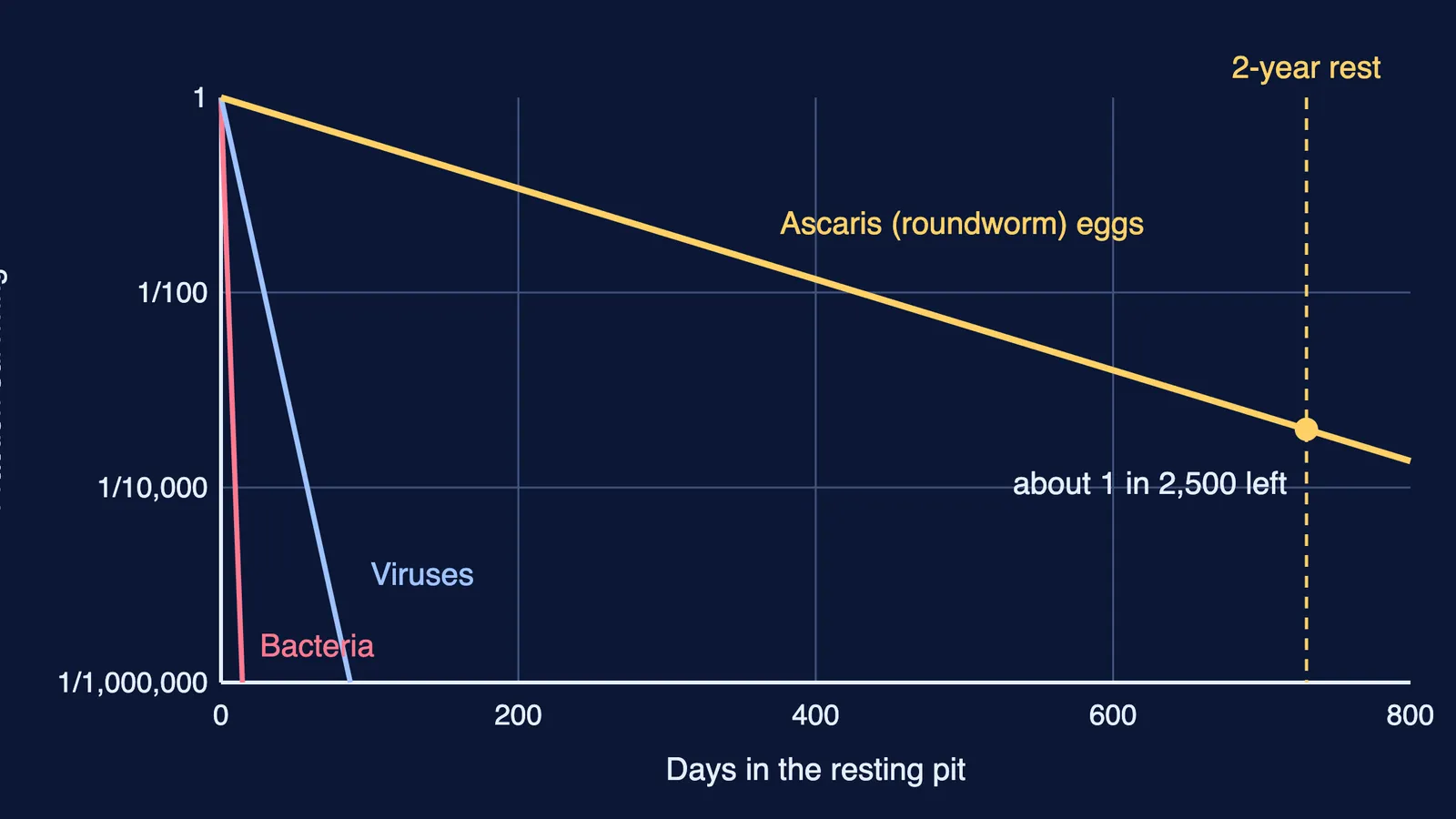
A 2023 meta-analysis by Isaac Musaazi and colleagues pooled 1,382 data points from 243 experiments described in 26 published articles on onsite sanitation such as pit latrines and composting toilets (Musaazi et al., Water Research X, 2023). It reported T99, the time it takes for 99 per cent of a pathogen to die.
Bacteria: median T99 of 4.8 days.
Viruses: median T99 of 29 days.
Protozoan cysts: more than 341 days.
Ascaris (roundworm) eggs: median T99 of 429 days.
The same paper concluded that six months of storage adequately controls the risk from bacteria and viruses, but protozoa and worm eggs need much longer storage or treatment; higher pH and higher temperature both sped up die-off (Musaazi et al., 2023). Worm eggs are among the slowest to die, and a two-year rest is well beyond their median T99.
Worked example: how many worm eggs survive two years?
Assume die-off is exponential, like radioactive decay, so every T99 leaves 1/100 of what was there. This is our own estimate from the median figures in Musaazi et al., 2023, not a measurement of any real pit.
Two years is 730 days. 730 / 429 = 1.70 T99 periods.
Fraction left = (1/100) to the power 1.70 = 10 to the power -3.4, about 1 egg in 2,500.
At 18 months (548 days): 548 / 429 = 1.28 periods, so 10 to the power -2.55, about 1 in 360.
Viruses over two years: 730 / 29 = 25 periods, so 10 to the power -50. In practice, none.
So the last six months cut surviving eggs about sevenfold. A colder pit may do worse than the median, so wear gloves and wash hands when emptying.
If logarithms and exponential decay feel slippery, the Fermi Concept Library has a lesson for every concept in chemistry, biology and mathematics, and the Fermi Simulation Lab has interactive simulations for ideas easier to see than to read.
A checklist if your family is building one
Drawn from Sulabh's specifications and its sanitation notes:
Two pits, one junction chamber, one branch open at a time.
Pits at the callout's distances from wells and hand pumps.
Paint the date on the wall when you switch pits; leave the closed pit for at least two years.
Pathak's idea was simple: give the waste time, and let biology do the cleaning.