On this page
The Statue of Unity, the 182-metre figure of Sardar Vallabhbhai Patel that stands 3.5 km downstream of the Sardar Sarovar Dam in Gujarat, was dedicated to the nation on 31 October 2018 (World Architecture Community). Outside it is a sculpture; inside it works like a tall building, and the physics that keeps it standing is the same physics you meet in Class 11.
How was the Statue of Unity built?
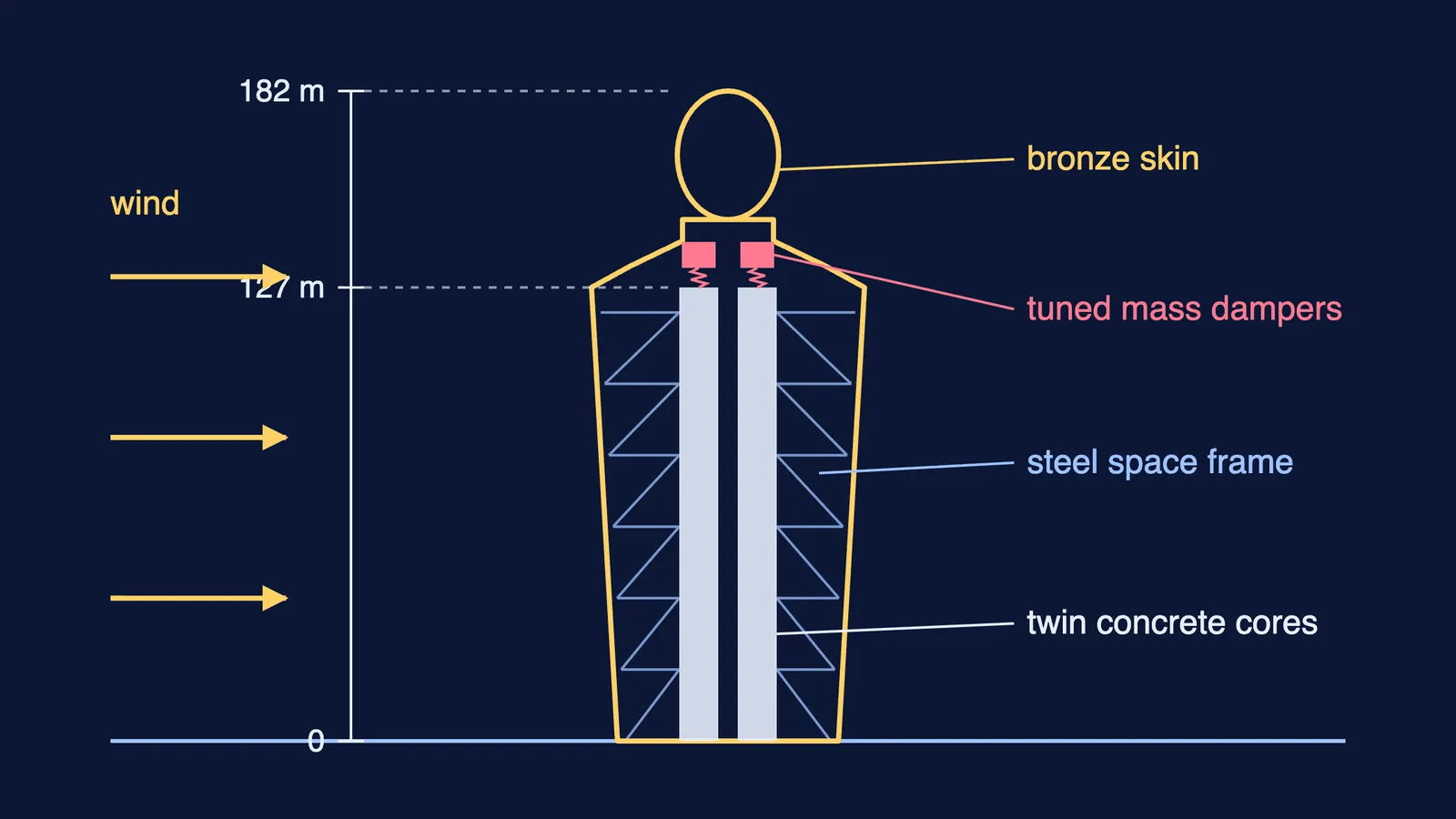
The contractor was Larsen & Toubro, with structural and geotechnical engineers from Arup turning sculptor Ram V. Sutar's design into a structure (Arup). It is built in layers:
Twin concrete cores. Two oval concrete cores rise from the foundations inside the statue (Arup). Each is a reinforced cement concrete tower 127 metres high (Swarajya).
A steel space frame. A three-dimensional steel framework surrounds the cores and connects them to the modules of the bronze skin (Arup).
A bronze skin. The outer cladding is bronze about 8 mm thick (Swarajya). Arup describes roughly 600 large panels, each about 6 m by 5.5 m, arranged in 27 rings (Arup).
Two tuned mass dampers, one on each core, to reduce vibration (Arup).
Swarajya reported over 210,000 cubic metres of concrete, 18,500 tonnes of reinforcing steel and 6,500 tonnes of structural steel (Swarajya); other reports differ slightly. Before anything was fabricated, a 3D model caught around 70 clashes between the steel structure and the supports that hold the bronze cladding (Trimble).
Why does a statue need a concrete core?
A thin bronze shell is not built to hold up a 182-metre figure or resist the wind on its own. So the skin is hung on a skeleton. Each panel is fixed to the steel frame, the frame passes the load to the concrete cores, and the cores take it down into the foundations. Engineers call this chain the load path.
The pose makes it harder. Patel is walking, which leaves a gap of 6.4 m between the two feet (World Architecture Community). The region also has earthquakes, which is why Arup brought in seismic engineers, and flexible joints between the panels let the statue flex with changes in temperature and wind (Arup). The statue was reported as built to withstand earthquakes of 6.5 on the Richter scale (World Architecture Community).
How do tuned mass dampers stop it swaying?
A tuned mass damper is a mass mounted on springs and dampers whose oscillation frequency is tuned to be similar to the resonant frequency of the structure it sits in (Wikipedia: Tuned mass damper). When gusts start the statue swaying at that frequency, the mass swings out of step with it, pulls against the motion and lowers the peak amplitude.
Think of a swing pushed in rhythm: it goes higher each time. That is resonance, and the damper is tuned to work against it. Swarajya reported two 250-tonne dampers in the statue (Swarajya).
How hard does a 180 km/h wind push on one panel?
The statue was reported as built to withstand winds of 180 km/h (World Architecture Community); Swarajya gives almost 220 km/h (Swarajya). Using the lower figure, dynamic pressure is q = ρv²/2, where ρ is the air's density and v its speed (NASA Glenn Research Center).
Convert the speed: 180 km/h ÷ 3.6 = 50 m/s.
Air density at sea level comes out at about 1.2 kg/m³ from NASA's standard-atmosphere formulas (NASA Glenn).
Pressure: q = 0.5 × 1.2 × 50 × 50 = 1,500 Pa, or 1.5 kN on every square metre.
One large panel is about 6 m × 5.5 m = 33 m² (Arup).
Force: 1,500 × 33 ≈ 50,000 N, or 50 kN.
Compare: 50,000 N ÷ 9.8 m/s² ≈ 5,100 kg. That is about the weight of five tonnes, pushing sideways on a single panel.
This is rough: real design adds factors for gusts, shape and height, but the order of magnitude shows why every panel needs a solid connection to the frame.
What can a JEE or board student take from it?
The statue is a revision sheet in bronze:
Load path is free-body diagrams stacked up: draw each part and the forces passed to the next.
Wind pressure is dynamic pressure from Bernoulli's principle in Class 11 fluids.
Tuned mass dampers are forced oscillations and resonance.
The v² rule is a scaling check you can use on any estimation question.
If resonance is easier to see than to read, try the Fermi Simulation Lab, which has interactive simulations for ideas like this. To check your own working on a numerical like the wind estimate above, the Fermi Problem Library has a step-by-step solver that explains the reasoning rather than printing an answer.
Next time you see a photo of the statue, picture the two grey cores and the steel lattice inside it.