On this page
On 16 January 2025, ISRO locked two small satellites together in orbit, and India became the fourth country to achieve space docking, according to the Press Information Bureau's SpaDeX explainer. Both craft were circling Earth at several kilometres per second, yet the last metres were closed at around a centimetre per second. Here is how that works, and why a future Indian space station depends on it.
What is the SpaDeX docking mission?
SpaDeX (Space Docking Experiment) is a cost-effective ISRO technology demonstrator that tests rendezvous, docking and undocking with two small spacecraft, according to ISRO's SpaDeX mission page.
The two satellites, SDX01 (the Chaser) and SDX02 (the Target), weigh about 220 kg each and were launched by PSLV-C60 into a 470 km circular orbit inclined at 55° (ISRO). The launch took place on 30 December 2024 from Sriharikota (PIB). The docking mechanisms are androgynous: they are identical on both craft, so either one can act as the chaser.
How do two satellites rendezvous in orbit?
In a circular orbit, any addition or reduction of velocity changes the orbit (ISRO). Standard orbital mechanics says what follows: speed up and you climb to a higher, slower orbit; slow down and you drop lower and move ahead.
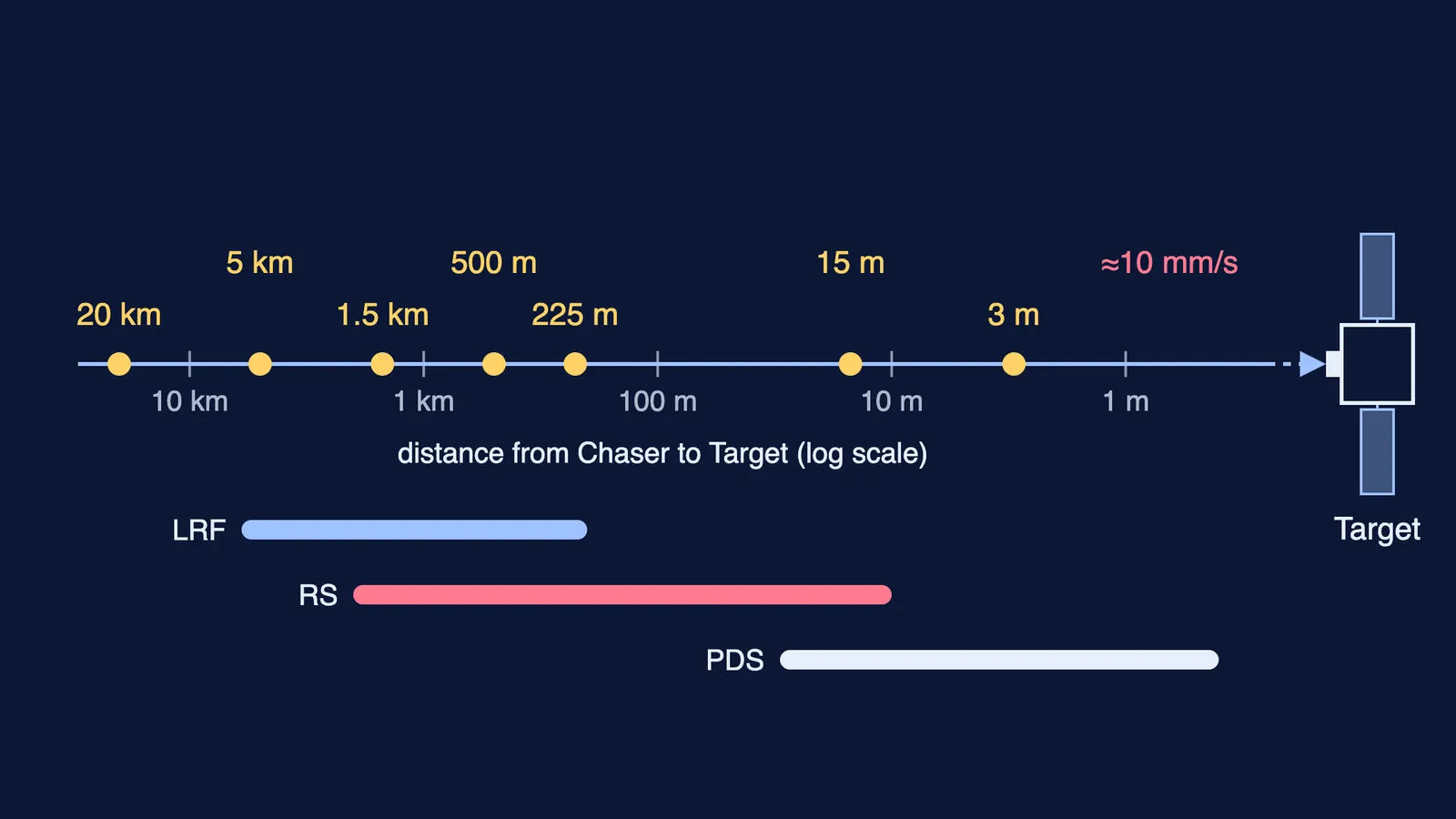
So SpaDeX was planned around a patient trick: add a small relative velocity, let the gap change, then cancel it. PSLV was to release the satellites with a small relative velocity, so the Target would drift 10 to 20 km away within a day. The Target's thrusters would then stop the drift, leaving both craft in the same orbit with the same velocity, about 20 km apart. From there the Chaser was to close in, stopping at each hold point listed on the ISRO mission page:
20 km (far rendezvous)
5 km
1.5 km
500 m
225 m
15 m
3 m, then docking
How do the satellites measure their relative velocity?
The ranges below come from ISRO's description of the sensor suite:
GNSS receivers on both craft compare signals from the same navigation satellites to work out relative position and velocity, sharing measurements over an inter-satellite radio link.
A Laser Range Finder measures range and velocity from 6,000 m to 200 m.
Rendezvous Sensors give relative position from 2,000 m to 250 m and from 250 m to 10 m.
The Proximity and Docking Sensor gives relative position and velocity from 30 m to 0.4 m.
A Mechanism Entry Sensor detects the Chaser entering the Target's mechanism from 8 cm to 4 cm.
Why does docking happen at about 10 mm/s?
The SpaDeX mechanism is a low-impact system with an approach velocity of the order of 10 mm/s (ISRO). The worked example below uses Earth's GM of 3.986 × 10^14 m³/s² and mean radius of 6,371 km from NASA's Earth fact sheet.
Orbital speed: r = 6,371 + 470 = 6,841 km, so v = √(GM/r) ≈ 7.63 km/s, and one orbit takes 2πr/v ≈ 94 minutes.
Relative speed: both craft move at about 7.63 km/s, but what the latches feel is the difference, about 0.01 m/s, roughly one part in 760,000.
Energy at contact: for two free bodies, use the reduced mass μ = (220 × 220)/(220 + 220) = 110 kg. The energy to absorb is ½μv² = ½ × 110 × (0.01)² ≈ 0.0055 J.
Compare: at 1 m/s the same formula gives 55 J, which is 10,000 times more. Energy grows as v², so an approach 100 times slower is 10,000 times gentler.
Time: if the final 3 m were flown at a steady 10 mm/s, it would take 300 s, or five minutes.
Now try it yourself: what is the contact energy at 5 cm/s? If a step like reduced mass is new to you, the Fermi Problem Library has worked problems with a step-by-step solver that explains the reasoning rather than printing an answer. Ideas like speeding up to fall behind are easier to see than to read, which is what the interactive simulations in the Fermi Simulation Lab are for.
Why does docking matter for a space station?
A space station is too big for one rocket. ISRO says in-space docking is essential whenever several launches must work towards one goal, and names the Bharatiya Antariksh Station, sample return from the Moon and an Indian on the Moon as missions that need it (ISRO).
SpaDeX also tested what comes after the latch closes. Its secondary goals include transferring electric power between the docked craft and controlling the pair as one spacecraft (ISRO). The PIB explainer, published on docking day, reports that combined control was achieved after docking, with undocking and power transfer checks still to come. ISRO also calls the mission a forerunner for the autonomous docking Chandrayaan-4 will need, without GNSS support from Earth. Next time a kinematics problem asks you to work in one body's frame, picture the Chaser closing on the Target.