

On this page
In the early twentieth century, epidemic typhus was among the world's most feared infectious threats. Carried by the human body louse (*Pediculus humanus corporis*), the disease caused relentless fevers, delirium, painful vasculitis, and mortality rates reaching 40% during wartime dislocations, as documented in the Journal of Medical Biography. Yet for decades, bacteriologists hit a wall trying to produce a vaccine. The causative bacterium, *Rickettsia prowazekii*, refused to grow in nutrient broths or petri dishes.
Polish biologist Rudolf Weigl at Jan Kazimierz University in Lwów (modern Lviv) realized that because the pathogen required living host cells, he could turn the insect vector itself into an incubator. In doing so, he developed the world's first effective typhus vaccine and established a clandestine sanctuary that protected over 2,000 Polish intellectuals and underground fighters from Nazi death squads.
Why was epidemic typhus impossible to culture in a dish?
Unlike free-living bacteria, *Rickettsia prowazekii* is an obligate intracellular parasite. It cannot generate metabolic energy or synthesize adequate adenosine triphosphate on its own; it must invade host cells to reproduce. Early bacteriologists who studied typhus in guinea pigs or monkeys found tissue pathogen concentrations far too dilute to yield a potent inactivated vaccine, as chronicled in the Journal of Medical Biography.
Typhus research was also perilous: pioneers Howard Ricketts and Stanislaus von Prowazek both died from accidental laboratory infections. As outlined in our guide to pathogens, immunity, and vaccine design, generating active immunity against an intracellular pathogen requires harvesting massive numbers of intact bacterial surface antigens. Without an abundant cellular culture system, an inactivated vaccine remained impossible.
How did Weigl manufacture a vaccine from louse intestines?
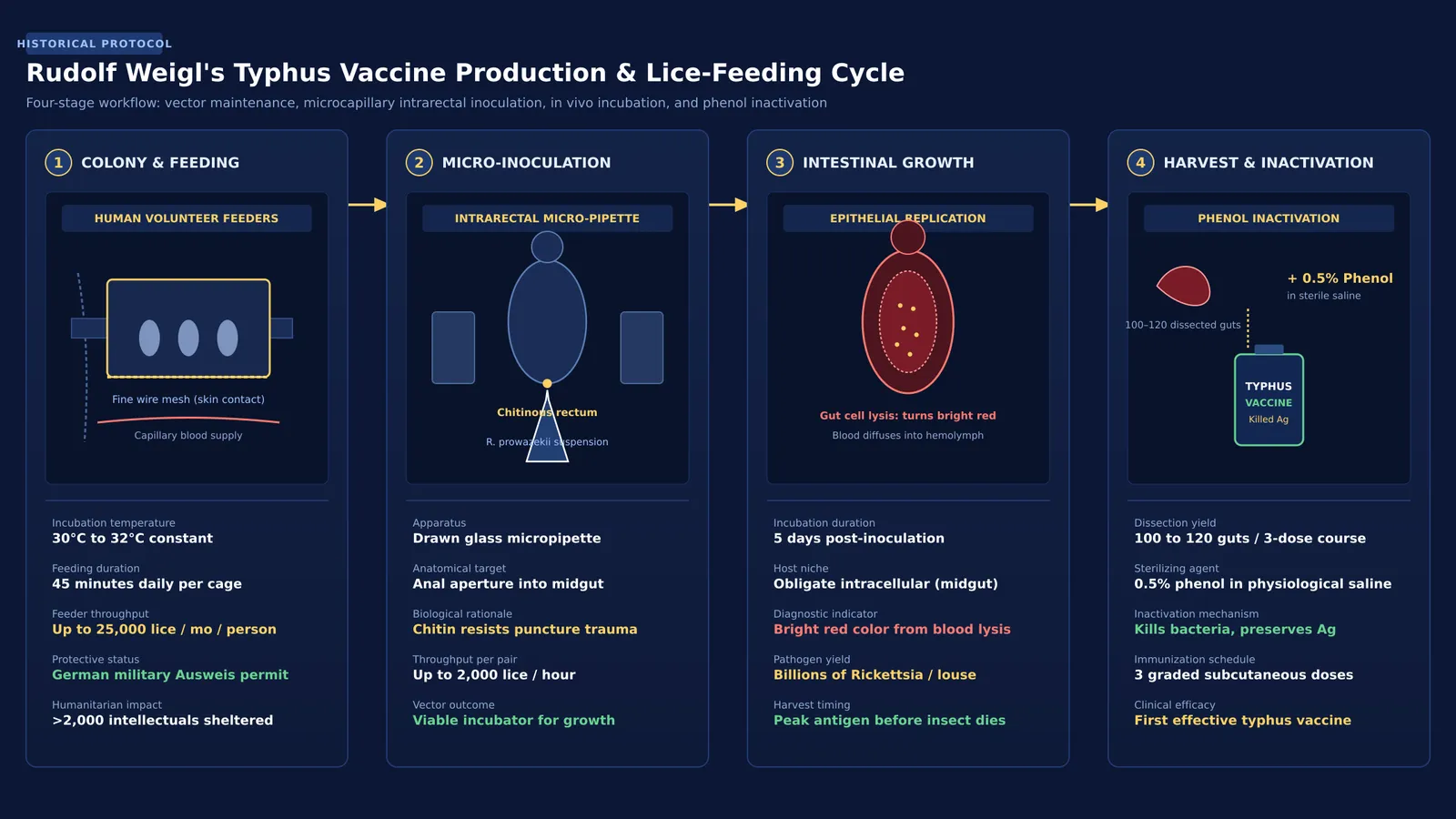
Weigl discovered that the louse midgut epithelium was the natural proliferation site for *Rickettsia*. As Chong-Gee Teo details in Emerging Infectious Diseases, Weigl bypassed the dangers of natural feeding by inventing intrarectal micro-inoculation. Because the insect's rectal lining is chitinous, it withstood glass needle insertion under magnification without puncturing the body cavity.
Technicians immobilized lice in wooden clamps and injected *R. prowazekii* into the rectum using microcapillary pipettes. Inside the gut lumen, the bacteria invaded epithelial cells and multiplied rapidly. Understanding this specific tissue cycle, much like Carlos Chagas' study of insect-borne parasites, enabled Weigl to establish an industrial vaccine workflow.
Breeding: Clean lice colonies were reared in incubators at 30°C to 32°C.
Inoculation: Inoculators micro-injected lice at rates reaching 2,000 insects per hour for trained pairs.
Incubation: Inoculated lice were maintained for 5 days until bursting gut cells diffused blood into the cavity, turning the lice bright red.
Dissection and inactivation: Preparators dissected the swollen guts and suspended them in 0.5% phenol-saline solution to kill the bacteria while preserving their immunogenic surface antigens.
Who were the Lwów lice feeders during World War II?
Sustaining millions of lice required human blood. As documented by Chong-Gee Teo in Emerging Infectious Diseases, Weigl employed human 'feeders.' Volunteers strapped wooden boxes with fine wire mesh to their legs for 45 minutes daily, enabling a single feeder to nourish up to 25,000 lice per month.
When Nazi Germany occupied Lwów in July 1941, the Gestapo murdered 25 Polish university professors. But as typhus threatened the Eastern Front, German military authorities prioritized securing Weigl's vaccine. As recorded by Agnieszka Polak and co-authors in Clinics in Dermatology, Weigl used his institute to shelter more than 2,000 Polish intellectuals, resistance couriers, and Jewish scientists as official lice feeders (*karmiciele wszy*). Each feeder received a German *Ausweis* protecting them from deportation.
Feeders included mathematician Stefan Banach, poet Zbigniew Herbert, and microbiologist Ludwik Fleck. Weigl also smuggled thousands of potent vaccine vials into the Warsaw and Lwów ghettos while delivering weakened batches to the German army. For his heroism, Yad Vashem posthumously recognized Weigl in 2003 as Righteous Among the Nations. His work demonstrated how host-parasite biology, comparable to Peter Medawar's research on immune tolerance, could protect lives under extreme oppression.
How do modern students master vector biology and immunology?
For students mastering vector-borne disease cycles and immunology, connecting host-pathogen biology to experimental design is essential. Memorizing lifecycle steps without understanding cellular interactions makes it difficult to solve questions on antigen presentation or vaccine platforms.
When exploring vector life cycles and pathogen structures, the Fermi Concept Library covers every concept in physics, chemistry, biology, mathematics and computing, each with its own lesson and its place in the map. If you are uncertain where to begin your revision, Fermi's AI tutor can work out what you already know and build a plan for the session, guiding you through complex immune mechanisms step by step. When practicing experimental questions, the Fermi Problem Library provides worked problems with a step-by-step solver that explains the reasoning rather than printing an answer.


