

On this page
Your NCERT biology book says that organs cannot be transplanted from just anyone, because the body can tell 'self' from 'non-self' and rejects foreign tissue. A natural follow-up question is whether that rule can ever be bent. Peter Medawar showed that it can, under special conditions, and the experiments that proved it are a model of how to reason from a strange observation to a clean test. This post tells his story from Nobel Prize records and his own Nobel lecture.
Who was Peter Medawar?
The Nobel Prize facts page records that Peter Brian Medawar was born on 28 February 1915 in Rio de Janeiro, Brazil, and died on 2 October 1987 in London. His Nobel biography says he studied zoology at Magdalen College, Oxford, and later held professorships at Birmingham and at University College London before becoming director of the National Institute for Medical Research in 1962.
Why did he start studying skin grafts?
During the Second World War the Medical Research Council asked Medawar to find out why skin taken from one person will not form a permanent graft on another. That practical question, his Nobel biography says, led him to work out basic rules of transplantation immunity. A graft from another person is accepted for a while and then destroyed by the recipient's immune system.
Your NCERT Class 12 chapter Human Health and Disease describes the same problem today: tissue and blood-group matching are needed before a transplant, patients take immunosuppressants afterwards, and the cell-mediated immune response is responsible for rejection.
What did twin calves have to do with it?
In his Nobel lecture, Medawar explains that the story started with cattle. In 1945 R. D. Owen found that non-identical twin calves, which share blood circulation before birth, are often born with a stable mixture of each other's red blood cells.
Medawar and Rupert Billingham were then working at Birmingham on a different problem. They had been pushed to find a reliable way to tell identical from non-identical cattle twins using skin grafts. It did not work, because most non-identical twins also accepted each other's skin. Grafts from a third, unrelated animal were still rejected. Medawar saw the link with Owen's finding: exposure to each other's cells before birth had made each twin treat the other's tissue as its own.
How did he prove it in mice?
If nature could do this by accident in twin calves, Medawar reasoned, it should be possible to do it on purpose. At University College London, Billingham, Leslie Brent and Medawar did exactly that, and published the first report, Actively acquired tolerance of foreign cells, in Nature in October 1953.
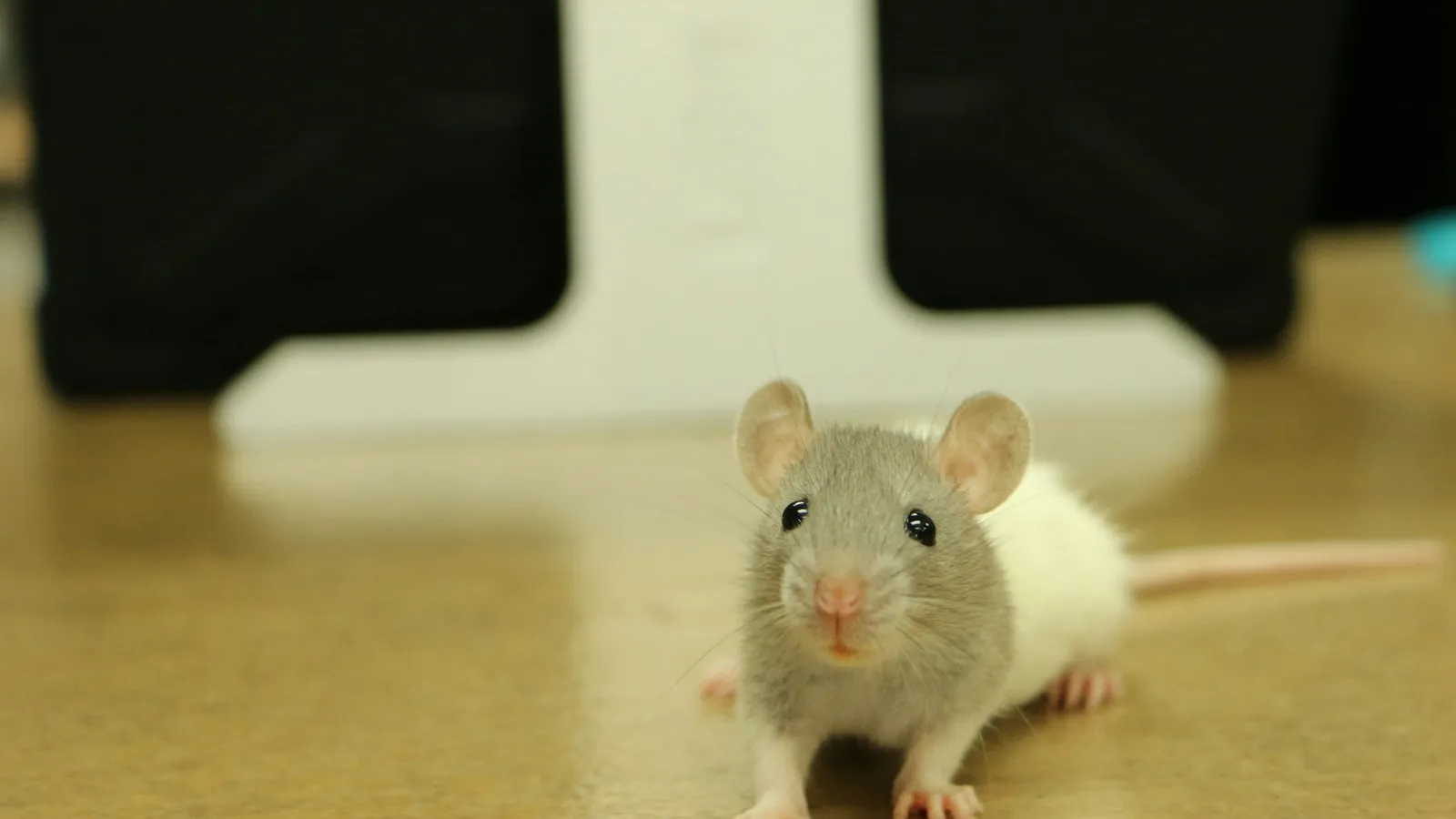
The lecture describes the design using two mouse strains, A and CBA:
Adult A mouse given CBA cells: destroys them, and then destroys any later CBA graft even faster.
Foetal or newborn A mouse given CBA cells: accepts them. When it grows up, it accepts a CBA skin graft "as if it were its own".
The same tolerant A mouse given a graft from a third strain: rejects it. Tolerance is specific to the donor.
The Nobel facts page on Medawar summarises the result: transplants made at the foetal stage were not rejected, and the mice accepted new grafts from the same source as adults.
Why is the design of this experiment so strong?
Look at what each group rules out. The adult group shows the CBA cells normally cause rejection. The newborn group shows timing changes the outcome. The third-strain graft shows the tolerant mice have not simply lost their immune system. Medawar also reports that tolerance comes from a change in the host, not from the grafted cells changing, because cells injected early kept their power to trigger rejection in other animals.
What did the discovery lead to?
The 1960 Nobel Prize in Physiology or Medicine was shared by Medawar and Macfarlane Burnet "for discovery of acquired immunological tolerance". Burnet had predicted, in 1949, that the ability to tell self from foreign is learned before birth; our post on Burnet and the clonal selection theory tells that half of the story. The Nobel facts page notes that the results mattered for organ transplants.
What mistakes do students make with this topic?
Mixing up tolerance and immunity. Tolerance is a specific lack of response to a particular antigen. The immune system still works against everything else.
Thinking any exposure causes tolerance. In these experiments timing was critical: early exposure produced tolerance, adult exposure produced faster rejection.
Confusing graft rejection with antibodies alone. NCERT says the cell-mediated response is responsible for graft rejection.
If self and non-self, humoral and cell-mediated immunity still feel tangled, the Fermi Concept Library covers every concept in physics, chemistry, biology, mathematics and computing, so you can untangle one idea at a time. Our guide to human health and immunity covers the NCERT chapter.
What can a student take from how Medawar worked?
Take the odd result seriously. Twins accepting each other's skin was a failure for the original plan and a clue for a better question.
Design groups that rule things out. Each group in the mouse experiment answers a different "what if".
Start from a real problem. A wartime question about skin grafts became a foundation of transplant biology.
Next step: for the mouse experiment above, write one sentence for each group stating what result would have disproved Medawar's idea.


