On this page
In the 1690s a professor in Tübingen, Germany, tested instead of guessed whether flowers have sexes. Rudolf Jakob Camerarius (1665-1721) removed flower parts, kept plants apart and looked at the seeds that came out. His answer sits at the centre of the plant reproduction chapter you study today.
What did Rudolf Camerarius discover about plant sex?
Camerarius became professor of medicine and director of the botanical garden at Tübingen in 1687 (Wikipedia). Before him, Millington, Grew and Ray had suggested that plants have sexes, but only as conjecture (Deutsche Biographie).
According to the botanist Julius Sachs's History of Botany, it began with a female mulberry tree that bore fruit with no male tree nearby: the berries held only empty seeds, which Camerarius compared to a bird's addled eggs (Sachs, History of Botany, Project Gutenberg). He then potted two female plants of annual mercury (Mercurialis annua) away from other plants. The fruit filled out, began to dry up half-ripe, and not one made a perfect seed. His report is dated 28 December 1691.
He set out the whole case in a letter, De sexu plantarum epistola, sent to Professor Valentin in Giessen on 25 August 1694 (Deutsche Biographie). In Sachs's English rendering, Camerarius wrote: "It is equally evident, that the ovary with its style ... represents the female sexual organ in the plant" (Sachs). The anthers, he argued, deserved "the significance of male sexual organs".
How did Camerarius prove plants need pollen?
His sharpest tests used monoecious plants, which carry separate male and female flowers on the same plant. The NCERT Class 12 biology textbook gives castor and maize as monoecious examples, and papaya as dioecious, with male and female flowers on different plants (NCERT, Sexual Reproduction in Flowering Plants). If the two words still blur, our explainer on monoecious vs dioecious plants with examples sets them side by side.
Here is what Camerarius reported in the 1694 letter, as translated by Sachs (Sachs):
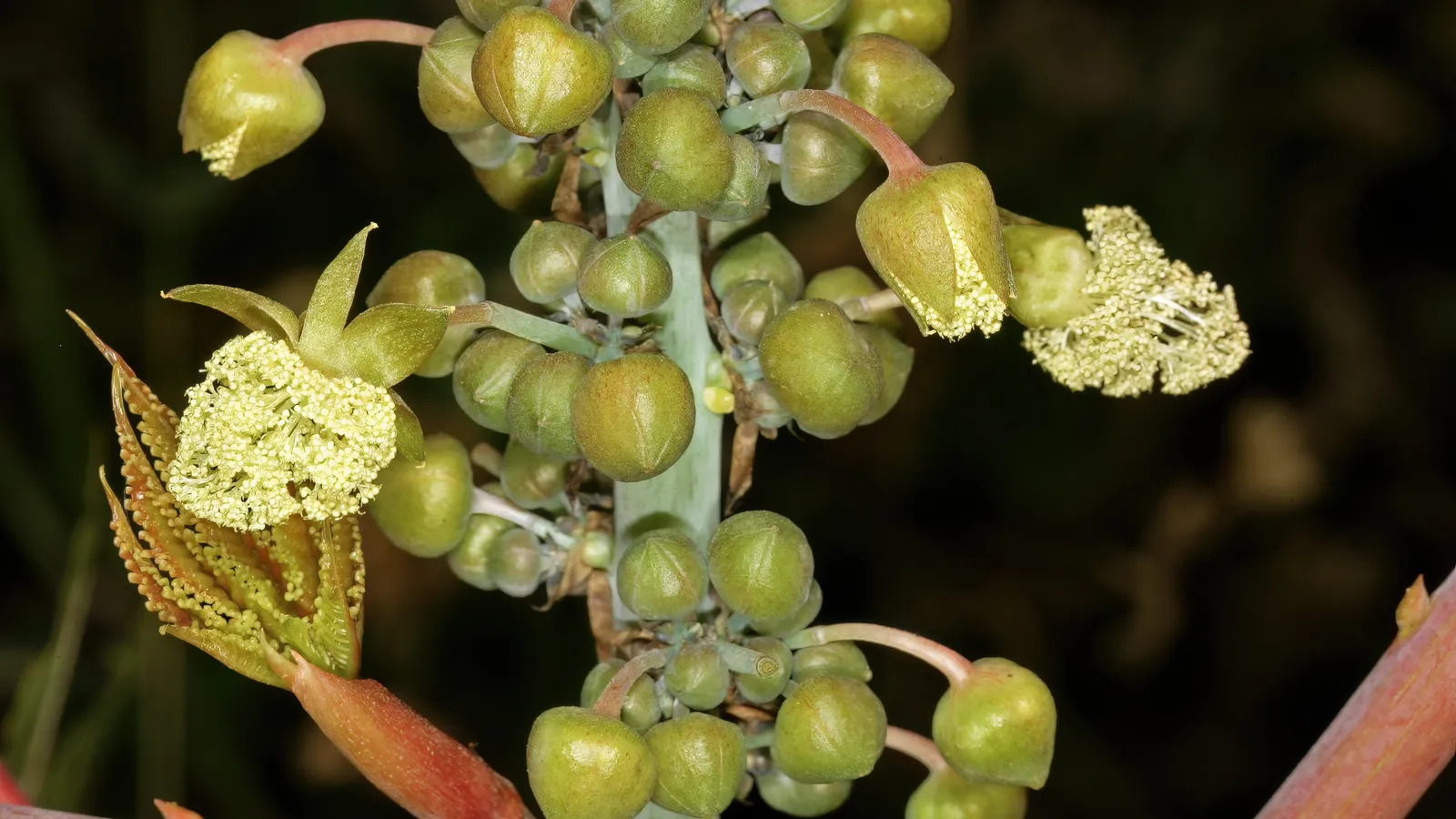
Castor (Ricinus): he removed the male flowers before their anthers opened and kept the young ovaries. He "never obtained perfect seeds", only empty fruits that dried and fell.
Maize: he cut off the stigmas (the silks) once they hung out, and two ears stayed entirely without seeds.
Spinach: he wrote that the case of spinach confirmed his earlier results with separate male and female plants such as mercury.
From this he argued that no seed forms unless the anthers, the source of pollen, have played their part first.
Why did some of his experiments fail?
Camerarius printed his failures too. A third ear on a treated maize plant held 11 fertile seeds he could not explain (Sachs). Hemp plants grown in a closed room, with the three males cut off before their flowers opened, still set a good many fertile seeds among the empty ones.
Sachs says Camerarius had already observed the cause of these failures but did not apply it. Camerarius had found that some spinach plants carried both male and female flowers, and Sachs notes that ignoring such mixed plants later led people to misread these experiments. Sachs's verdict: "The statement of his failures is our best proof of the exactness of his observations."
How can you design a Camerarius-style experiment?
Plant breeders still use his logic. NCERT describes emasculation, removing the anthers from a flower bud with forceps before they release pollen, and bagging, covering the flower with a butter-paper bag so no unwanted pollen reaches the stigma (NCERT). For unisexual flowers, the female buds are simply bagged before they open.
Here is a worked plan built on his castor test:
Question: does seed formation need pollen?
Plant: castor, because male and female flowers grow separately on one plant.
Treatment: remove the male flowers before the anthers open (his step) and bag the female flowers (the step he did not have).
Control: bag matching female flowers on the same plant, then dust them by hand with castor pollen.
Prediction: if pollen is needed, treated flowers give empty fruit and controls give seeds.
Leak check: look for missed male flowers, torn bags, wind or insects. A seed in the treated group points to a leak, not a disproof.
Record: write down every count, including the ones that do not fit.
If emasculation, bagging or pollen-pistil interaction still feels shaky, the Fermi Concept Library gives each biology concept its own lesson, so you can revise the ideas behind the experiment one at a time.
Who took Camerarius's work further?
Linnaeus wrote in 1749 that Camerarius was the first to clearly demonstrate the sexuality of plants (Sachs). Sachs judged that the 1694 letter held more profound observations than any botanist made before Joseph Kölreuter, whose hand-made plant hybrids you can read about in Joseph Kölreuter and the first plant hybrids.
Camerarius also believed that flowers with both stamens and pistil fertilise themselves, an idea Sachs says Konrad Sprengel showed to be wrong about a century later. Our story on how Christian Sprengel showed flowers recruit insects picks up from there.
Next time you see a castor plant, find its male and female flowers and ask what Camerarius would cut.