

On this page
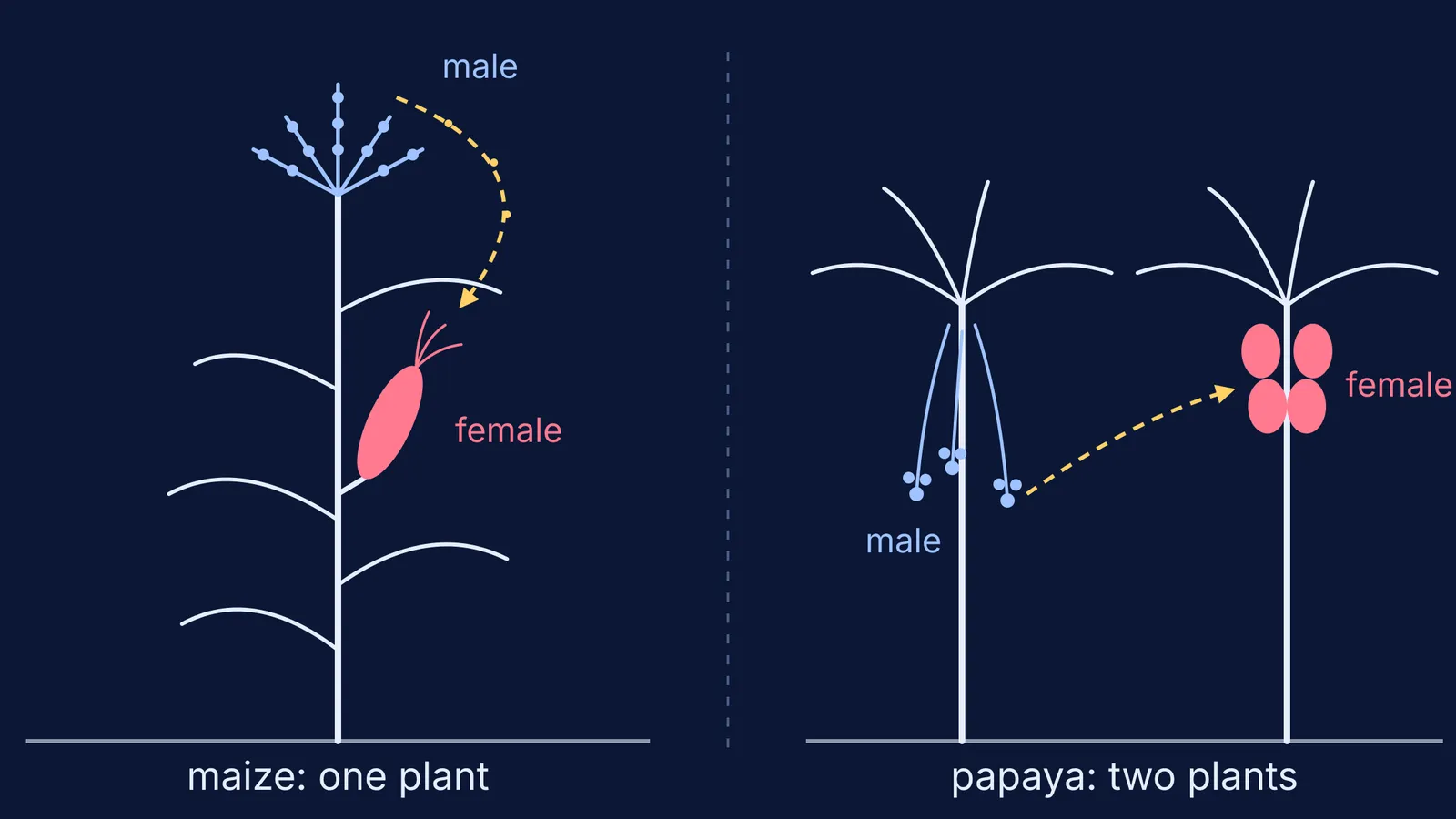
In a maize field, the feathery tassel at the top of each plant sheds pollen, and the silks hanging from the cob catch it. Both sexes are on one plant. In many papaya plants, by contrast, the flowers are all male or all female. That is the whole difference between monoecious and dioecious plants, and it sits in the NCERT Class 12 biology chapter that CBSE board and NEET-UG questions draw on.
What is the difference between monoecious and dioecious plants?
Both words describe plants with unisexual flowers, meaning each flower has either stamens or a pistil, not both. The question is where those flowers sit.
Monoecious: male and female flowers are on the same plant. The NCERT Class 12 biology chapter on sexual reproduction in flowering plants gives castor and maize as examples.
Dioecious: male and female flowers are on different plants, so each plant is either male or female. The same NCERT chapter gives papaya as its example.
Dioecy is the rarer arrangement. A review of plant sexual systems by Susanne Renner in the American Journal of Botany (2014) put the total at about 15,600 dioecious species, or 5 to 6% of all flowering plants. The same paper found that 31.6% of dioecious species are wind-pollinated, compared with 5.5 to 6.4% of other flowering plants.
Which plants are monoecious and which are dioecious?
Maize (monoecious). The male flowers form the tassel at the top of the plant, and the female flowers grow from a side leaf node into the ear, as described in this University of Nebraska plant science lesson. The silks are the long styles of the female flowers.
Castor (monoecious). NCERT lists it beside maize.
Papaya (dioecious in NCERT, with a twist). NCERT gives papaya as its dioecious example. Research papers describe it more precisely: a 2018 PLoS One study calls papaya trioecious, with male, female and hermaphrodite plants. The same study says sex is set by a sex-specific chromosome region: XX plants are female, XYm plants male and XYh plants hermaphrodite. A 2004 Nature paper led by Zhiyong Liu described papaya's primitive Y chromosome. For a board or NEET answer, write papaya as dioecious, as NCERT does.
Date palm (dioecious). A 2018 Nature Communications study by Maria Torres and colleagues sequenced male and female trees from all 14 species of the date palm genus Phoenix, all of them dioecious, and found genes present only in males.
Date palms also show what dioecy costs a farmer. The FAO's date palm cultivation manual says a modern plantation keeps a male to female ratio of 1/50 (2%), and that the artificial pollination commercial growers rely on also reduces the number of male palms they need.
Why does dioecy prevent geitonogamy when monoecy cannot?
Autogamy means pollen landing on the stigma of the same flower. A unisexual flower carries either anthers or a pistil, never both, so autogamy is impossible in the unisexual flowers of maize and of male and female papaya plants.
Geitonogamy means pollen moving to another flower on the same plant. In maize, pollen can fall from the tassel onto the silks of the same plant, so geitonogamy can still happen.
A female date palm or a female papaya plant has no male flowers at all. No pollen comes from the same plant, so geitonogamy cannot happen either, and its seeds come from cross-pollination. (Hermaphrodite papaya plants carry bisexual flowers, so this reasoning does not apply to them.)
That is exactly the NCERT line: monoecy "prevents autogamy but not geitonogamy", and dioecy "prevents both autogamy and geitonogamy" (NCERT, Chapter 1). If the three pollination types still blur together, read our explainer on autogamy, geitonogamy and xenogamy and the wider list of outbreeding devices flowers use to avoid their own pollen.
How do you answer monoecious vs dioecious questions in an exam?
Use this four-step check.
Does one flower have both stamens and a pistil? If yes, the flower is bisexual, and neither term applies.
If the flowers are unisexual, can one plant carry both kinds? Yes means monoecious (maize, castor).
Is each plant only male or only female? Yes means dioecious (papaya, date palm).
Now answer the follow-up: monoecious prevents autogamy only; dioecious prevents autogamy and geitonogamy.
One practical follow-up appears in plant breeding. NCERT notes that when the female parent has unisexual flowers, emasculation is not needed: the female buds are simply bagged and later dusted with chosen pollen. Our post on artificial hybridisation, emasculation and bagging walks through those steps.
To see where these terms sit next to flower structure and pollination, the Fermi Concept Library covers every concept in biology, each with its own lesson and its place in the map. And for practice with the reasoning behind questions like these, the Fermi Problem Library has worked problems with a step-by-step solver that explains the reasoning rather than just printing an answer.


