

On this page
Pollination types look like a memory test of three Greek words. They are really one question: where did this pollen come from? Answer that, and the definitions, the outbreeding devices and the assertion-reason questions all follow. This guide uses the wording of the NCERT Class 12 Biology chapter, Sexual Reproduction in Flowering Plants, free on the NCERT textbook site.
What is the difference between autogamy, geitonogamy and xenogamy?
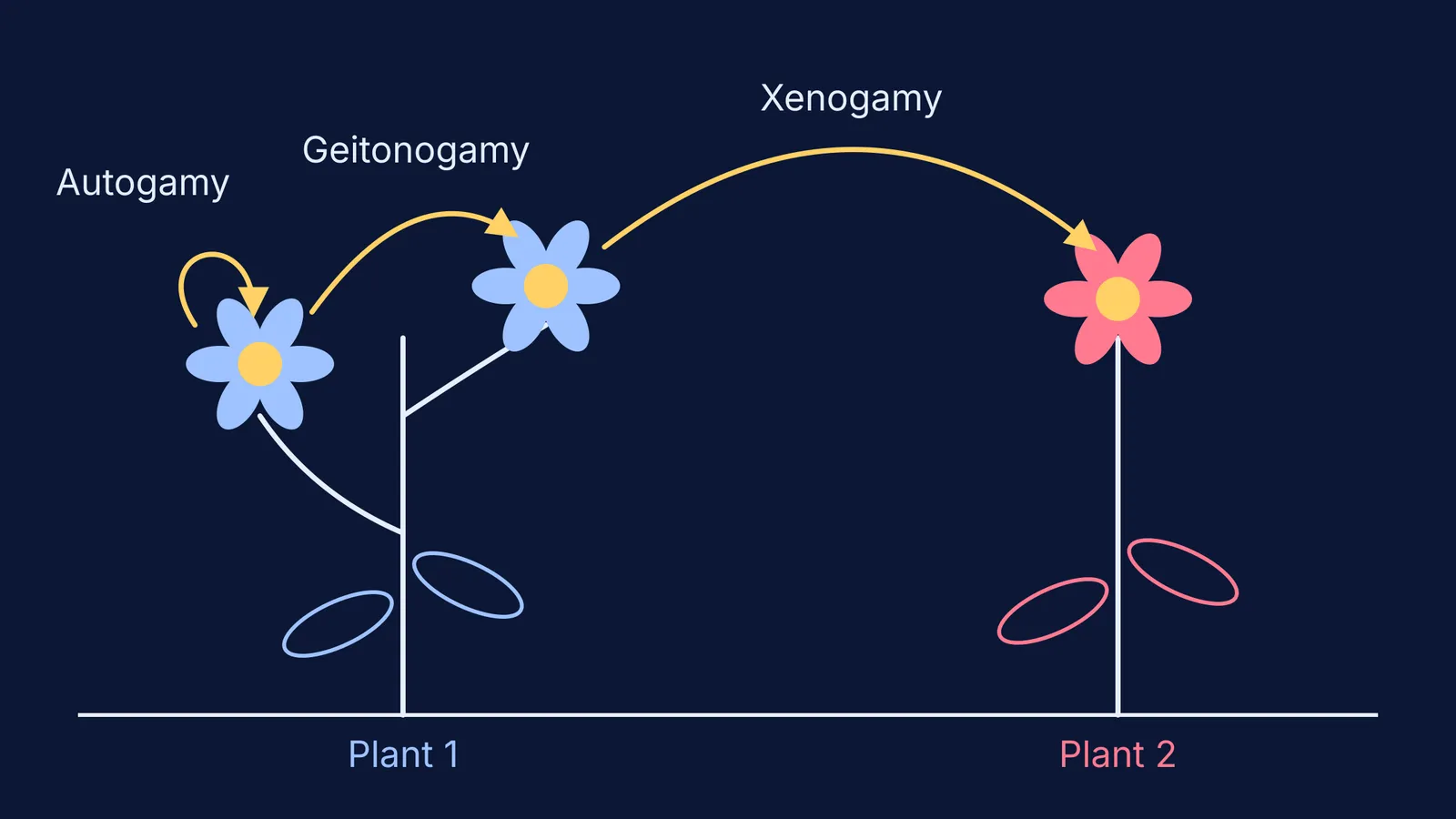
NCERT sorts pollination into three kinds by the source of the pollen (NCERT Biology Class 12, Chapter 1):
Autogamy is the transfer of pollen from the anther to the stigma of the same flower.
Geitonogamy is the transfer of pollen from the anther to the stigma of another flower of the same plant.
Xenogamy is the transfer of pollen from the anther to the stigma of a different plant.
The Greek roots help: auto means self, geiton means neighbour, xenos means stranger.
The same chapter adds two details examiners like. Complete autogamy is rather rare in a flower that opens, because pollen release and stigma receptivity must happen together and the anthers and stigma must sit close. Some plants, such as Viola, Oxalis and Commelina, also produce cleistogamous flowers, which never open. These are invariably autogamous and give assured seed-set even without pollinators.
Why is geitonogamy genetically similar to autogamy?
NCERT puts it in one sentence: geitonogamy is functionally cross-pollination involving a pollinating agent, but genetically it is similar to autogamy since the pollen grains come from the same plant (NCERT Biology Class 12, Chapter 1).
Here is the reasoning behind that sentence. Every flower on a plant is part of the same individual, with the same set of genes. So the pollen in flower 1 and the ovules in flower 2 carry the same parent's genes. A bee may fly between them, which makes it look like cross-pollination, but genetically the seed gets both sets of genes from one parent, exactly as it would after autogamy.
NCERT also notes that xenogamy is the only type of pollination that brings genetically different pollen grains to the stigma.
Why does this matter to the plant? NCERT notes that continued self-pollination results in inbreeding depression. A review in Nature Reviews Genetics defines inbreeding depression as the reduced survival and fertility of offspring of related individuals, and says the evidence suggests it is predominantly caused by harmful recessive mutations (Charlesworth and Willis, 2009). Selfing exposes those recessive mutations in double dose.
Geitonogamy also slips past many anti-selfing features. A 1993 review in Trends in Ecology and Evolution notes that separating pollen and stigma within a flower does not prevent pollen moving between flowers on the same plant, and that geitonogamy is often substantial and increases with plant size (de Jong, Waser and Klinkhamer, 199390239-L)).
Which outbreeding devices stop autogamy, and which stop geitonogamy?
This is where the genetic point earns marks. Use this check, built from NCERT's outbreeding devices section (NCERT Biology Class 12, Chapter 1):
Pollen release and stigma receptivity at different times: prevents autogamy.
Anther and stigma placed at different positions: prevents autogamy.
Self-incompatibility: a genetic mechanism that stops self-pollen, from the same flower or other flowers of the same plant, from fertilising the ovules by inhibiting pollen germination or pollen tube growth. It acts against both.
Unisexual flowers on the same plant (monoecious, such as castor and maize): prevents autogamy but not geitonogamy.
Male and female flowers on different plants (dioecy, such as papaya): prevents both autogamy and geitonogamy.
Notice the pattern. A device that works inside one flower cannot stop geitonogamy. Only a device that recognises the plant's own genes, or removes the second sex from the plant entirely, can.
How do you identify the type in an exam question?
Ask three questions in order:
Did the pollen land on the flower it came from? If yes, autogamy.
If not, did it come from the same plant? If yes, geitonogamy.
If it came from another plant of the species, xenogamy.
Worked examples:
A closed, cleistogamous flower of Commelina sets seed. Same flower, so autogamy.
Wind carries pollen from a maize plant's male flowers to the silks of the same plant. Different flower, same plant, so geitonogamy, even though wind did the carrying.
A papaya fruit forms on a female tree. Its flowers have no anthers, so the pollen had to come from another plant: xenogamy.
If you keep mixing up which device blocks which type, write the five-line check above on a card and test yourself until you can say each answer without looking. For the surrounding ideas, such as self-incompatibility and pollen-pistil interaction, the Fermi Concept Library gives each biology concept its own lesson and shows its place in the map.
When you practise assertion-reason questions on this chapter, the Fermi Problem Library has worked problems with a step-by-step solver that explains the reasoning rather than printing an answer, so you can see where your logic went wrong.


