On this page
Every time you tap a metro card, pay with a RuPay card, or insert a SIM card into a phone, you rely on a secure computer no larger than a grain of rice. Before the mid-1970s, portable identification relied on magnetic stripes. But magnetic stripes had a fatal vulnerability: they were passive targets.
Why were magnetic stripe cards so vulnerable?
Magnetic stripe cards, introduced in the late 1960s, stored data on a thin strip of ferromagnetic tape. Like an audio cassette, a magnetic stripe is passive. When swiped through a terminal, it broadcasts its magnetic flux transitions to any pickup head.
Because the stripe lacks internal processing, it cannot verify who is reading it. Anyone with a magnetic tape head could clone the track onto a blank card or modify data without detection, as documented in the Smart Card Handbook. Early payment systems required continuous telecommunication links to verify every transaction against a central mainframe. Securing portable transactions required silicon memory capable of protecting itself, inspiring engineers to study semiconductor memory such as Robert Dennard's single-transistor memory cell.
How did Roland Moreno design the smart card chip?
The breakthrough came from French inventor Roland Moreno, who founded Innovatron in 1972. Moreno inverted card security: instead of allowing a card reader to extract confidential data, the card should verify credentials internally.
On March 25, 1974, Moreno filed French patent application 74 10191, published as FR 2266222 and issued in the United States as US Patent 4,007,355. While his earliest draft depicted a signet ring with an integrated circuit, Moreno adapted the design into a standardized plastic card by 1975.
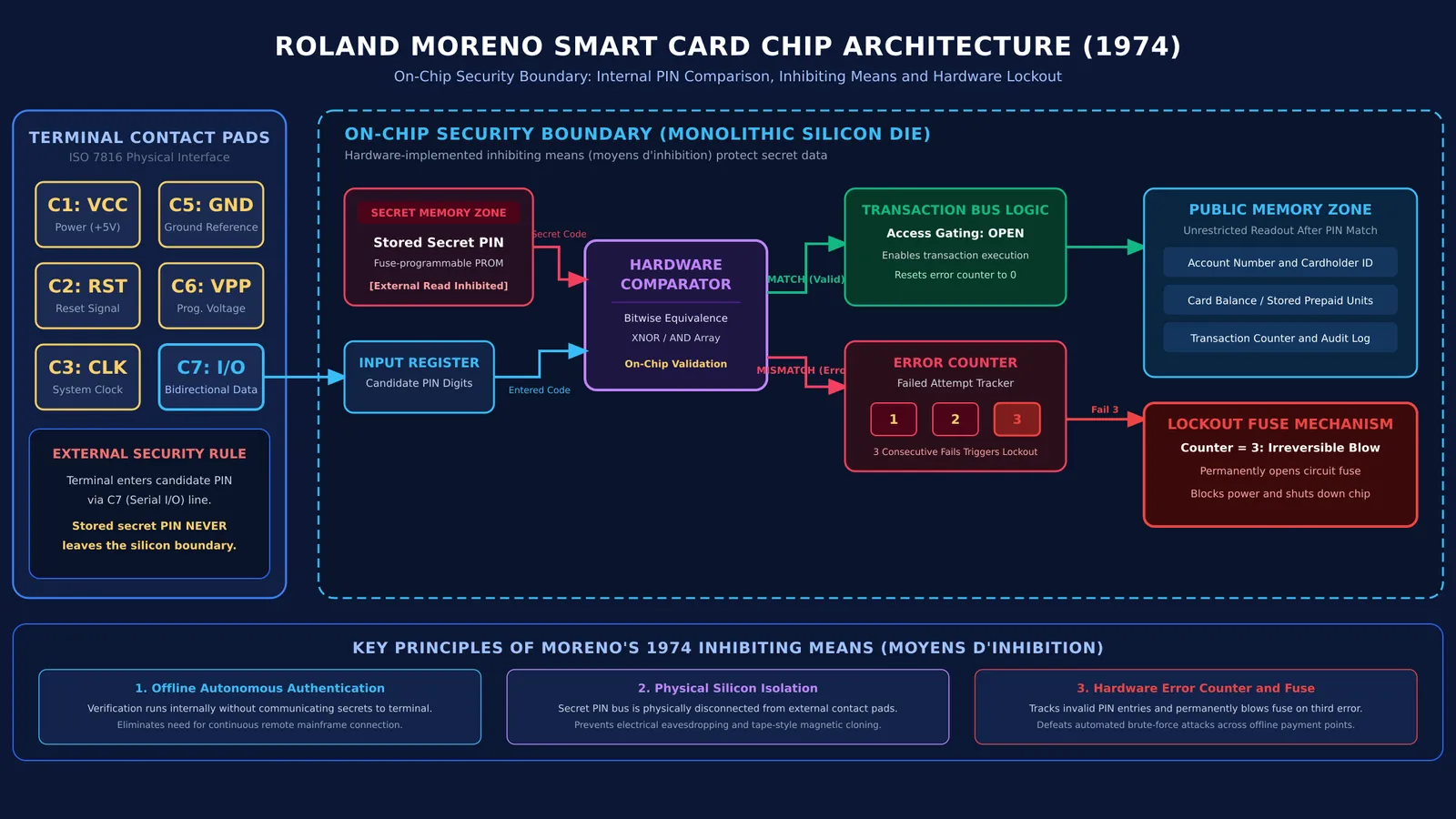
Moreno's core architectural contribution was what his patent termed "inhibiting means" (*moyens d'inhibition*), detailed in the Smart Card Handbook. Rather than exposing the entire memory array, he partitioned the silicon into distinct security zones:
Public memory zone: Held non-sensitive identifiers and transaction logs that external terminals could read freely.
Secret memory zone: Held the confidential Personal Identification Number (PIN) behind physical gating that blocked direct external readout.
Hardware comparator: An on-chip logic block that evaluated candidate codes against stored secrets without transmitting either off the chip.
How does internal PIN verification work step by step?
Moreno's architecture enabled secure offline authentication. The verification sequence described in US Patent 4,007,355 and analyzed in the Smart Card Handbook operates in four distinct phases:
Power and handshake: The card draws power and clock signals through standardized contact pads, initializing internal logic without exposing stored data.
Candidate PIN entry: The cardholder types their PIN on a terminal keypad, which transmits the candidate digits across the serial I/O line into the chip's input register.
On-chip comparison: The chip feeds the candidate digits into an internal comparator circuit. The comparator evaluates bitwise equivalence between the entered code and the stored secret, applying the digital principles explored in Claude Shannon's analysis of Boolean logic in circuits and the output of logic gate combinations.
Authorization or lockout: If the bits match, the comparator enables the transaction bus. If the codes differ, an error counter increments. If the counter reaches 3 failed attempts, a logical fuse blows permanently, shutting down the card to defeat brute-force guessing.
How did smart cards expand from payphones to global banking?
Commercial adoption began in 1983 when France Télécom introduced the *Télécarte*, a prepaid smart card for public payphones. Replacing coin slots with memory chips that burned write-once bits during calls stopped coin theft and street vandalism across France.
Banking adoption followed. In 1992, France made chip-and-PIN universal across its domestic *Carte Bleue* network. As examined in Business History, smart cards caused counterfeit card fraud in French retail banking to fall sharply.
Moreno's company Innovatron collected approximately €150 million in royalties before his foundational patents entered the public domain in the late 1990s, as reported by The Guardian. In 2000, confident in his architecture, Moreno offered one million francs to anyone who could break the card's code within 90 days; no one succeeded (The Guardian). Today, that same on-chip comparison model secures billions of SIM cards, transit passes, and EMV payment cards.
Mastering digital logic and semiconductor circuits
For students of physics and computing, Roland Moreno's card shows how fundamental electronic components solve vital practical problems. A smart card is an assembly of logic gates, flip-flops, and non-volatile memory cells operating under strict power and size limits.
When studying digital circuits in Class 12 physics or college courses, working with logic gates in the abstract can make design principles difficult to visualize. The Fermi Concept Library maps every concept across semiconductor physics, logic gates, and computing to help you see how theoretical circuits function inside real devices.
If you encounter circuit analysis problems or need help tracing logic states across flip-flops and counters, the Fermi Problem Library provides worked problems with a step-by-step solver that explains the reasoning rather than printing an answer.