

On this page
A combination-of-gates question gives you three or four gate symbols wired together and asks what comes out. It is bookkeeping: track every wire. Logic gates sit in the Electronic Devices unit of the official JEE Main 2027 syllabus from NTA, which lists OR, AND, NOT, NAND and NOR. If the symbols feel rusty, start with our guide to semiconductors, diodes and logic gates.
How do you find the output of a combination of logic gates?
Use the same four steps every time.
Label every wire that is not an input. Name the internal outputs P, Q, R from left to right.
Write every input combination: 4 rows for two inputs, 8 for three. Keep the order 00, 01, 10, 11 so your output column reads like a code.
Fill one column per gate, left to right.
Read the final column from top to bottom and match it to a known gate.
The codes to know by heart, in row order 00, 01, 10, 11:
AND: 0001
OR: 0111
NAND: 1110
NOR: 1000
XOR: 0110
XNOR: 1001
Worked example: four NAND gates
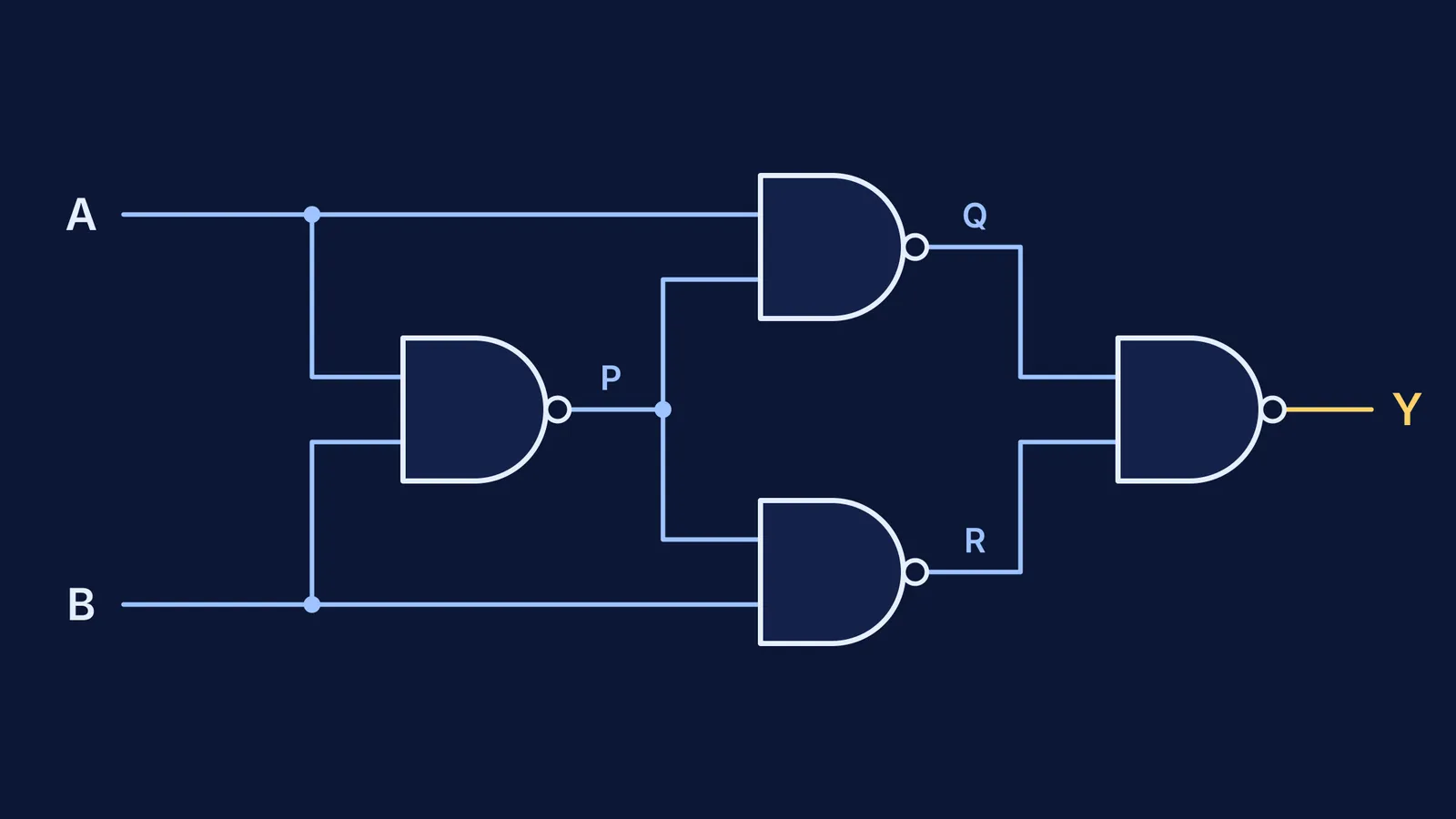
Take the circuit in the diagram at the top. Gate 1 gives P = (AB)'. Gate 2 gives Q = (AP)'. Gate 3 gives R = (BP)'. Gate 4 gives Y = (QR)'.
A = 0, B = 0: P = 1, Q = 1, R = 1, so Y = 0
A = 0, B = 1: P = 1, Q = 1, R = 0, so Y = 1
A = 1, B = 0: P = 1, Q = 0, R = 1, so Y = 1
A = 1, B = 1: P = 0, Q = 1, R = 1, so Y = 0
The output reads 0110, so these four NAND gates make an XOR gate: the output is 1 only when the inputs differ.
How do you spot a hidden NAND, NOR or XOR?
A combination circuit is often a familiar gate in disguise. Watch for three patterns.
A gate followed by NOT. AND then NOT is NAND; OR then NOT is NOR. Two NOTs in a row cancel.
Inverted inputs. An AND gate with both inputs inverted gives A'B', which by De Morgan's law, explained in our CBSE Class 11 Boolean logic guide, equals (A + B)', a NOR. An OR gate with inverted inputs gives A' + B' = (AB)', a NAND.
The 0110 code. If the output is 1 only when the inputs differ, it is XOR, however many gates it took. 1001 is XNOR.
To narrow it down, check the 00 and 11 rows first:
00 gives 0, 11 gives 1: AND if 01 and 10 give 0, OR if they give 1.
00 gives 1, 11 gives 0: NAND if 01 and 10 give 1, NOR if they give 0.
Both give 0: XOR, if 01 and 10 give 1.
Both give 1: XNOR, if 01 and 10 give 0.
How do you make every gate from NAND gates alone?
A set of gates is called universal, or functionally complete, when it can build any logic function, and NAND on its own is such a set. Henry Maurice Sheffer showed in a 1913 paper in the Transactions of the American Mathematical Society that Boolean algebra can be built from a single operation. His "stroke" meant NOR; Jean Nicod first used it for NAND in 1917, and Charles Sanders Peirce had found the property around 1880 without publishing it. The algebra itself goes back to George Boole's Laws of Thought of 1854.
The recipes:
NOT: join both inputs of one NAND, since (AA)' = A'. One gate.
AND: a NAND followed by a NAND wired as NOT. Two gates.
OR: invert A and B with one NAND each, then NAND the results, since (A'B')' = A + B. Three gates.
NOR: the OR circuit plus a NAND wired as NOT. Four gates.
XOR: the four-gate circuit from the worked example.
NOR is universal too. The Apollo Guidance Computer, designed by MIT in 1962, used about 4,000 three-input NOR gate circuits in each system, according to the Computer History Museum.
What should you practise before the exam?
A short plan for this week:
Write the six output codes from memory.
Draw the NAND recipes for NOT, AND and OR without looking, then check each with a truth table.
Solve five past-paper combination circuits with the four steps, naming the hidden gate each time.
When an answer comes out wrong, the Fermi Problem Library has worked problems with a step-by-step solver that explains the reasoning rather than printing an answer. If the gap is the idea rather than the method, the Fermi Concept Library gives each concept its own lesson.
Label the wires, fill the columns, read the code.


