

On this page
In short
In 1966, IBM researcher Robert H. Dennard invented modern Dynamic Random-Access Memory (DRAM) by storing a bit of data on a single transistor and capacitor. This 1T1C design replaced bulky six-transistor cells, making possible the high-capacity memory in every computer today.
In the mid-1960s, computer memory was large, expensive, and difficult to scale. Most early computers relied on magnetic core memory. This technology used tiny magnetic rings to store data and had to be laboriously woven together by hand with fine wires. The early semiconductor alternative, static random-access memory (SRAM), was faster but no less complicated in its own way: it required six transistors to store a single bit of information, taking up far too much physical space on a silicon chip to be practical for large-capacity storage (Wikipedia).
Robert Dennard solved this fundamental problem in 1966. After hearing a colleague present about the complex challenges of magnetic memory systems, he had a radical idea. He realised that a single bit of information could be stored as a tiny electrical charge on a single capacitor, with just one transistor acting as a switch to read or write it. This flash of insight laid the foundation for the entire modern computing industry.
How does a one-transistor memory cell work?
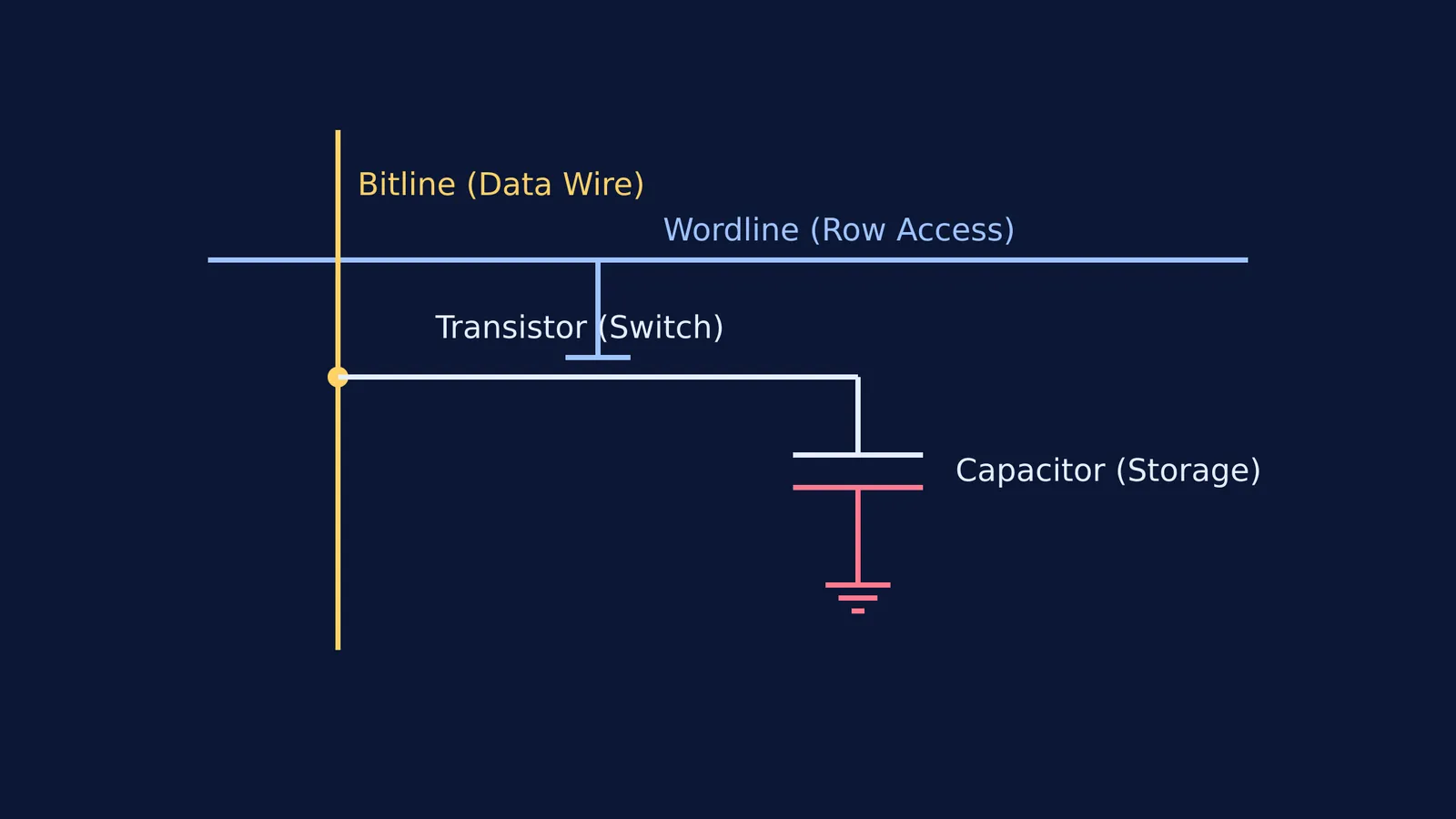
Dennard's elegant invention is known as the 1T1C (one-transistor, one-capacitor) memory cell.
The capacitor stores the actual data as a microscopic electrical charge. A fully charged capacitor represents a binary 1, and an empty (discharged) capacitor represents a binary 0.
The transistor acts as a control switch. When the computer processor needs to read or write a specific bit, it turns on the transistor to connect the capacitor to a shared data wire, known as the bitline.
Because the capacitor is not perfect, it slowly leaks its electrical charge over time. To prevent data loss, the memory system must periodically "refresh" the cell by reading the data and immediately writing it back at full strength. This constant need for refreshing is exactly why the technology is called dynamic random-access memory (DRAM). In 1968, IBM was officially granted US Patent 3,387,286 for this "Field-Effect Transistor Memory" design (US Patent 3,387,286).
How do you read a DRAM bit?
Reading a bit from a 1T1C memory cell requires a precise sequence of events. Because reading the capacitor's charge physically drains it into the bitline, the read operation is inherently destructive and requires a restore step:
Precharge: The bitline (the main data wire) is first set to a specific voltage exactly halfway between a logical 0 and a 1.
Access: The wordline turns on the transistor, acting as a gate that connects the capacitor to the bitline.
Sense: If the capacitor held a 1, its charge slightly raises the bitline's overall voltage. If it held a 0, it slightly lowers the voltage. A sensitive circuit called a sense amplifier detects this tiny fluctuation and pulls the bitline all the way to a full 1 or 0 voltage level.
Restore: Because connecting the capacitor drained its original charge, the sense amplifier must write the full 1 or 0 back into the capacitor to preserve the data before the transistor closes.
Why was the invention of DRAM so important?
The older six-transistor static memory used far too much valuable silicon space. By replacing six components with just two, Dennard's DRAM drastically reduced the cost, power consumption, and physical size of computer memory. It quickly made magnetic core memory obsolete and cleared the path for the personal computer revolution (Wikipedia).
Today, the main working memory of almost every smartphone, laptop, server, and gaming console is based on DRAM. A modern memory chip holds billions of microscopic 1T1C cells, storing the data your applications and operating systems need right now.
To learn more about the physics behind these components, you can explore the Fermi Concept Library, where every concept in physics and computing has its own lesson and its place in the map.
If you are curious about the origins of modern technology, you can also read about Russell Ohl and the cracked silicon that revealed the p-n junction or George Boole and the logic algebra of 1854.


