On this page
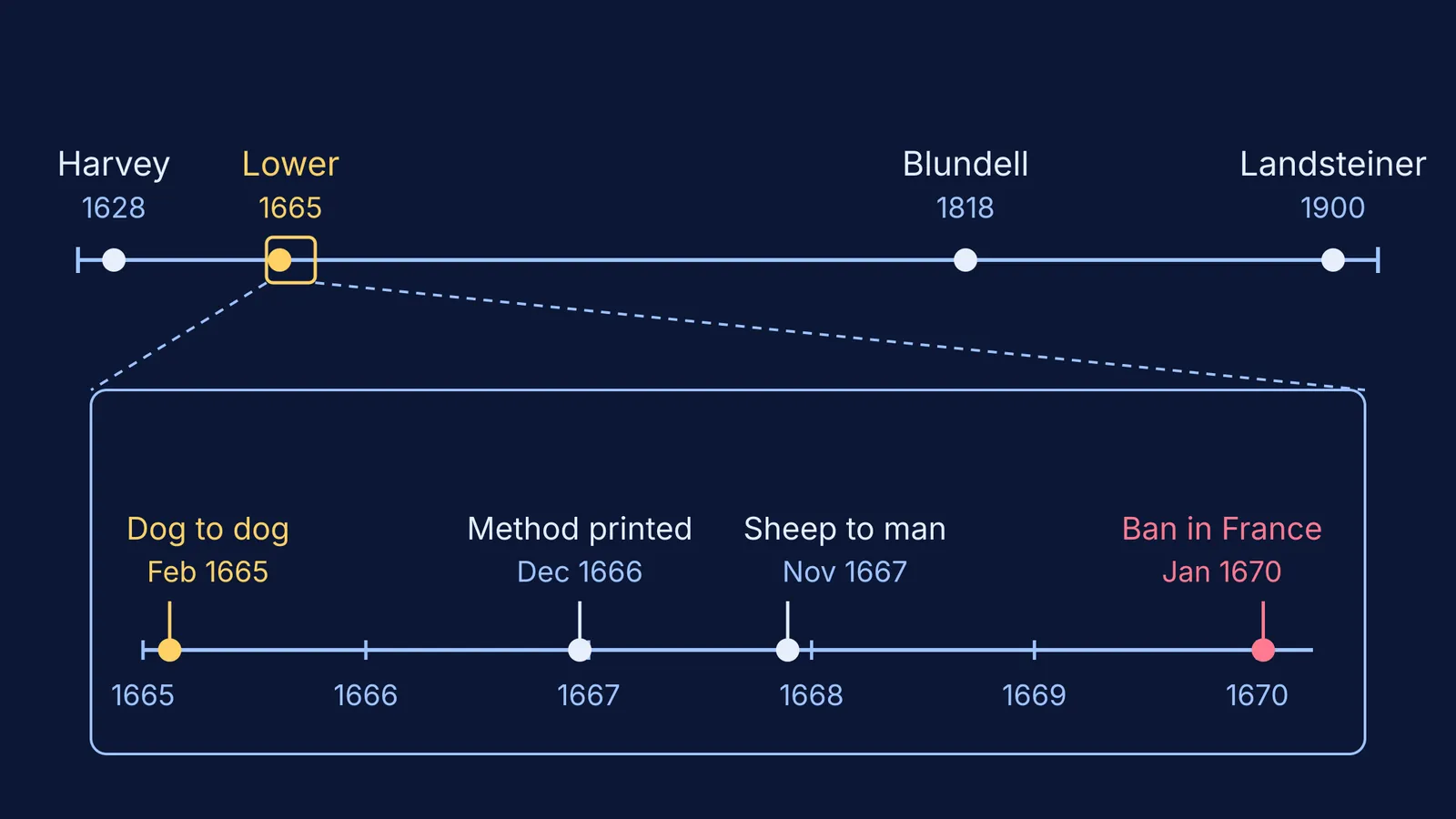
In February 1665, an Oxford physician named Richard Lower joined the artery of one dog to the vein of another and kept the receiving dog alive on borrowed blood. The AABB transfusion medicine timeline calls it the first recorded successful blood transfusion. Reliable human transfusion had to wait more than two centuries, and the reasons are good biology.
Who was Richard Lower?
Richard Lower was an English physician and physiologist, born in Cornwall probably in 1631 and died in 1691, according to the Linda Hall Library's profile. He was an assistant to Thomas Willis in Oxford and shared his transfusion ideas with Robert Boyle; after Lower moved to London in 1666, Boyle introduced him to the new Royal Society. His 1669 book on the heart, *Tractatus de corde*, is described by the same profile as perhaps second in importance in 17th-century physiology only to Harvey's 1628 book on circulation.
Harvey had shown that blood moves in a closed loop (see how William Harvey proved blood circulates), and if blood runs in a circuit, you can in principle join two circuits together.
How did Richard Lower transfuse blood between dogs in 1665?
The Wikipedia biography of Lower dates the first dog-to-dog transfusion to February 1665. His step-by-step method, communicated by Boyle, was printed in the Royal Society's journal on 17 December 1666 (Philosophical Transactions, vol. 1, pp. 353-358, DOI 10.1098/rstl.1665.0128; free text on Wikisource). The DOI says 1665 because that first volume covers 1665 and 1666, which is one reason you see both years quoted.
The recipe, in plain terms:
Expose the carotid artery of the donor dog.
Expose the jugular vein of the recipient dog, about an inch and a half of it.
Push a hollow quill into each vessel and tie the vessel tightly onto it with thread.
Join the quills so blood runs from the donor's artery into the recipient's vein.
At the same time, let the recipient's own blood run out of a second quill into dishes, "proportionably" to what goes in.
It was an exchange, and it was not kind to the donor. The paper says the donor dog faints, convulses "and at last dye by his side", while the recipient "will leap from the Table and shake himself; and run away, as if nothing ailed him" (Wikisource text). Lower later swapped the quills for thin silver tubes, notes the Linda Hall Library.
Why did Lower connect an artery to a vein?
This is physics hiding inside biology:
Blood flows from high pressure to low pressure, like water in a pipe.
Arteries carry blood pushed out by the heart, so their pressure is high.
Veins carry blood returning to the heart, so their pressure is low.
An artery-to-vein link therefore drives blood across with no pump. The donor's own heart does the work.
Now try the reverse: vein to artery. Blood would have to move from low pressure into high pressure, so it would not flow. Lower's choice was Harvey's circulation used as an engineering rule. If the pressure idea feels shaky, our post on double circulation in humans shows where pressure is high and low.
What happened when they tried transfusion on humans?
In 1667, Jean-Baptiste Denis in France and Lower in England separately reported transfusions from lambs to humans (AABB timeline).
On 23 November 1667, Lower and Edmund King transfused arterial blood from a young sheep into a man named Arthur Coga in London (Philosophical Transactions, vol. 2, no. 30). The report says they took 6 to 7 ounces of Coga's blood, let in roughly 9 to 10 ounces of sheep's blood, and that he "found himself very well" afterwards.
It did not last. The AABB timeline records that within 10 years, transfusing animal blood into humans was prohibited by law because of reactions; Wikipedia dates the French ban to 10 January 1670, with England following. Today we know the immune system attacks blood from another species.
The next steps came much later: in 1818 the British obstetrician James Blundell turned to transfusing human blood, and in 1900 Karl Landsteiner found the first human blood groups (AABB timeline). Read the full story of James Blundell's human blood transfusions.
What can you learn from Lower's dog experiment?
Use Lower's story to practise four questions that work on any famous experiment in your biology textbook:
What was the claim? Blood from one animal can replace blood lost by another.
What counted as success? The recipient survived and behaved normally.
What was missing? Nobody knew about blood groups, so nobody could explain why sheep-to-human transfusion caused reactions.
What came next? Blundell used human donors, and Landsteiner explained compatibility.
Do the same for Harvey, Blundell and Landsteiner, and you have a one-page revision sheet.
If arteries, veins and pressure still blur together, the Fermi Concept Library gives each biology concept its own lesson and its place in the map. If you would rather be walked through it, Fermi's AI tutor works out what you already know, then draws the figure and checks your understanding as it goes.