

On this page
It is easy to assume James Blundell's first transfusion in 1818 saved a mother bleeding after childbirth. The real record starts with a failure, moves through careful method, and ends with mothers who lived.
Who was James Blundell?
James Blundell (1790-1878) was a London obstetrician who took his medical degree in Edinburgh and later held the chair of midwifery at St Thomas' and Guy's hospitals, according to haematologist Philip Crispin's account in Hektoen International. As an obstetrician he saw women die of postpartum haemorrhage, which means heavy bleeding after delivery, and medicine had no way to replace the blood they lost.
He ran animal experiments to work out a technique before treating people, and they led him to believe that transfusing blood between species could be hazardous, Crispin notes. He published experimental work as "Experiments on the Transfusion of Blood by the Syringe" in Medico-Chirurgical Transactions in 1818.
What happened at the first human blood transfusion in 1818?
The first well-documented human-to-human transfusion was performed by James Blundell on 25 September 1818, on a man of about 40 who was wasting away, not on a new mother, according to a 2012 history in the Journal of Vascular Surgery.
That paper describes the method. A surgeon kept a cannula (a thin tube) in a vein in the patient's arm. Blundell opened arm veins of several willing onlookers and let about 45 mL at a time drip into a cup, which was then drawn into a syringe and injected. Ten such transfers were made over 40 minutes. The man seemed stronger for two days but died 56 hours after the injections, and the post-mortem found a stomach cancer blocking his gut (Chandler and colleagues, 2012).
Sources differ by a day: literary historian Matthew Rowlinson dates the case to 26 September and notes Blundell reported it in Medico-Chirurgical Transactions in 1819 (BRANCH).
Did Blundell's transfusions save women after childbirth?
Yes, but later. Rowlinson writes that in 1828 Blundell reported two cases of postpartum haemorrhage successfully treated by his method (BRANCH). The 2012 history says Blundell got good results with his syringe technique, "particularly for postpartum hemorrhage" (Journal of Vascular Surgery).
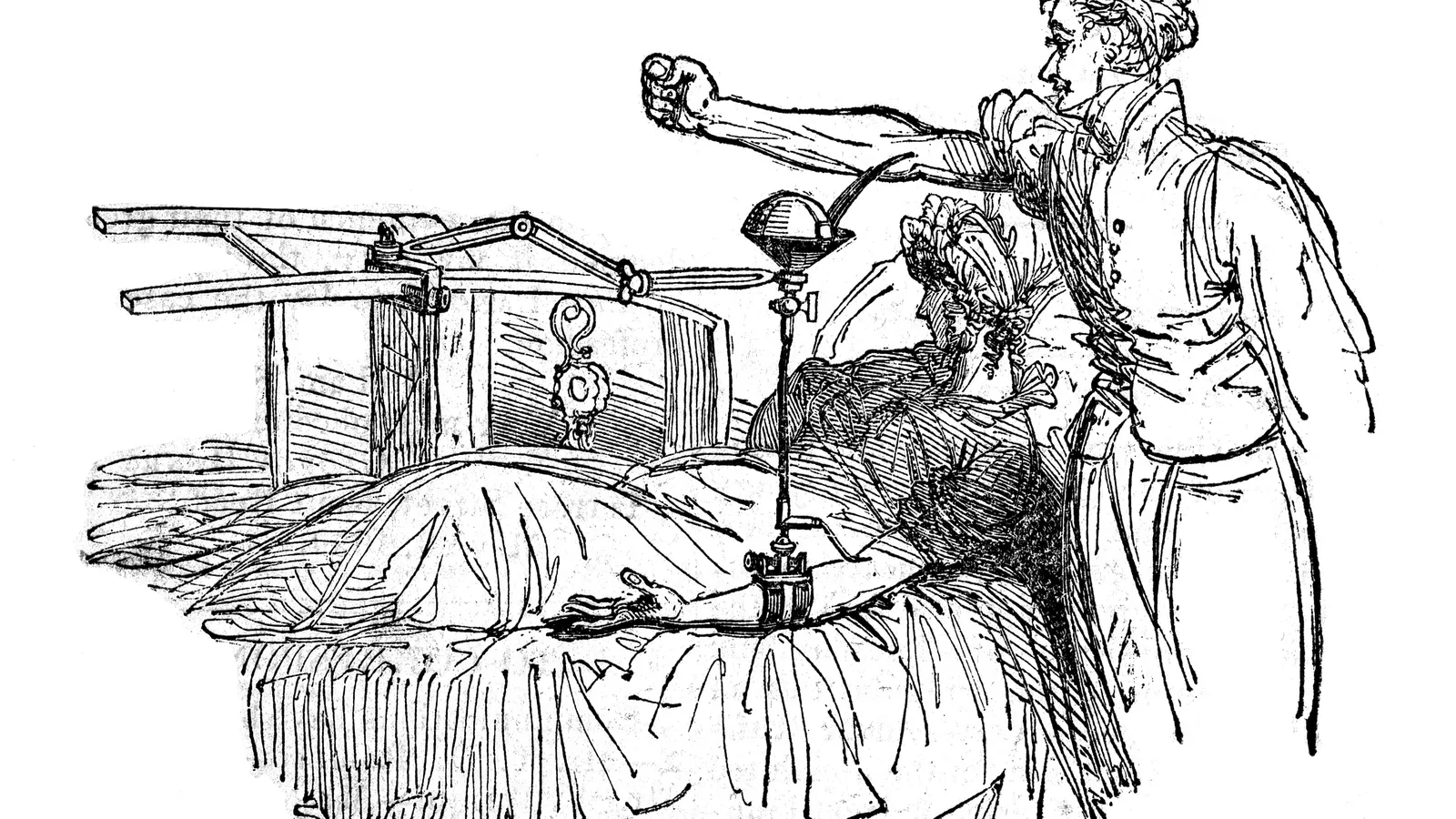
In 1829 Blundell published what The Blood Project calls the first account of a successful blood transfusion, in The Lancet. The patient was a woman whose doctor, Charles Waller, feared she would die from blood loss after childbirth, and the donor was apparently her husband. In June 1829, Blundell's "Observations on transfusion of blood"92543-2) appeared in The Lancet. He also designed instruments, including the Gravitator, which fed blood down a tube from a vessel held high above the patient (Healio).
Blundell reportedly performed ten transfusions in all; two patients had stopped breathing before he began and did not recover, and five of the other eight were successful (Hektoen International). His donors included colleagues, patients' husbands or wives, and sometimes blood relatives.
Why did some of Blundell's patients die?
Some were already beyond saving. But Blundell also worked before Karl Landsteiner identified the ABO blood groups in 1901 (Hektoen International), the story told in our post on Karl Landsteiner and the discovery of blood groups.
The NHS explains the rule. Group A blood has A antigens on the red cells and anti-B antibodies in the plasma. Group B has B antigens and anti-A antibodies. Group O has no A or B antigens but both antibodies. Group AB has both antigens and no antibodies. If the patient's antibodies meet matching antigens on the donor's red cells, they attack those cells.
Would a husband have been a safe donor?
Use one question for every pair: does the donor's red cell carry an antigen that the patient has antibodies against?
Patient A, husband O: O cells carry no A or B antigens. Safe.
Patient A, husband B: the patient's anti-B attacks B cells. Unsafe.
Patient O, husband A: the patient carries both antibodies. Unsafe.
Patient AB, husband B: the patient has no anti-A or anti-B antibodies. Safe.
Only the patient's antibodies and the donor's antigens matter, and this direction is the one students most easily flip. If you mix up antigens and antibodies, the Fermi Concept Library has a lesson for every concept in biology, so you can rebuild the idea step by step and see where it sits on the map.
How do you check a "first ever" claim in science history?
Use this checklist:
Find the original paper and its year, not just a retelling.
Ask who the patient or subject actually was.
Note where sources disagree, such as 25 or 26 September, and say so.
Separate the first attempt from the first success.
Transfusion makes more sense once you know how blood moves around the body, which began with William Harvey and the circulation of blood. The next big step, storing blood so it is ready when a mother bleeds, came with Charles Drew and the blood bank. If you are not sure where to start revising this chapter, Fermi's AI tutor works out what you already know and builds a plan for the session.


