

On this page
In the 1760s, cotton was spun by hand, or several threads at a time on a spinning jenny. Richard Arkwright, a former barber and wig-maker from Preston, built a machine that did the stretching with rollers instead of fingers. According to his Wikipedia biography, he patented this spinning frame in 1769, working with a clockmaker named John Kay (not the John Kay who invented the flying shuttle), and was knighted in 1786.
It became known as the water frame because of what drove it. To see why it mattered, you need two ideas: how rollers make thread thinner, and why that thread needed a river.
How did Arkwright's water frame spin thread?
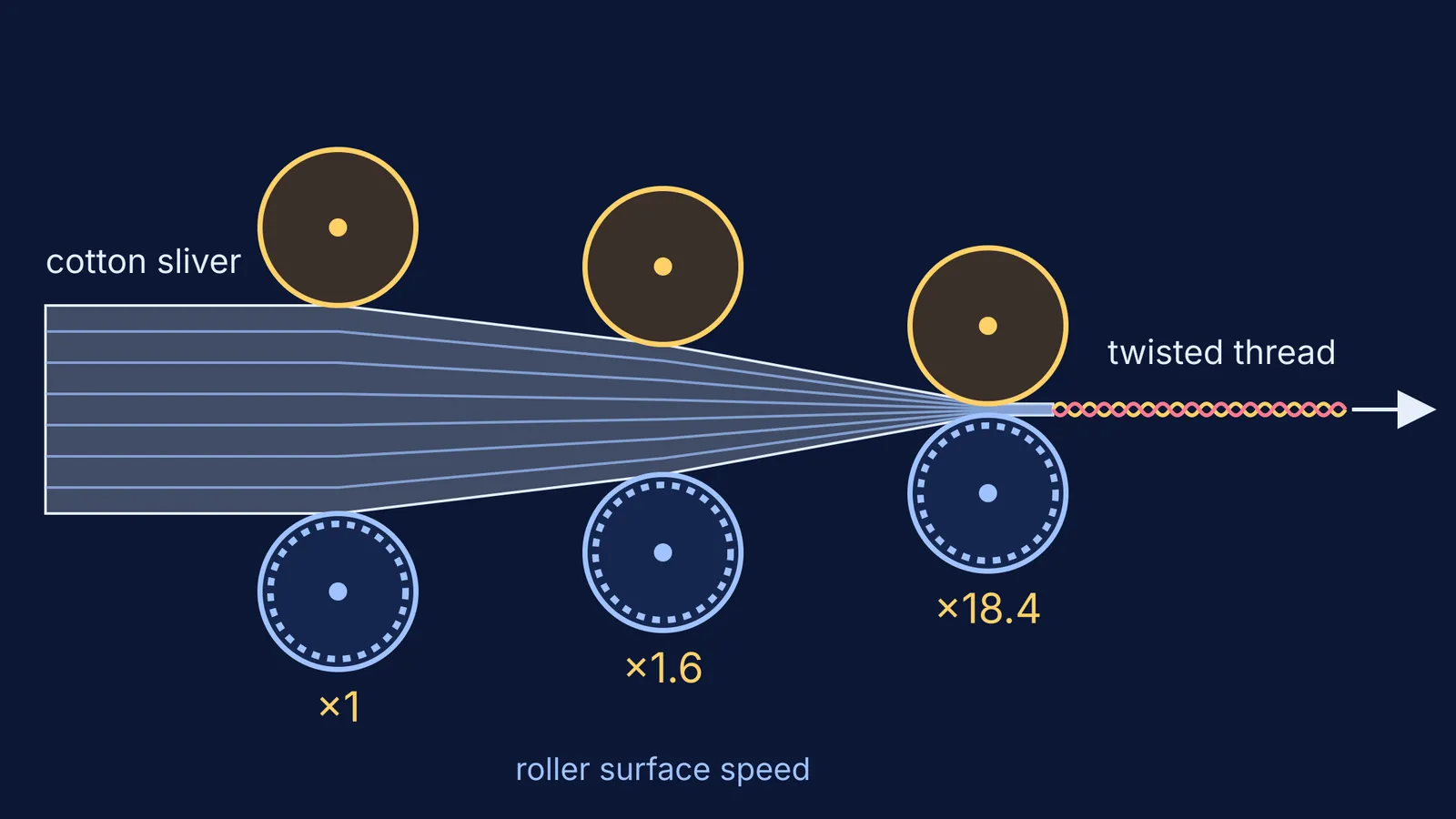
The Science Museum Group's record of its 1775 water frame describes three pairs of rollers, the top ones covered with leather and the lower ones fluted. Their speeds were in the ratio 1 : 1.6 : 18.4.
Here is what happens to the cotton:
A loose rope of combed cotton, called a sliver, goes into the first pair of rollers.
Each pair grips the cotton and turns faster than the pair before it, so the fibres slide past one another and the rope gets thinner.
Below the rollers, a spinning flyer twists the thin strand and winds it onto a bobbin. Twist is what locks the fibres together into thread.
The same museum record says this improved 1775 machine spun eight threads at a time rather than four, and used a heart-shaped cam to move the bobbins up and down so thread was wound evenly.
A worked example: what does 1 : 1.6 : 18.4 actually do?
This is a conservation problem you can solve with Class 9 physics. Cotton is not created or destroyed between the rollers, so the mass going in each second equals the mass coming out each second.
Mass per second = (mass per metre) x (speed). Using the museum's ratio:
Suppose 1 metre of sliver weighs 5 grams and enters at a speed of 1 unit.
It leaves the last pair at 18.4 units. To keep the mass flow the same, the mass per metre must drop to 5 / 18.4, about 0.27 grams.
So 1 metre of sliver becomes 18.4 metres of strand.
Between the first and second pairs the stretch is only 1.6 times. Most of the thinning happens between the second and third pairs (18.4 / 1.6 = 11.5 times).
The 5 grams is our made-up starting value; the ratios come from the museum's machine.
Why was the water frame's thread so strong?
Cloth has two sets of threads. Warp threads run the length of the loom and are held under tension; weft threads are passed across them. Warp has to be strong.
Cromford Mills, the trust that runs Arkwright's first mill, explains that before his machine-made yarn, the British textile industry could not make pure cotton cloth: hand-spun cotton was strong enough only for the weft, so the warp had to be linen, wool or silk. Arkwright's yarn changed that. The result was all-cotton fabric, made in Britain.
This fits a chain you can follow through earlier inventions. John Kay's flying shuttle let weavers work faster, so they needed more yarn. James Hargreaves's spinning jenny made more yarn at once. The water frame supplied the strong warp.
Why did the water frame lead to the first factories?
Rollers that turn steadily all day need steady power. The Wikipedia article on the water frame notes that it was first driven by horses, at a mill Arkwright and his partners built in Nottingham. Horses tire; a water wheel does not. (Horses were the yardstick of the day, which is why James Watt measured his engines in horsepower.)
Cromford Mills says that Cromford, built by Arkwright in 1771, was the world's first successful water-powered cotton spinning mill. It adds that he became known as the "Father of the Factory System" for launching the world's first production line.
The same trust is honest about the cost. In 1771, Cromford offered paid work to children as young as 7, for 13-hour days, six days a week. Arkwright's son inherited three mills, and by 1800 he employed 1,150 workers, 700 of them classed as children. Cromford is now part of the Derwent Valley Mills World Heritage Site, inscribed in 2001.
How can you study an invention like this?
Use the water frame as a template for any machine in your syllabus:
Energy chain: where does the energy come from and where does it go? (River, wheel, shafts, belts, rollers.)
Conserved quantity: what stays the same? (Mass flow through the rollers.)
Key ratio: which number does the work? (18.4.)
Human cost: who paid for the gain? (Child workers on long shifts.)
If ratios and flow rates feel abstract, the Fermi Concept Library gives each physics concept its own lesson and shows its place in the map, so you can connect a mill to a textbook chapter.
Try it yourself: redo the worked example with your own starting weight, then work out what changes if the middle rollers turned at 3 instead of 1.6.


