On this page
Most antibiotic stories start with luck: a mould lands on a plate and someone notices. René Dubos did the opposite. He went looking, on purpose, for a soil microbe that could kill disease bacteria, and in 1939 he found one. The chemical it made, gramicidin, showed that a planned search of the soil could turn up medicines.
Who was René Dubos?
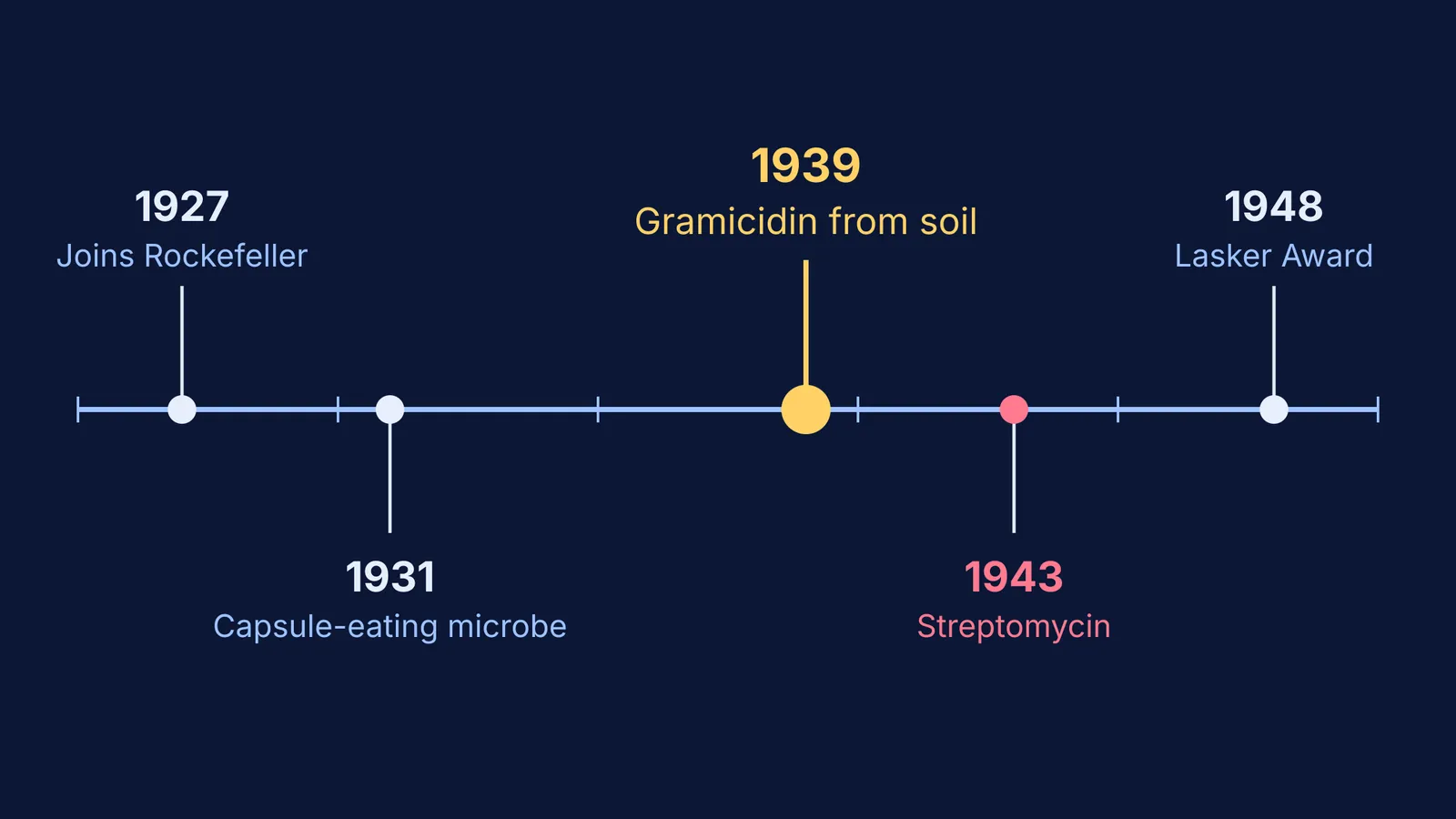
Dubos was born in France in 1901 and earned his PhD at Rutgers University in 1927 (Rockefeller University). His doctorate was in soil microbiology, supervised by Selman Waksman (What is Biotechnology). That same year the bacteriologist Oswald Avery recruited him to the Rockefeller Institute in New York (Van Epps, Journal of Experimental Medicine, 2006).
Avery handed him a hard problem. Type III pneumococcus, a cause of pneumonia, hides inside a sugary coat called a capsule. Dubos fed soil from a New Jersey cranberry bog a diet of that purified capsule sugar, and by 1931 he had a microbe that devoured the capsule; its enzyme stripped the coat off (What is Biotechnology). The enzyme never became a medicine, but it taught him a method.
How did Dubos find gramicidin in soil?
He used the same trick on a bigger scale. Soil kept for two years on a mixture of staphylococci, pneumococci and haemolytic streptococci yielded a spore-forming bacterium, *Bacillus brevis* (Van Epps, 2006). The logic: if the only food on offer is disease bacteria, the microbes that multiply are the ones that can break those bacteria down.
His report of July 1939 described a soluble agent from the bacillus that was bactericidal against "all the Gram-positive microorganisms so far tested" but did nothing to the Gram-negative bacilli he tried (Dubos, Journal of Experimental Medicine, 1939). With the biochemist Rollin Hotchkiss, he showed this extract, called tyrothricin, was a mix of two substances: tyrocidine and gramicidin (Van Epps, 2006).
Was gramicidin the first antibiotic produced commercially?
The histories say so. What is Biotechnology describes gramicidin and tyrocidine as the first antibiotics to be manufactured commercially, used for war wounds and skin infections such as ulcers (What is Biotechnology). Rockefeller University writes that the discovery of tyrothricin soon led to the first commercially produced antibiotics (Rockefeller University), and its hospital history records that gramicidin was the first antibiotic to be tested clinically and was used in topical form during World War II (Rockefeller University Hospital Centennial).
It never became a tablet or injection. Given into a vein it was toxic, so it stayed on the skin, and it is still an ingredient in some topical antibiotics (Van Epps, 2006). A chemical that kills bacteria is only a drug if it spares the patient.
What did gramicidin change for penicillin and streptomycin?
Its biggest effect was on other scientists. Howard Florey at Oxford credited Dubos with reviving his research on penicillin, which had been shelved for nearly a decade after Fleming's discovery (Van Epps, 2006). Our post on Alexander Fleming and penicillin tells how that mould was first noticed.
The soil search spread too. By October 1943 Waksman and his student Albert Schatz had isolated streptomycin, the first effective cure for tuberculosis (What is Biotechnology); read more in Selman Waksman and streptomycin. In 1948 Waksman and Dubos shared the Albert Lasker Basic Medical Research Award for studies of the antibiotic properties of soil bacteria (Lasker Foundation).
Dubos later turned to tuberculosis and warned, in his 1952 book The White Plague, that drugs alone would never eliminate it (What is Biotechnology).
How can you use Dubos's method in a biology answer?
Exam and olympiad questions often ask you to design an experiment: "How would you find a microbe that does X?" Dubos's search gives you a four-step frame.
Name the target. What must the microbe do? Dubos wanted something that killed Gram-positive bacteria.
Make it the only food. Grow a mixed sample, such as soil or compost, where using the target is the only way to thrive.
Wait and isolate. Let the winners multiply, then grow single colonies on separate plates.
Test and purify. Check the extract against the target, then against host cells, because a poison that harms the patient is no use.
Worked example: you want a microbe that breaks down cellulose. Step 2 means a medium where cellulose is the only carbon source, seeded with a pinch of garden soil. Anything that keeps growing after repeated transfers is a candidate. Step 4 is checking it really digests cellulose rather than living on traces of something else, so add a control flask with no cellulose and compare.
If Gram-positive and Gram-negative still blur together, the Fermi Concept Library has a lesson for every concept in biology, with its place in the map. For the drug side, our explainer on how antibiotics kill bacteria covers the main targets.
Next time a textbook line mentions antibiotics from soil microbes, remember that one of the first came from soil Dubos fed for two years.