On this page
In September 1972, Physical Review Letters published a two-page paper called An Upper Limit on the Neutrino Rest Mass, by R. Cowsik and J. McClelland. It used the whole universe as a scale to weigh a particle that no laboratory could yet weigh.
Who is Ramnath Cowsik?
Ramanath Cowsik (often spelt Ramnath) was born in Nagpur in 1940 and joined the faculty of the Tata Institute of Fundamental Research (TIFR) in Mumbai in 1961. He later directed the Indian Institute of Astrophysics in Bengaluru from 1992 to 2003 and received the Padma Shri in 2002, according to the same biography. Washington University in St. Louis, which he joined in 2002, calls him "the father of astroparticle physics", the field where particle physics and astronomy meet. His co-author, J. McClelland, was at the University of California, Berkeley (NASA record of the paper).
How did Cowsik use cosmology to limit neutrino mass?
The Big Bang made neutrinos in predictable numbers. The hot early universe filled with neutrinos, just as it filled with the photons of the cosmic microwave background that Alpher and Herman predicted in 1948. These relic neutrinos stopped interacting when the universe was about one second old and today have a temperature of roughly 1.95 K.
Number times mass gives density. The number of relic neutrinos is fixed by physics, so their total mass depends only on how heavy each one is.
Matter slows the expansion. In Friedmann's equations for an expanding universe, more matter means more braking. Astronomers measure that braking with the deceleration parameter.
Compare with what is observed. Allan Sandage had just measured that braking, and Cowsik and McClelland pointed out that his measurement "implies an upper limit of a few tens of electron volts on the sum of the masses of all the possible light, stable particles that interact only weakly" (paper abstract, NASA NTRS).
For a single neutrino species, the pair derived an upper limit of 8 eV, according to a history of dark matter by Gianfranco Bertone and Dan Hooper. Gershtein and Zeldovich had used a similar argument in 1966 to reach about 400 eV each for the electron and muon neutrinos.
Can you redo the estimate yourself?
Yes, with one modern formula. The Particle Data Group gives the density of relic neutrinos as Ω h² = Σm / 93.14 eV, where Σm is the sum of the neutrino masses (PDG review of cosmological parameters). Here Ω is a density as a fraction of the "critical" density that makes the universe flat, and h is the Hubble constant divided by 100 km/s/Mpc. We use today's inputs from the Planck 2018 results.
Find h². Planck measures a Hubble constant of 67.4 km/s/Mpc, so h = 0.674 and h² ≈ 0.454.
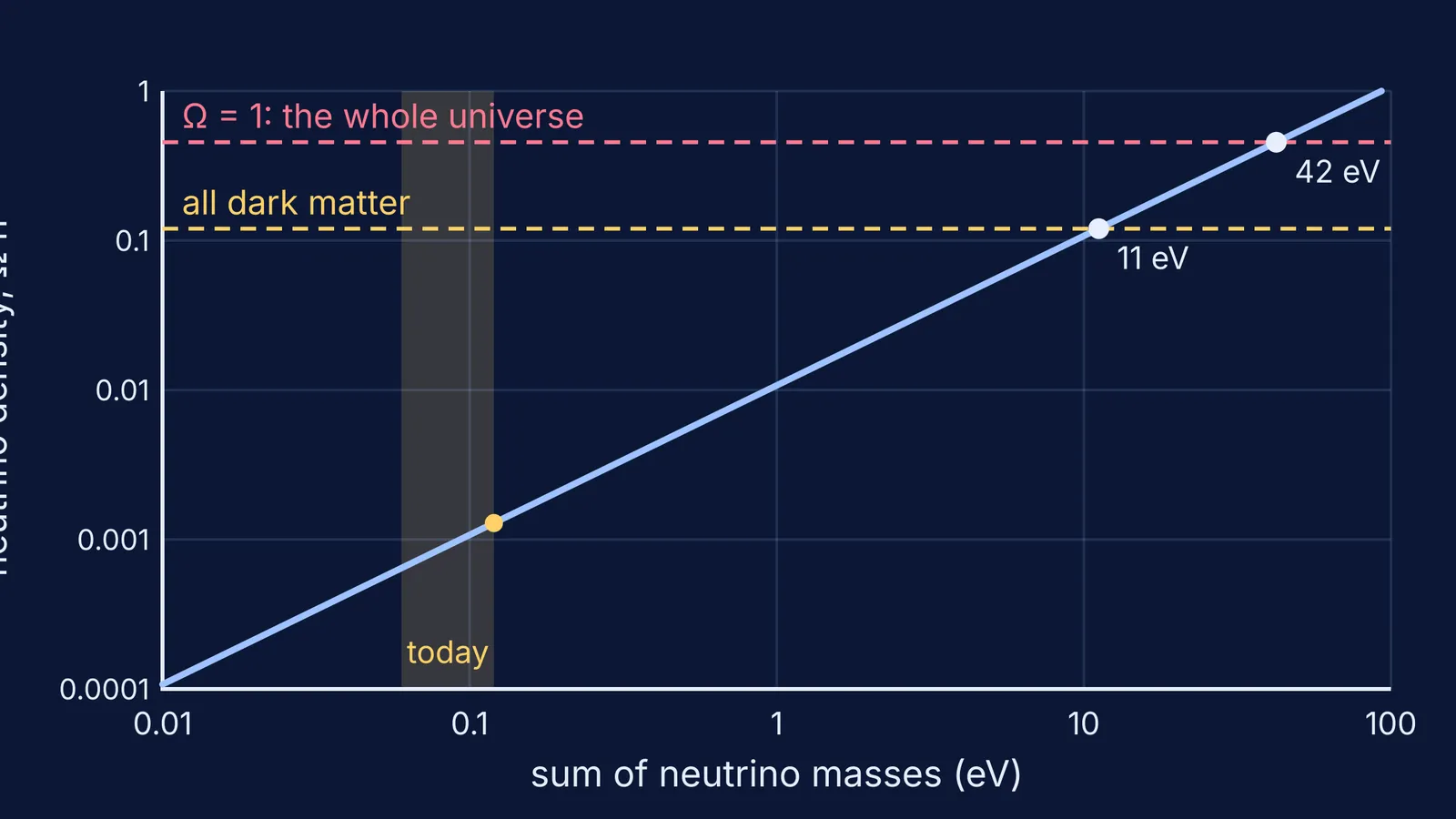
Ceiling 1: the whole universe. If neutrinos alone made up the critical density (Ω = 1), then Σm = 0.454 × 93.14 ≈ 42 eV. That is "a few tens of electron volts", the same scale as the 1972 result.
Ceiling 2: all the dark matter. Planck measures the cold dark matter density as Ω h² = 0.120. If neutrinos were all of it, Σm = 0.120 × 93.14 ≈ 11 eV.
Today's answer. Planck limits Σm to below 0.12 eV, so Ω h² for neutrinos is below 0.0013. That is only about 1% of the dark matter density.
The diagram above plots this line.
Why does this link particle physics and dark matter?
The same arithmetic runs both ways. If neutrinos weighed about 10 eV, they could supply the "missing mass" astronomers saw in galaxy clusters. Szalay and Marx proposed exactly this in 1976, and a 1980 tritium experiment reporting about 30 eV boosted interest in the idea, Bertone and Hooper record.
Computer simulations then sank it. Fast-moving "hot" neutrinos would build the largest structures first, and in 1983 White, Frenk and Davis concluded that "the conventional neutrino-dominated picture appears to be ruled out", according to the same history. The 1972 argument itself has lasted: Crossref lists the paper as cited 454 times.
How light is the neutrino now?
In April 2025 the KATRIN experiment in Germany reported, in Science, that the neutrino mass is below 0.45 eV, making neutrinos at least a million times lighter than electrons (Max Planck Institute for Nuclear Physics). Oscillation experiments show the masses are not all zero and, assuming a simple mass ordering, suggest a sum of at least about 0.06 eV (PDG). Cosmology, the route Cowsik helped open, still gives the tighter ceiling: below 0.12 eV for the sum, from Planck.
If terms like critical density or the Hubble constant are new to you, the Fermi Concept Library gives every physics concept its own lesson and its place in the map. To practise estimates like the one above, the Fermi Problem Library has worked problems with a step-by-step solver that explains the reasoning rather than printing an answer.
For another Indian physicist who read the sky for clues about particles, see Piara Singh Gill and the cosmic rays of India.