

On this page
In November 1948, two American physicists published a short letter in Nature called Evolution of the Universe. Ralph Alpher and Robert Herman argued that if the universe began hot and dense, its early radiation could not simply vanish. It would cool as space expanded, and it should still be around today as a faint, even glow a few degrees above absolute zero. In 1965, two Bell Labs scientists reported finding it by accident. Here is how close the prediction came, with a worked example using Wien's law.
What did Alpher and Herman predict in 1948?
Alpher was doing his PhD with George Gamow, who had suggested that the chemical elements might have been formed in an early, hot, expanding universe and recommended that Alpher do the actual calculations, according to Martin Harwit's obituary of Alpher in Physics Today. That work appeared as The Origin of Chemical Elements, the famous Alpher, Bethe and Gamow paper in Physical Review dated 1 April 1948.
The same obituary says Alpher and Herman showed the universe must once have been at temperatures in the billion-degree range, and predicted that a faint remnant of that radiation should persist today at a temperature "of order 5°K". They set out the calculation in more detail in Remarks on the Evolution of the Expanding Universe in Physical Review in 1949.
The idea in one line: the glow is black-body radiation that has been stretched by the expansion of space, so its temperature falls as the universe grows.
Why was the prediction forgotten for 17 years?
Physics Today reports that most experts of the time felt an isotropic 5 K signal was undetectable, and that over the following 17 years the prediction was forgotten.
Then, in 1965, Arno Penzias and Robert Wilson of Bell Labs reported A Measurement of Excess Antenna Temperature at 4080 Mc/s in The Astrophysical Journal. Their horn antenna at Holmdel, New Jersey, picked up about 3.5 K more noise than they could explain, spread evenly over the sky (background on the discovery). A companion paper by Dicke, Peebles, Roll and Wilkinson, Cosmic Black-Body Radiation, explained it as the leftover glow of a hot early universe. Penzias and Wilson shared the 1978 Nobel Prize in Physics for the detection.
Alpher and Herman expected their contributions to be recognised after the discovery, Harwit writes. Two weeks before Alpher died in 2007, his son Victor represented him at the White House, where he was awarded the National Medal of Science (Physics Today). You can read the discovery side of the story in our post on Penzias, Wilson and the noise that turned out to be the Big Bang, and Gamow's side in George Gamow and the hot big bang.
How close was 5 K to the real temperature?
The modern value of the cosmic microwave background temperature is 2.72548 ± 0.00057 K, from Fixsen's 2009 analysis in The Astrophysical Journal (abstract on arXiv). So Alpher and Herman's 5 K was too high by a factor of about 1.8. For a prediction made with no measurement to aim at, that is close.
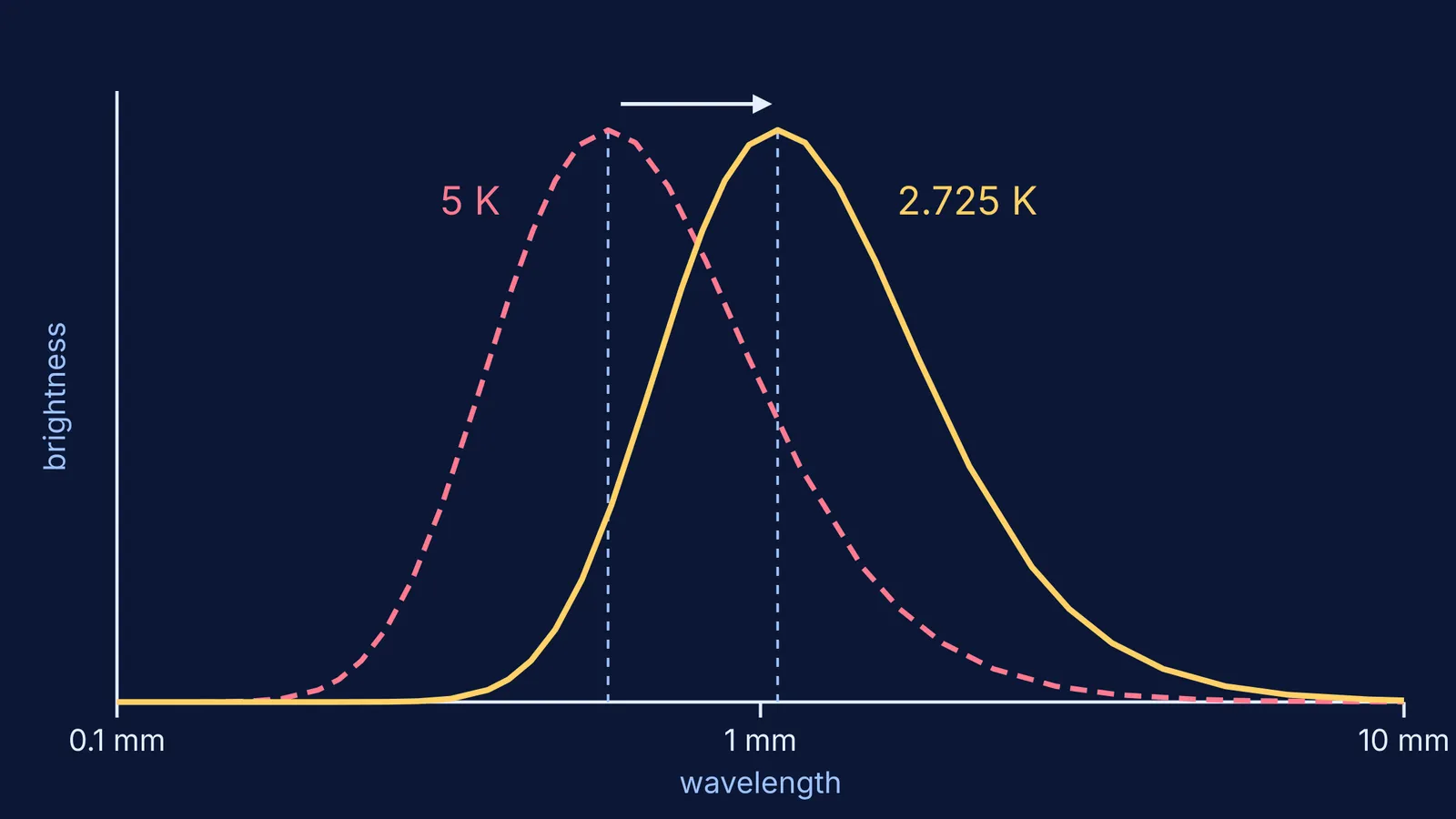
Here is a worked example that turns those temperatures into wavelengths. Wien's displacement law says the peak wavelength of black-body radiation is λmax = b / T, where NIST gives b = 2.897771955 × 10⁻³ m K.
Measured glow: λmax = 2.8978 × 10⁻³ / 2.72548 = 1.063 × 10⁻³ m, about 1.06 mm. That is in the microwave band.
Alpher and Herman's 5 K: λmax = 2.8978 × 10⁻³ / 5 = 0.58 mm, still microwaves.
Penzias and Wilson's receiver worked at 4080 Mc/s: λ = c / f = (3.00 × 10⁸ m/s) / (4.080 × 10⁹ Hz) = 7.35 cm.
Compare: 7.35 cm is about 69 times the 1.06 mm peak. They caught the glow far out on its long-wavelength tail, not at its brightest point.
For more practice, see our post on black-body radiation problems with Stefan's law and Wien's law.
What can you learn from a prediction that was off by a factor of two?
Alpher and Herman's estimate was wrong in its exact number and right in what mattered: the glow existed, it was black-body, and it was a few kelvin. That is getting the order of magnitude right, a skill you can practise. When you make an estimate, run this check:
Units: does the answer come out in kelvin, metres or joules as it should?
Size: is it within a factor of ten of something you already know? A few kelvin and a millimetre peak fit together through Wien's law.
Test: what measurement would prove you wrong? Theirs needed a sensitive microwave receiver, and most experts then thought the signal could not be detected.
If the curve shifting with temperature is hard to picture from the formula alone, the Fermi Simulation Lab has interactive simulations for ideas that are easier to see than to read. If black-body radiation itself is the gap, the Fermi Concept Library gives each physics concept its own lesson and its place in the map.


