On this page
On 12 January 1920, Srinivasa Ramanujan, back in India and very ill, wrote to G. H. Hardy in Cambridge about functions he had recently discovered (overview of mock modular forms). He died on 26 April 1920 in Kumbakonam, aged 32 (MacTutor biography). The ideas in that letter took mathematicians more than 80 years to place properly.
What did Ramanujan write in his last letter to Hardy?
In the letter, Ramanujan gave examples of 17 curious q-series that he called mock theta functions, according to a 2013 paper by Amanda Folsom, Ken Ono and Robert Rhoades in Forum of Mathematics, Pi. The paper quotes his words: "I discovered very interesting functions recently which I call 'Mock' ϑ-functions. Unlike the 'False' ϑ-functions (studied partially by Prof. Rogers in his interesting paper) they enter into mathematics as beautifully as the ordinary theta functions."
He then asked: if a series blows up near the edge of its circle the way a theta function does, must it be a theta function plus something harmless? His answer, quoted in the same paper: "The answer is it is not necessarily so. When it is not so I call the function Mock ϑ-function. I have not proved rigorously that it is not necessarily so."
Notice that last sentence. Ramanujan told Hardy exactly what he had and had not proved.
What is a mock theta function, in plain words?
A q-series is an infinite sum in powers of a variable q, a little like the geometric series 1 + q + q² + ... that you meet in school. The only specific example Ramanujan offered is the third-order function f(q) = 1 + q/(1+q)² + q⁴/((1+q)²(1+q²)²) + ... (Folsom, Ono and Rhoades, 2013).
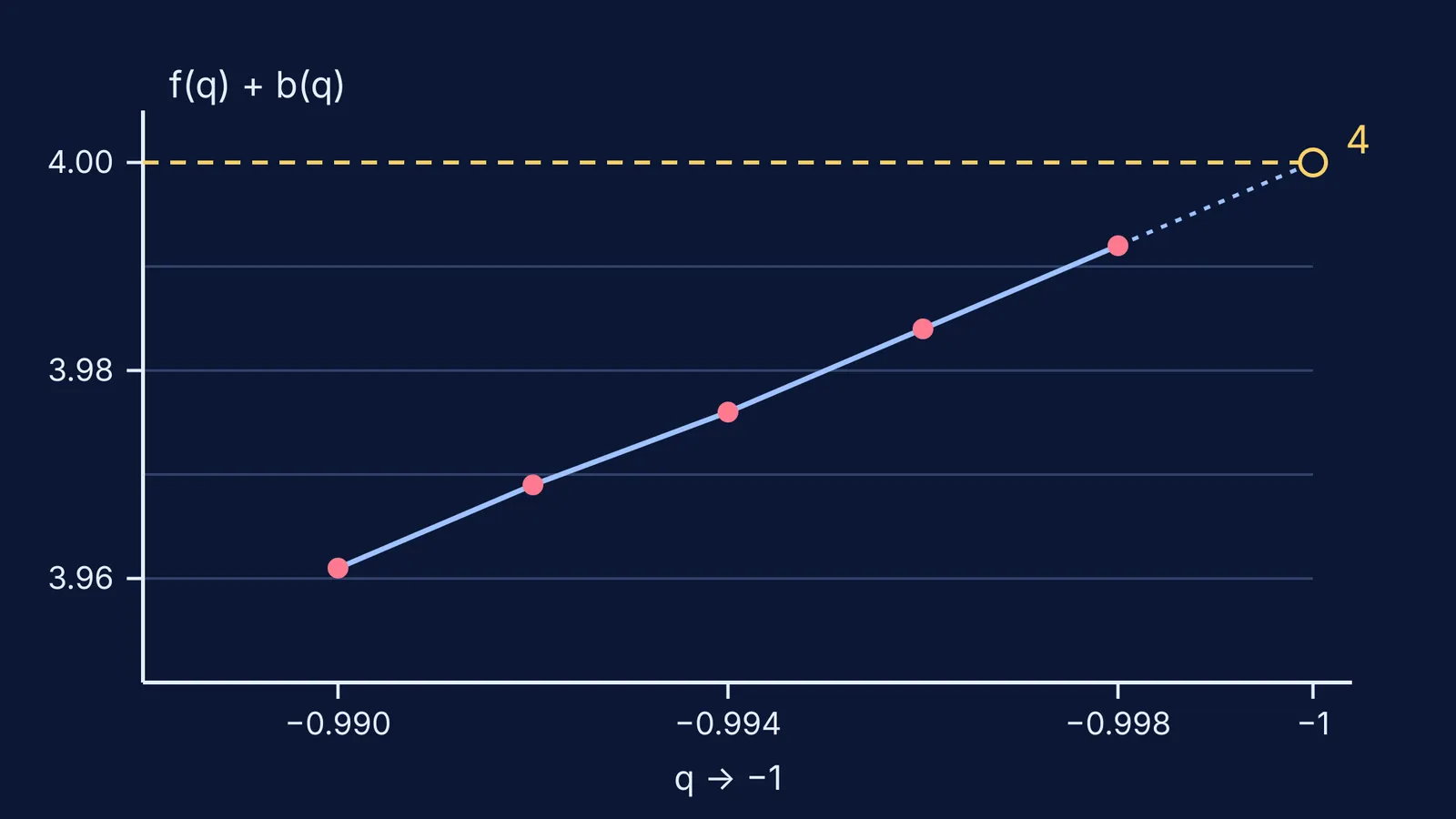
The sum converges when the size of q is less than 1, but it explodes as q approaches -1: the paper computes f(-0.994) as roughly -1.08 × 10³¹ and f(-0.998) as roughly -6.41 × 10⁹⁰. Ramanujan found a modular function b(q), built from theta-type products, that cancels this explosion, so that f(q) + b(q) stays small near -1.
The catch is that no modular form of the usual kind cancels all of f's blow-ups exactly; the same paper reports that Griffin, Ono and Rolen confirmed this speculation of Ramanujan's (Forum of Mathematics, Pi). That is the "mock": the function imitates a theta function closely, but not perfectly.
Why did it take until the 2000s to understand mock theta functions?
G. N. Watson was the first to prove Ramanujan's claim about f(q), yet for decades mathematicians could not say how these functions fit into the theory of modular forms (Folsom, Ono and Rhoades). In 1936 Watson showed that the third-order functions almost transform like modular forms, apart from error terms (overview).
The turn came with Sander Zwegers's 2002 PhD thesis at Utrecht University. He showed that adding a correction term to a mock theta function produces a real-analytic modular form of weight 1/2 (Zwegers, Mock Theta Functions). In today's language, Ramanujan's functions are the "holomorphic parts" of harmonic weak Maass forms.
That framework let Kathrin Bringmann and Ken Ono find an exact formula for the coefficients of f(q), published in 2006 (Inventiones Mathematicae). In 2013, Folsom, Ono and Rhoades gave a new proof of Ramanujan's claim and a simple formula for the constants he left unexplained (Forum of Mathematics, Pi).
How can you try Ramanujan's example yourself?
Take q = -0.5. The first term after 1 is q/(1+q)² = -0.5/0.25 = -2.
The next term is q⁴/((1+q)²(1+q²)²) = 0.0625/(0.25 × 1.5625) = 0.16.
The third term is about -0.0065 and the fourth is about 0.00005. So f(-0.5) is roughly 1 - 2 + 0.16 - 0.0065 = -0.85.
Now take q = -0.99. The first term alone is -0.99/(0.01)² = -9,900. Every term after 1 has the factor (1+q)² in its denominator, and that factor is heading to zero.
Finally, compare with the paper's own table: f(q) + b(q) is 3.961 at q = -0.990, 3.976 at q = -0.994 and 3.992 at q = -0.998, creeping towards 4 (Folsom, Ono and Rhoades).
Steps 1 to 4 resemble the checks in our guide to what it means for a series to converge. If the algebra of products and denominators feels shaky, the Fermi Concept Library has a lesson for each concept in mathematics, each placed in its map.
What can a student take from Ramanujan's last letter?
Experiment before you prove. Ramanujan wrote that he had constructed a number of examples, even though he had no rigorous proof.
Push to the edge. The interesting behaviour of f(q) shows up near q = -1, not at easy values like -0.5.
Say what you have not proved. His honest "I have not proved rigorously" gave later mathematicians a precise target.
If a long calculation goes wrong and you cannot see where, the Fermi Problem Library works through problems with a step-by-step solver that explains the reasoning rather than printing an answer.
For more of Ramanujan's work, read how his 1914 infinite series computes pi and why 1729 is called the Hardy-Ramanujan number.