On this page
In short In 1754, the Czech priest Prokop Diviš erected a 40-metre-tall "weather machine" to draw electricity from clouds. His device used over 400 metal spikes and heavy chains connected to the earth, making it an early, fully grounded lightning conductor.
Centuries before the modern electrical grid, thunderstorms were viewed as an uncontrollable and terrifying force of nature. But during the Enlightenment, a few researchers began to realise that lightning was simply a massive spark of static electricity. One of these pioneers was a Czech priest who decided to tame the weather.
Who was Prokop Diviš?
In the mid-1700s, scientists across Europe were fascinated by static electricity. Prokop Diviš (1698–1765) was a Catholic priest and theologian from Bohemia who spent his time experimenting with electrical machines and natural philosophy Source: Wikipedia. He was spurred to action by a tragic accident. In 1753, the physicist Georg Wilhelm Richmann was struck and killed by lightning in St. Petersburg while measuring atmospheric electricity with an ungrounded iron rod. Hearing of this, Diviš decided to build a safer apparatus that would control the unpredictable forces of nature.
How did the 1754 lightning conductor work?
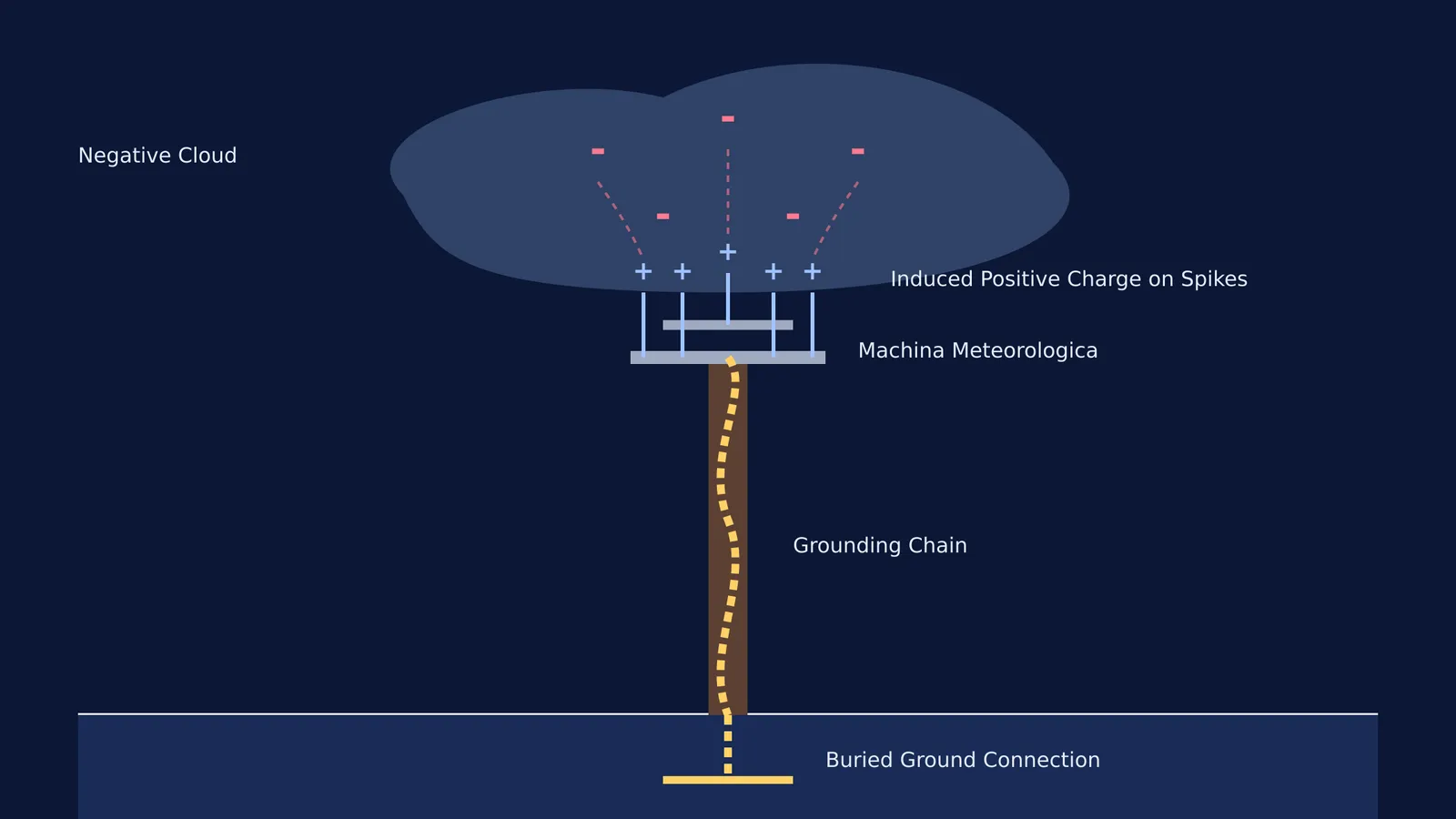
On 15 June 1754, Diviš erected his *machina meteorologica*, or weather machine, in the village of Přímětice. The structure was a free-standing wooden pole measuring 40 metres high. At the top, horizontal iron bars supported a series of tin boxes. More than 400 metal spikes pointed toward the sky to extract electricity from the air Source: Wikipedia.
His goal was to prevent lightning altogether. Diviš believed that hundreds of sharp points would continuously draw electricity out of the clouds, quietly neutralising the storm before a bolt could form. In physics, sharp points create a high electric field gradient that can ionise the surrounding air and allow charge to leak away. You will encounter this principle when calculating the energy density in an electric field. This corona discharge is why modern lightning rods are pointed rather than rounded.
Why was his lightning rod grounded?
The most important feature of Diviš's machine was its direct connection to the earth. He ran heavy metal chains from the top of the apparatus down to the soil, burying them to ensure excellent contact Source: Wikipedia.
Earthing provides a low-resistance path for electrons to reach the ground. If a direct strike did occur, the massive electrical charge would travel safely down the iron chains instead of destroying the wooden pole or starting a fire in the nearby buildings. Understanding how charge redistributes when a conductor touches the earth is a central idea in electrostatics, and you use the exact same logic to find the charge on concentric spherical shells after earthing. This concept of equipotential surfaces remains fundamental to modern electrical safety systems.
By making sure his conductor was firmly anchored to the ground, Diviš built one of the first truly functional lightning rods in history. He developed his machine independently of Benjamin Franklin, who was refining his own grounded designs in America around the same time. While Franklin's simpler rod eventually became the global standard, Diviš's complex weather machine successfully proved that grounding was the key to safety.
What happened to the weather machine?
For a few years, the machine stood safely in Přímětice. Then, in 1759, a severe drought struck the region. The local farmers, who desperately needed rain for their crops, blamed the strange spiked tower for clearing the clouds and changing the weather patterns. Angry parishioners formed a mob and tore the 40-metre structure down Source: Wikipedia.
Diviš later built a second machine on the local church tower, but the church authorities eventually ordered him to dismantle it to keep the peace with the community. Despite the setbacks, his theories were published in 1765, the same year he died. Today, a replica of his machine stands in the Czech Republic as a monument to his pioneering work in electrical engineering.
If you are learning the principles of electric fields, conductors, and earthing, Fermi's AI tutor can help. When you bring a physics concept or a tough problem set, Fermi works out what you already know, builds a plan for the session, and teaches through it — writing on a board, drawing the figure, running the simulation, and checking understanding as it goes.