

On this page
In 1687, the same year Newton published the Principia, a French mathematician named Pierre Varignon published a book on mechanics. According to his MacTutor biography, Varignon was born in Caen in 1654, died in Paris on 23 December 1722, and his *Projet d'une nouvelle mécanique* (1687) studied the composition of forces. You use one result from that book in every torque problem.
What is Varignon's theorem of moments?
Varignon's theorem states that the sum of the moments of several concurrent forces about a point is equal to the moment of the resultant of those forces (Engineering Statics, Baker and Haynes).
The moment of a force about a point is the force multiplied by its perpendicular distance from that point, M = F × d, and the sign tells you the turning direction (LibreTexts, Engineering Statics/04:_Moments_and_Static_Equivalence/4.03:_Varignons_Theorem)). In Class 11 physics, this is torque.
The theorem also runs backwards, and that is the useful direction: to find the moment of one awkward force, break it into components, find each component's moment, and add them (Engineering Statics).
How does the parallelogram of forces lead to it?
The starting point is the parallelogram rule. In Newton's own words, as translated in 1729: "A body acted on by [two] forces acting jointly describes the diagonal of a parallelogram in the same time in which it would describe the sides if the forces were acting separately" (quoted in Martínez Adame, Theoria, 2012). So two forces P and Q pulling at one point act like a single force R along the diagonal.
Varignon applied this to turning effects. A modern check: put the point O at the origin and let a force with components (Fx, Fy) act at the point (x, y). Its moment about O is M = x·Fy − y·Fx. That expression is linear in the force: if R = P + Q acts at the same point, then M(R) = M(P) + M(Q). Moments add exactly the way the forces do.
Worked example: one force, two ways
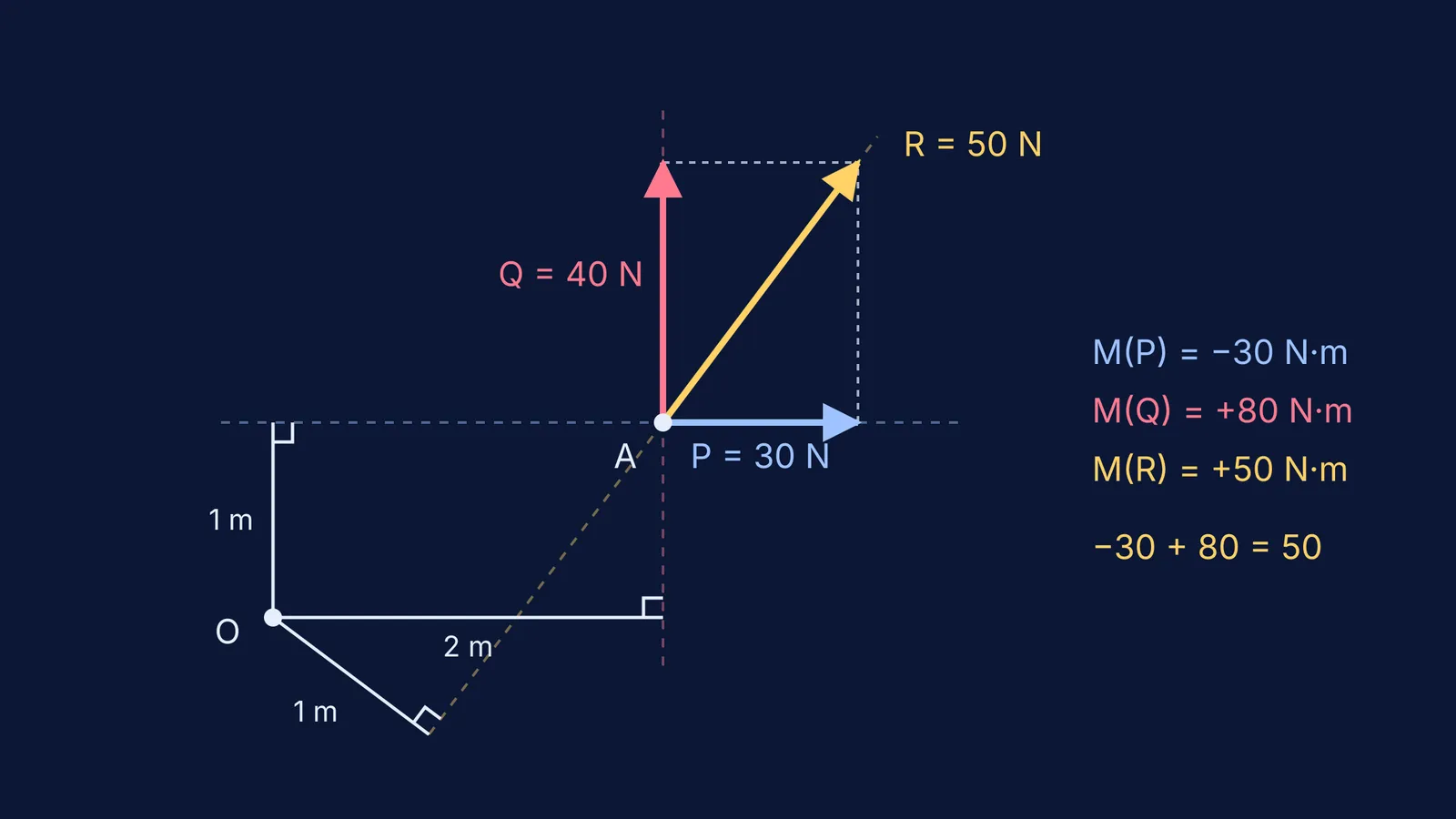
This is the setup in the diagram above. A 50 N force R acts at point A, which is 2 m to the right of O and 1 m above it. R points up and to the right, with a 30 N horizontal component and a 40 N vertical component.
Way 1, directly. You need the perpendicular distance from O to R's line of action. The line through A has direction (0.6, 0.8), so the distance is |2 × 0.8 − 1 × 0.6| = 1 m. The moment is 50 N × 1 m = 50 N·m, anticlockwise.
Way 2, with Varignon.
The 40 N vertical component has a lever arm equal to the horizontal distance, 2 m. It turns anticlockwise: +80 N·m.
The 30 N horizontal component has a lever arm equal to the vertical distance, 1 m. It pushes along a line above O towards the right, so it turns clockwise: −30 N·m.
Add them: 80 − 30 = 50 N·m anticlockwise.
Same answer, with every distance read straight off the drawing. Adding 80 and 30 to get 110 is the classic sign error.
How do you use it in JEE and board torque problems?
Use this checklist whenever a force is slanted or a lever arm is hard to find:
Choose the point first. Taking moments about a point that unknown forces pass through removes them; see which point to take torque about in equilibrium problems.
Resolve each slanted force along the edges of the figure, usually horizontal and vertical.
Pair each component with the distance at right angles to it.
Pick a sign convention (anticlockwise positive) and write a sign on every term before adding.
Drop any component whose line passes through the point. Its moment is zero.
Sanity check: the moment can never exceed the force times the distance OA. Here that is 50 × √5, about 112 N·m.
The same idea sits under simpler problems, from balancing a see-saw in Class 9 to finding reaction forces on a beam on two supports.
If you keep getting the right method but the wrong sign, work a few problems in the Fermi Problem Library, where the step-by-step solver explains the reasoning rather than printing an answer. If the turning direction of a component is hard to picture, the Fermi Simulation Lab has interactive simulations for ideas that are easier to see than to read.
Why does a 1687 idea still matter?
MacTutor notes that his *Nouvelle mécanique*, published in 1724 after his death, gave the best approach to geometrical statics until the work of Poinsot over 75 years later, and that he was one of the first French scholars to recognise the power of the calculus (MacTutor).
The lasting habit: when one force is awkward, split it into easy parts and add their moments. Try it on your next slanted-force question, and check the answer both ways.


