

On this page
Water channels in cells had been suspected since the middle of the nineteenth century, but nobody had found one (Nobel Prize press release, 2003). In April 1992, Gregory Preston, Tiziana Carroll, William Guggino and Peter Agre at Johns Hopkins University reported in Science that frog eggs made to carry a red-blood-cell protein called CHIP28 became far more permeable to water (Science, 1992). Here is how a protein nobody was looking for, and a dish of dilute water, settled the question.
How did Peter Agre find the protein in the first place?
By accident. Agre was a haematologist studying the Rh blood group antigens, and his antibodies kept binding a 28 kDa protein that his team had wrongly taken for a broken piece of the Rh protein, as he explained in his Nobel lecture. He credited the find to the method of "sheer blind luck".
The stray protein was strikingly common: the same lecture says there were about 200,000 copies in each red blood cell, and it was abundant in kidney tubules too. Nobody he asked could say what it did, until his clinical mentor, John Parker, pointed out that red cells and kidney tubules are both very permeable to water.
What did the frog egg experiment show?
Frog eggs suited the test because, Agre said, they let very little water through and survive in fresh-water ponds (Nobel lecture). The team set up a plain comparison:
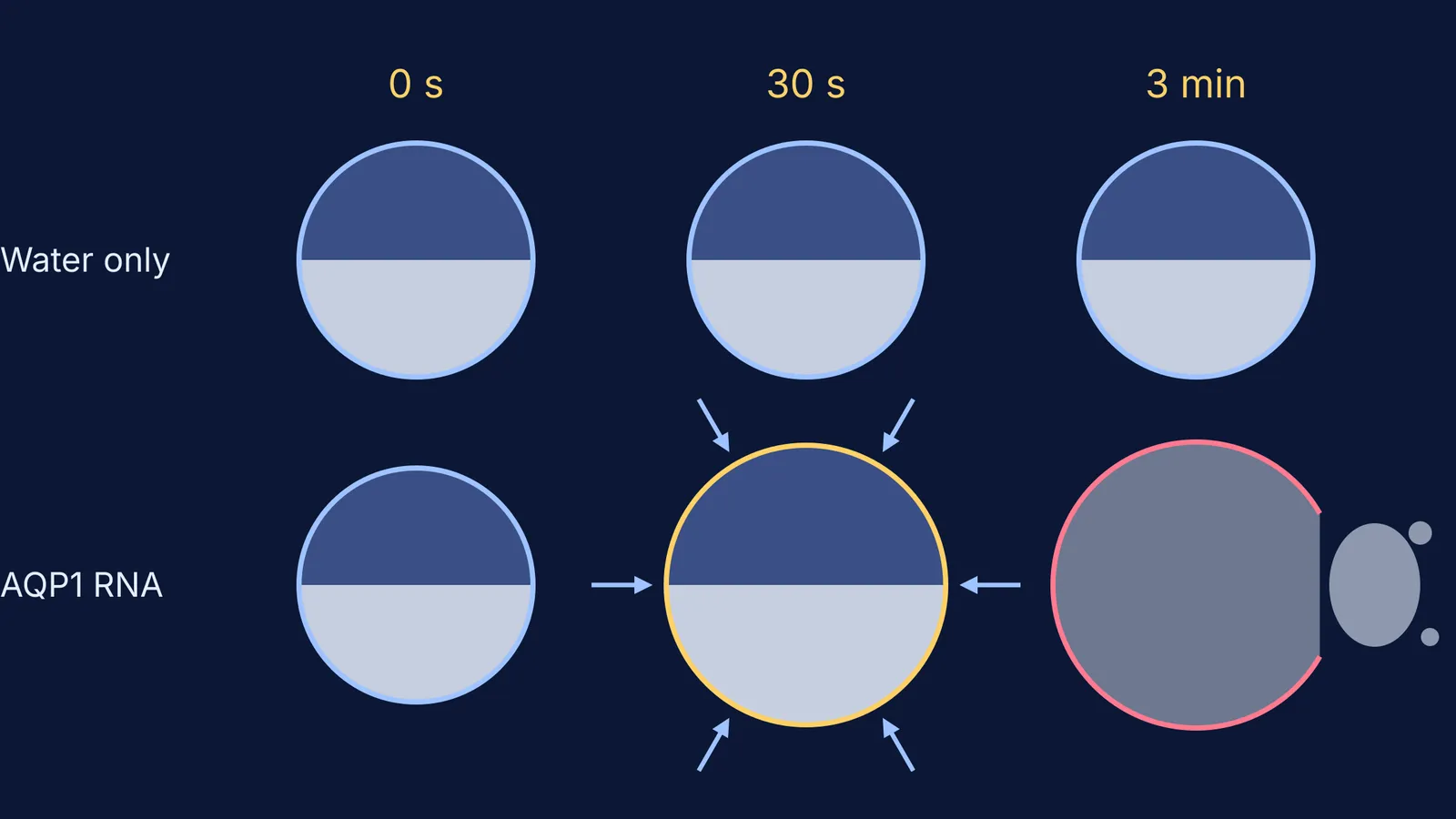
Control eggs from the frog Xenopus laevis were injected with water only.
Test eggs were injected with 2 ng of RNA coding for the protein, so they built it into their own membranes.
After three days, the two groups looked the same.
Both groups were moved into distilled water.
The control eggs did not swell. The test eggs began swelling within 30 seconds and had burst by 3 minutes; Agre said they "exploded like popcorn".
Then came the check that made it convincing. Mercury was already known to block water flow in red cells, and mercuric chloride reversibly blocked the extra water flow in the test eggs (Science, 1992). A protein that lets water in, and is shut by a known water-channel blocker, is acting like a water channel.
What is an aquaporin?
An aquaporin is a membrane protein that forms a pore letting water through while keeping ions out; Agre named it from the words for "water pore" (Nobel Prize popular information). The 1992 protein is now called AQP1.
Later tests on tiny artificial vesicles showed how fast it works. Vesicles without AQP1 took about half a second to shrink to balance in a saltier solution, while vesicles with AQP1 took about 20 milliseconds (Nobel lecture). Each channel unit passes roughly 3 billion water molecules per second, yet acid (H3O+ ions) does not get through.
Humans have at least eleven aquaporin variants, and the kidneys depend on them: they filter about 170 litres of primary urine a day, pass only about one litre, and AQP1 reabsorbs about 70% of the water (Nobel Prize popular information). In 2003, Agre received half the Nobel Prize in Chemistry "for the discovery of water channels" (Nobel Prize press release).
How can you read an experiment like this one?
Ask these five questions of Agre's paper, then of the next experiment in your textbook:
What was the question? Do red cells have a protein that carries water?
What was changed? Only whether the egg had the protein.
What was the control? Eggs injected with water alone.
What was measured? How fast the eggs swelled in dilute water.
What ruled out other explanations? A known water-channel blocker, mercuric chloride, stopped the effect, and the block could be reversed.
Now make a prediction. If you put AQP1 eggs in a solution saltier than their insides, what happens? Water still moves towards the higher solute concentration, so they should shrink, and faster than the control eggs. Agre made the same point: water movement is directed by osmotic gradients, so aquaporins are not pumps (Nobel lecture).
Where does this connect to what you study?
If osmosis itself feels shaky, start with how a pig's bladder revealed osmosis in 1748. The same physics, run in reverse, is in how an RO water purifier pushes against osmotic pressure. For the kidney figures in your textbook, see how much urine and urea is excreted per day.
When membrane transport keeps tripping you up, the Fermi Concept Library gives every concept in biology and chemistry its own lesson and its place in the map, so you can see how osmosis, diffusion and channels connect before your next test.


