On this page
Pedro Nunes (Petrus Nonius in Latin) gave navigators two ideas that still sit inside things you use: a way to read angles finer than an instrument's marks, ancestor of the vernier scale on your lab caliper, and the proof that a fixed compass course is not the shortest route round the globe.
Who was Pedro Nunes?
Nunes was born in Alcácer do Sal in 1502 and died in Coimbra on 11 August 1578, according to the MacTutor History of Mathematics biography of Pedro Nunes. The same biography records that he was appointed Cosmographer of the Kingdom of Portugal in 1529, held the chair of mathematics at the University of Coimbra from 1544, and became Chief Royal Cosmographer in 1547.
How did the nonius measure angles finer than a degree?
A quadrant marked only in whole degrees forces you to round. Nunes's fix, published in *De crepusculis* (1542), was to draw 45 concentric arcs on the quadrant: the outer arc divided into 90 equal parts, the next into 89, then 88, 87 and so on, down to 46 parts on the innermost, as the MacTutor biography describes the nonius.
Because each arc is cut into a different number of pieces, their marks fall in slightly different places. When an angle was measured, the observer noted the arc and the division on which the sighting arm (the alidade) fell, then looked up the exact angle in a table, as the Wikipedia article on the nonius) explains.
How do you read a nonius, step by step?
Suppose the alidade lands exactly on mark 40 of the arc with 87 divisions.
Each division on that arc is 90 ÷ 87 = 1.0345 degrees.
Mark 40 therefore sits at 40 × 90 ÷ 87 = 41.379 degrees.
Convert the decimal part to minutes: 0.379 × 60 ≈ 22.8 minutes.
Reading: about 41° 23′, where the 90-part arc alone would only have told you "about 41°".
The idea was clever but fiddly. Tycho Brahe considered it too complex, Clavius and Jacob Curtius made improved versions, and in 1631 Pierre Vernier reduced it to a sliding scale that he himself called a perfected nonius, according to Wikipedia's article on Pedro Nunes. You can follow that next step in our story of how Pierre Vernier built his scale in 1631, and practise it with this vernier caliper reading simulation.
What is a rhumb line, and why does it spiral towards the pole?
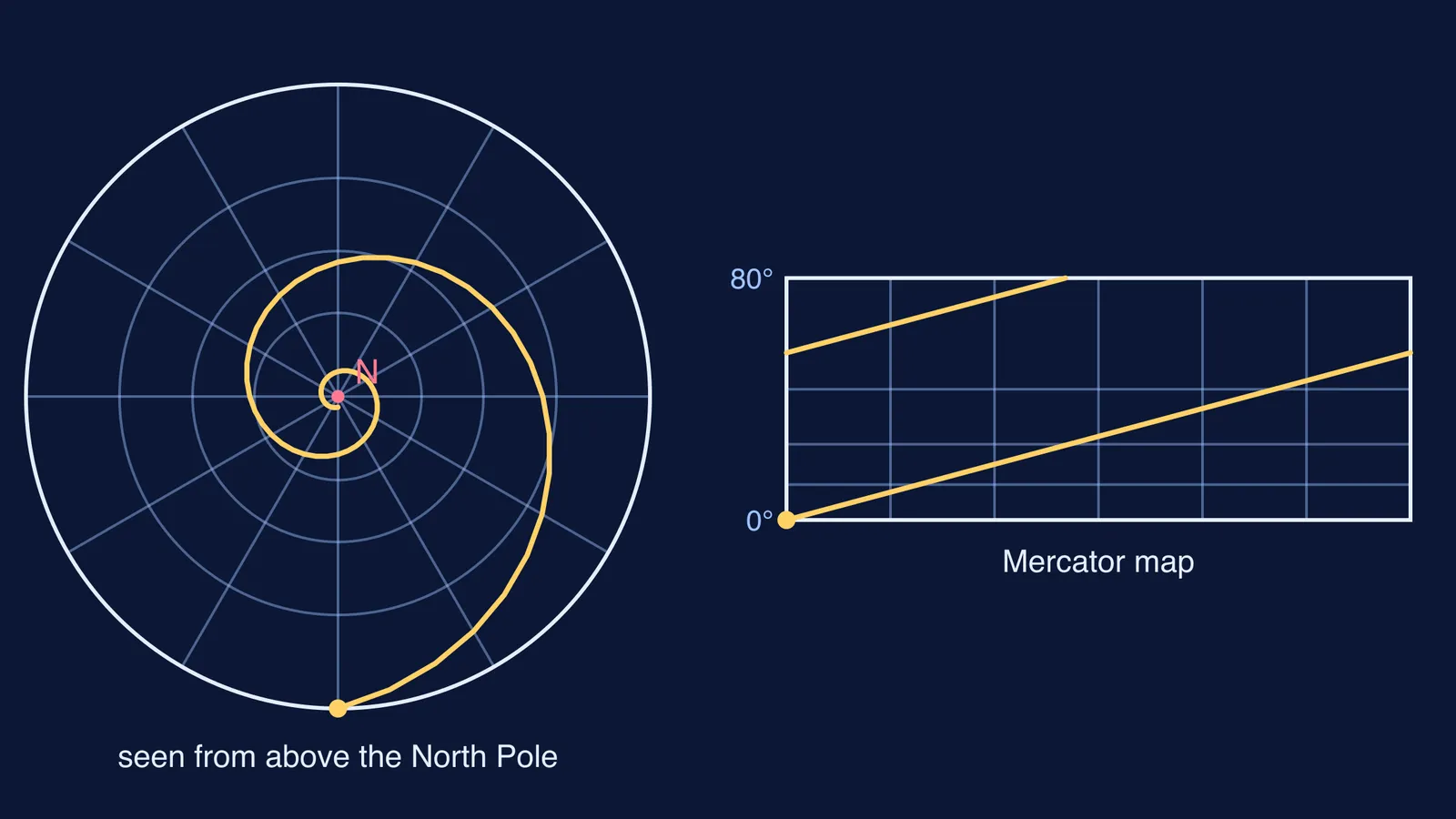
A rhumb line, or loxodrome, is the path a ship follows when it holds one compass bearing, so it crosses every meridian at the same angle. The Wikipedia article on rhumb lines credits Nunes with first discussing the effect of following such a course on a globe, in his 1537 *Treatise in Defense of the Marine Chart*; the MacTutor biography dates his best-known investigation of the loxodrome to around 1550. His key point, as Wikipedia's Pedro Nunes article puts it, is that a steady course is not a great circle, the shortest path between two points on Earth, but a spiral.
Why a spiral? Meridians bunch together towards the pole, so if you keep cutting each one at the same angle, your path keeps turning round it. A rhumb line that is not due north-south or due east-west winds around the pole an infinite number of times, yet reaches it in a finite distance, according to the rhumb line article.
The same source gives a neat formula: on a perfect sphere, the pole-to-pole length of a loxodrome is the meridian length divided by the cosine of the bearing from north. Try it:
Bearing 60°: cos 60° = 0.5, so the spiral is 2 times as long as the meridian.
Bearing 75°: cos 75° ≈ 0.259, so it is about 3.9 times as long.
On a Mercator map every rhumb line becomes a straight line, which is exactly why navigators valued that map; read how Gerardus Mercator designed his map projection.
If curves on a sphere are hard to picture, the Fermi Simulation Lab has interactive simulations for the ideas that are easier to see than to read.
How can you use Nunes's ideas in your own studies?
Find the least count first. Work out the smallest step a scale can show. For a nonius arc with n divisions over 90°, it is 90/n degrees.
Look for a match, not a guess. A nonius and a vernier both work by finding the mark that lines up exactly.
Ask what "constant direction" means. On a sphere, a fixed bearing (rhumb line) and the shortest route (great circle) are different paths.
Test it on a globe. From a point on the equator, draw short steps that each cross the next meridian at 45°. The path soon curls towards the pole.
If least count, bearings or spherical geometry feel shaky, the Fermi Concept Library covers every concept in physics, chemistry, biology, mathematics and computing, each with its own lesson.
Next time you read a vernier caliper, you are using a royal cosmographer's trick.