On this page
On Christmas Eve 1883, a student in Berlin sat alone with an oil lamp and worked out how to send a moving picture down a wire. Paul Nipkow's spiral of holes became the heart of the first television experiments of the 1920s. If you have ever wondered why a screen is built from lines, his disk is the simplest place to see it.
What is a Nipkow disk?
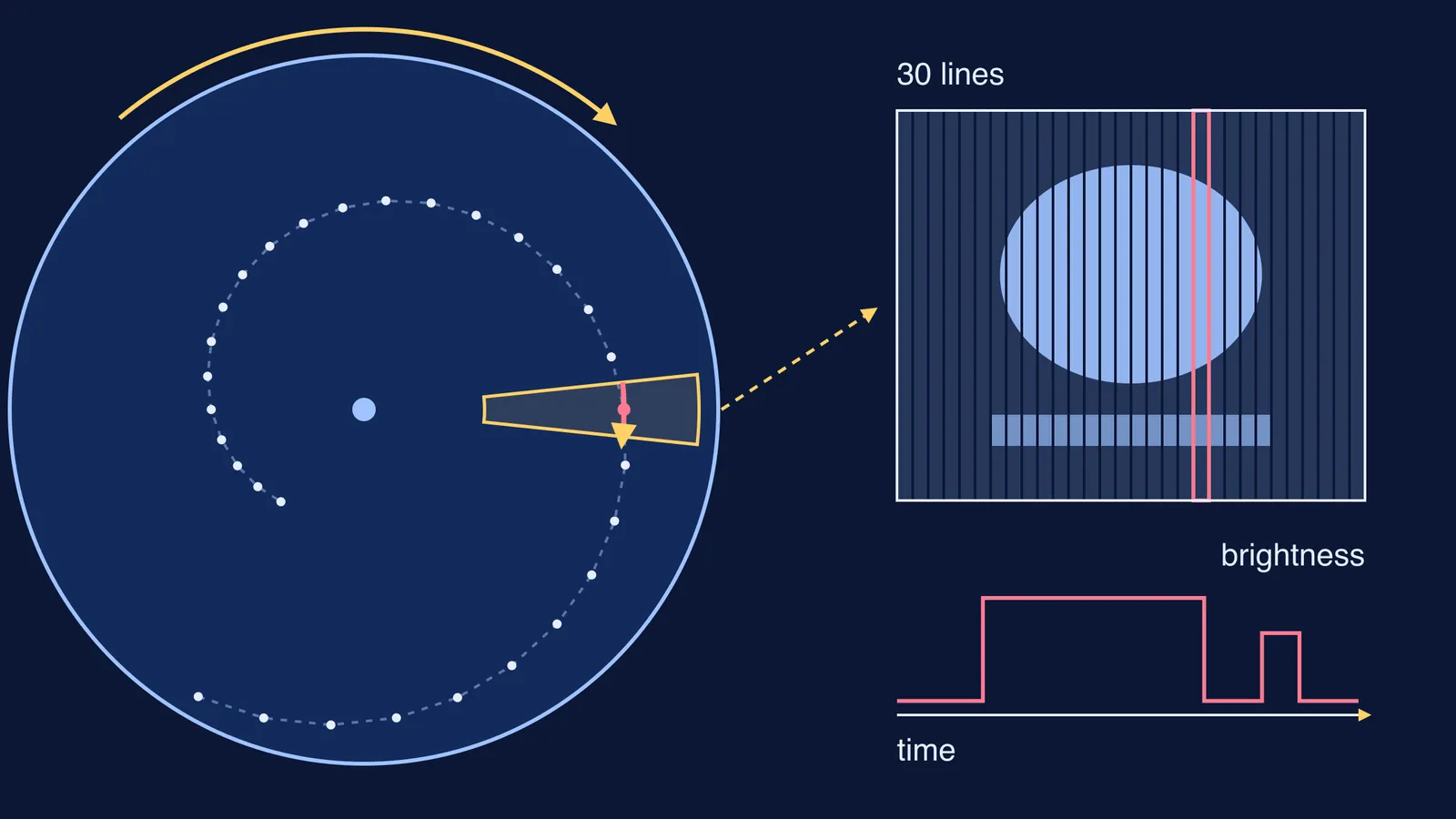
A Nipkow disk is a flat disk with equally spaced holes arranged in a single-turn spiral, so each hole sits a little closer to the centre than the one before, as Wikipedia's Nipkow disk article describes. The German Patent and Trade Mark Office (DPMA) records that Nipkow's patent DE30105, titled "Elektrisches Teleskop" (electric telescope), was granted on 15 January 1885 with retroactive effect from 6 January 1884.
Nipkow, born in 1860 in Lauenburg, Pomerania, had moved to Berlin in 1882 to study natural sciences. He could not afford the patent fee, so his girlfriend, Sophia Colonius, paid it, the DPMA says; the Baird Television archive's biography of Nipkow puts the fee at 30 marks.
How did a spinning disk turn a picture into a signal?
Only one hole is in front of the picture at a time. It sweeps across the picture in a curved line; as it leaves, the next hole arrives, one step closer to the centre, and sweeps the next line. One full turn scans the whole picture.
In Nipkow's design, a light-sensitive selenium cell behind the disk turned the changing brightness into a changing electric signal, as the DPMA explains. For how selenium became a light sensor, read our post on Willoughby Smith and selenium photoconductivity.
At the receiver, a second disk spinning in step rebuilt the picture, and your eye blends the lines back into one image.
Nipkow probably never built his electric telescope. Experts think it could not have worked in 1884, the DPMA notes: selenium was too slow, and nobody could yet keep two distant disks in step.
How many lines did a mechanical TV picture have?
Nipkow's patent lapsed after 15 years, says Wikipedia's biography of Paul Nipkow. In the 1920s, pioneers including John Logie Baird took up the disk (read our post on how John Logie Baird built television).
The Cinémathèque française's story on Baird's Televisor, a receiver sold from 1930, gives its numbers: a Nipkow disk around 50 cm across with 30 holes, turning at 750 rpm, receiving 12.5 images per second made of 30 vertical lines. Here is how those numbers fit together.
Turns per second: 750 rpm ÷ 60 = 12.5.
Pictures per second: one turn scans one picture, so 12.5.
Lines per picture: one hole draws one line, so 30 holes give 30 lines.
Angle per line: the holes share the full circle, so each is 360 / 30 = 12 degrees from the next. The picture window can be no wider than 12 degrees of arc, or two holes would be in it at once.
Lines per second: 30 × 12.5 = 375, so each line lasts 1/375 of a second, about 2.7 milliseconds.
Step 4 shows the design problem. More holes give more lines, but each hole gets a narrower slice of the circle, so the picture shrinks unless the disk grows. Scan lines equal holes, which in practice ranged from 30 to 100, notes Wikipedia's Nipkow disk article.
Why did electronic TV replace the Nipkow disk?
A spinning disk could not keep adding lines; electronic scanning could. In 1931 Manfred von Ardenne demonstrated electronic image scanning with a cathode ray tube, and the mechanical disk soon became obsolete, according to the DPMA. For another pioneer of that next step, read about Kenjiro Takayanagi and electronic television.
Nipkow lived to see his idea on a screen. At a Berlin radio show in 1928 he saw "a flickering image, not easy to discern", as he later recalled in Wikipedia's biography. In 1935 Berlin's first public television station was named after him, according to the Baird Television archive.
Try it: a paper scanning disk in 20 minutes
Check the geometry with a compass, protractor, card and pin.
Draw a circle 16 cm across on stiff card and mark its centre.
Draw 12 lines from the centre, 30 degrees apart.
Prick a hole on the first line 7 cm from the centre, then go 3 mm further in on each next line: 6.7 cm, 6.4 cm, and so on.
Push a pencil through the centre, hold the disk before a printed photo and spin it slowly. Watch each hole trace a curved strip.
Now ask: what changes with 24 holes at 15 degrees?
If the spiral is hard to picture in motion, the Fermi Simulation Lab has interactive simulations for ideas that are easier to see than to read.