On this page
Kenjiro Takayanagi was a young teacher in Hamamatsu who bet that television would one day be electronic, not mechanical. On 25 December 1926 he got his first proof: the katakana character イ ("i") glowing on the face of a cathode-ray tube. The IEEE Milestone record, Development of Electronic Television, 1924-1941, names both that date and that character.
Who was Kenjiro Takayanagi?
Takayanagi was born in Hamamatsu on 20 January 1899 and died in 1990, according to his Wikipedia biography, which also notes that he is known as "the father of Japanese television".
In 1924 he joined Hamamatsu Higher Technical School, now the Faculty of Engineering at Shizuoka University, as an assistant professor. A profile by the Institute of Electrical Engineers of Japan records this and notes he worked with very little contact with Western researchers. He later helped build NHK's television broadcasting and worked on television at Victor Company of Japan (JVC). He also founded the society that became the Institute of Image Information and Television Engineers and served as its first president. In 1981 he received Japan's Order of Culture.
What happened on 25 December 1926?
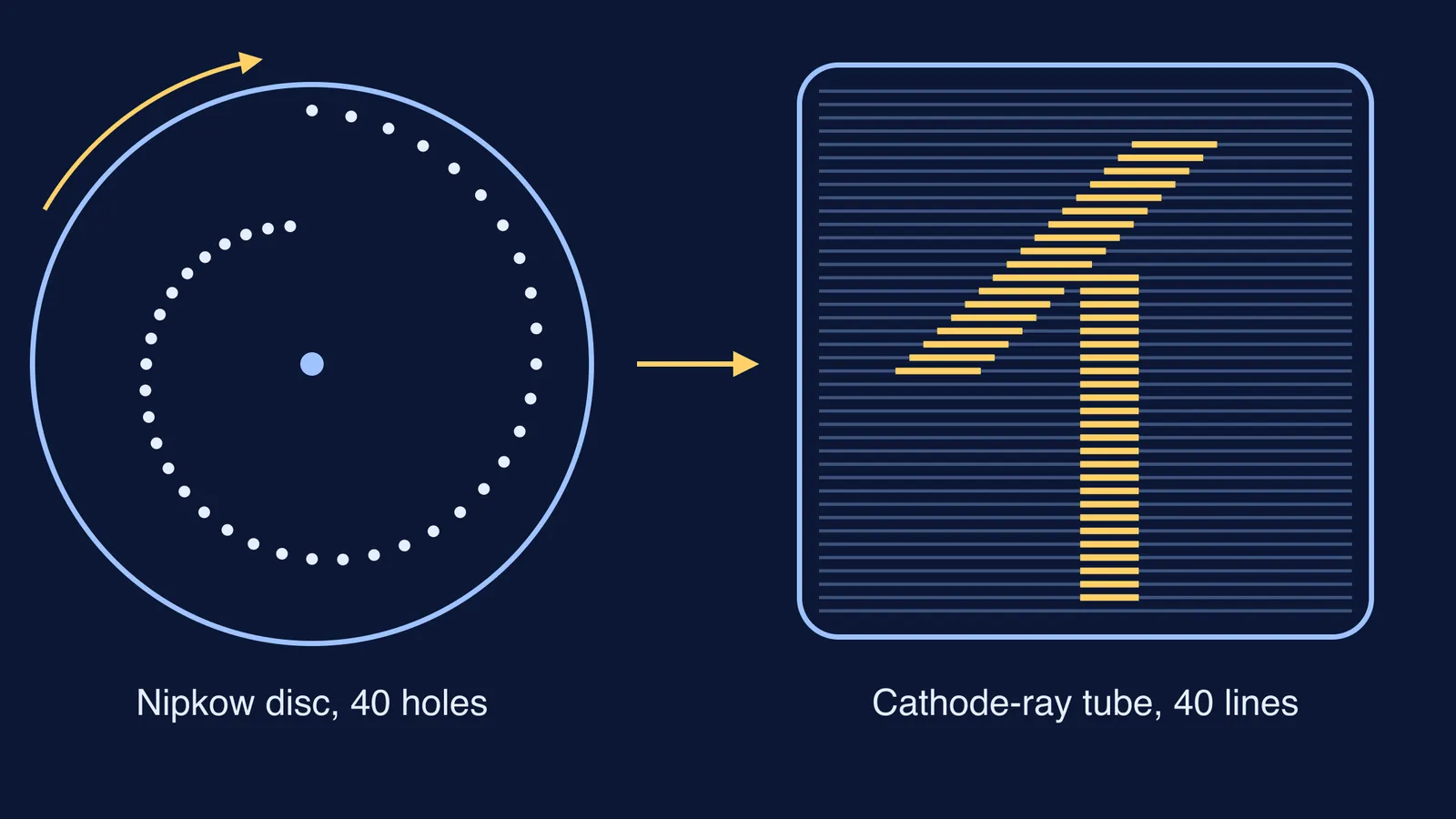
The set-up was half old, half new. A nippon.com profile of Takayanagi describes a mechanical Nipkow disc at the camera end and a Braun tube (an early cathode-ray tube) as the receiver. The tube's screen was about 13 cm across, and it showed 40 scan lines.
The camera was so insensitive that the subject needed very strong light. So Takayanagi wrote イ in ink on a plate of heat-resistant mica, according to the same profile. At first the picture broke up when the disc spun fast. Takayanagi used synchronising pulses, timed to the disc, to steer the tube's electron beam, and the character then showed steadily, at 14 pictures a second.
To see how that tube grew out of 19th-century physics, read our story on Karl Ferdinand Braun and the cathode-ray tube.
How did a 40-line picture of イ work?
A television picture is not sent all at once. It is cut into lines, and each line is sent as a signal that rises and falls with brightness. You can check the speed of Takayanagi's system with the two figures from the nippon.com profile, 40 lines and 14 pictures a second:
Lines per second: 40 lines × 14 pictures = 560 lines every second.
Time for one line: 1 ÷ 560 s, about 1.8 milliseconds for the beam to cross the screen once.
Disc speed: in the simplest Nipkow design, with one hole per line on a spiral, the disc turns once per picture. That means 14 turns a second, or 840 revolutions per minute.
Progress check: the IEEE milestone records 80 lines at 20 pictures a second by 1931, which is 1,600 lines a second. By about 1940, nippon.com reports 441 lines at 25 to 30 pictures a second: up to 13,230 lines a second, more than 23 times the 1926 rate.
Try it on paper. Draw 40 rows on squared paper, shade a large イ, then read each row from left to right as "dark, dark, bright, dark...". That list is your signal. Play it back row by row and the character reappears.
The hard part is steering the beam. In a cathode-ray tube, electric or magnetic fields bend the electron beam to paint each line, the same deflection you meet in Class 12 physics. If that bending is hard to picture, the Fermi Simulation Lab has interactive simulations for ideas that are easier to see than to read.
Was Takayanagi's the first electronic television?
Half of it was. The 1926 receiver was electronic, but the camera still used a spinning disc. In Britain, John Logie Baird built television around mechanical scanning. In the United States, Philo Farnsworth worked on an all-electronic camera tube.
Takayanagi's group closed the gap. The IEEE milestone says he made his first Iconoscope camera tube in October 1935 and showed an all-electronic television system on 12 November 1935. In 1939 his group set up Japan's first television station, and weekly experimental broadcasts began in May 1941 before the war stopped them. The IEEE dedicated the milestone in Hamamatsu on 12 November 2009.
What can you take from Takayanagi's story?
Start with the smallest test that proves the idea. He did not try to send a face. He sent one character.
Fix the weak link you have. A dim camera meant brighter light, and brighter light meant mica instead of paper.
Put numbers on progress. 40 lines in 1926, 80 in 1931, 441 by about 1940: each step can be measured.
Link history to the syllabus. Electron deflection, fields and frequency are all inside this one picture.
If you want to rebuild the physics step by step, Fermi's AI tutor can work out what you already know and build a plan for the session.