On this page
Jørn Utzon, a Danish architect, won the international competition to design the Sydney Opera House, and in 1957 Ove Arup's firm was appointed as its consulting engineers (Arup). The white sails were the hard part. One geometric idea, cutting every shell from the same sphere, turned them into parts a factory could make.
Why was the Sydney Opera House roof so hard to build?
The Opera House's own history of the spherical solution says that in the 1958 designs “each shell was different”, so builders could not reuse formwork. Between 1958 and 1962, Utzon and his team tried parabolic, ellipsoid and finally spherical geometry. Arup says the architect and engineers produced 12 trial schemes before settling on the sphere (Arup).
Michael Lewis, a senior partner at Ove Arup & Partners, explained in a 1973 paper for the Royal Society of New South Wales that the early roof was an elliptical paraboloid “unsuitable for repetitive precasting”. On that surface the tiles would have had to be laid by traditional methods, with a serious risk of tiles falling off.
How did one sphere solve the Opera House shells?
By Utzon's own account, he was stacking the shells of a model in his Hellebæk office when he noticed how alike they looked, and wondered whether all could come from one sphere (Sydney Opera House). His Yellow Book of January 1962 set out the shells, ribs and tiling. Credit is shared: Engineers Australia's obituary of Jack Zunz, Arup's structural designer on the building from 1961, says the final concept was worked out between the architect and Arup.
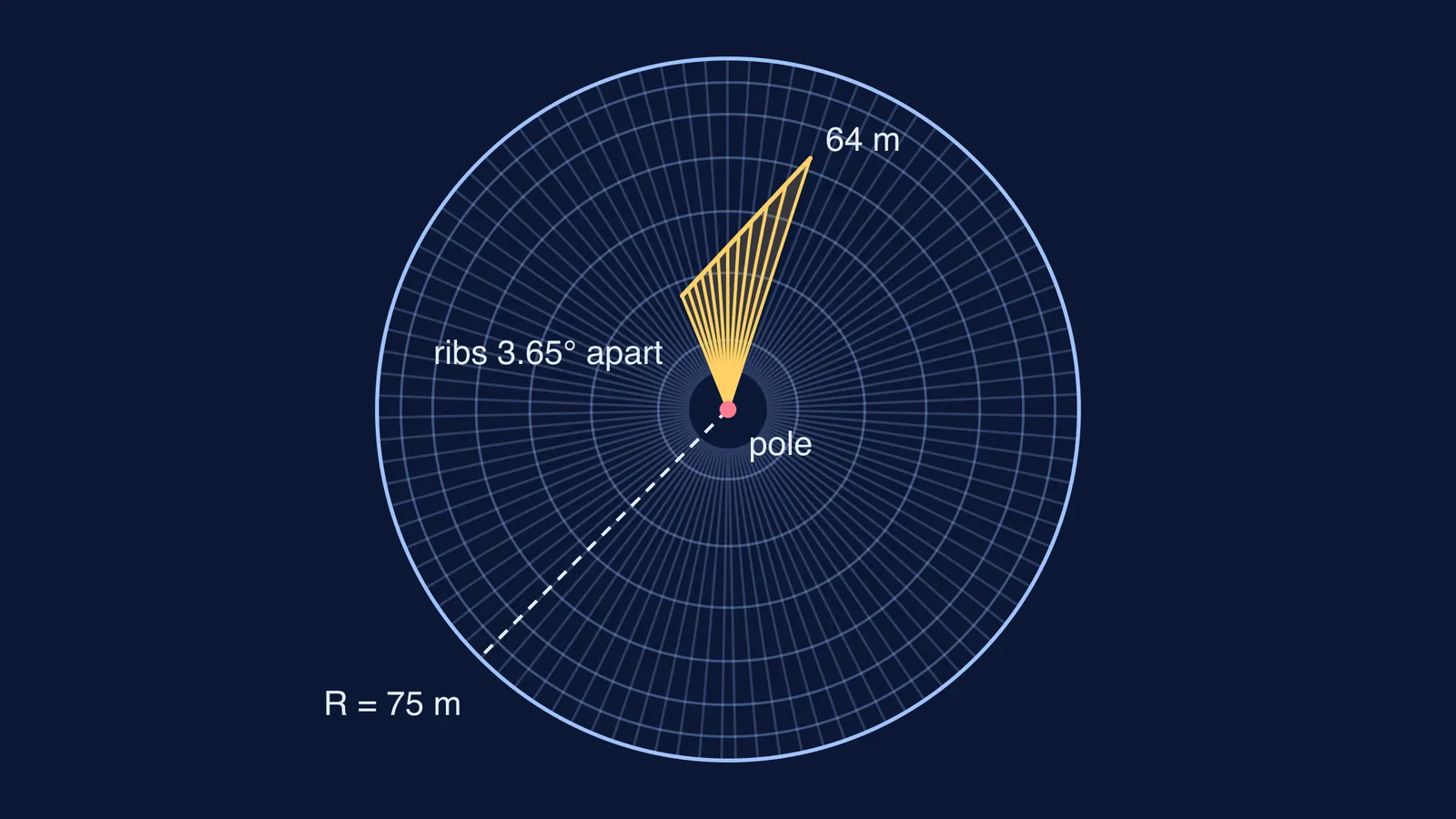
The geometry is set out in Lewis's paper. Each triangle forming the outer surface of a shell is part of a sphere of radius 246 ft (75 m). The centre line of every rib is a great circle of that sphere, the ribs radiate from a common springing point at the podium, and neighbouring centre lines are 3.65° apart. The tallest shell rises 54.6 m, and its longest rib has 13 segments and a centre-line length of 64 m.
Why does a sphere help? As the American Institute of Physics' Inside Science put it, “the only surface that curves in the same way in all directions is a sphere of a given radius.” A piece shaped for one part of the roof fits the curvature anywhere else. The same article counts 1,498 standard rib segments of just 12 types, plus 280 non-standard ones.
Why do the Opera House ribs get wider as they rise?
Lewis's paper notes that the ribs “become wider up the shell”. You can check why with Class 11 maths.
Picture the springing point as the North Pole and the ribs as lines of longitude, which spread apart as they leave the pole. On a sphere of radius R, the gap between two of them at a distance s from the pole, measured along the surface, is R × sin(s/R) × Δθ, with Δθ in radians.
Convert the angle: 3.65° × π/180 = 0.0637 rad.
At s = 10 m: s/R = 0.133 and sin(0.133) = 0.133, so the gap is 75 × 0.133 × 0.0637 = 0.64 m.
At s = 30 m: sin(0.4) = 0.389, so the gap is 75 × 0.389 × 0.0637 = 1.86 m.
At the top of the 64 m rib: s/R = 0.853 rad (about 48.9°) and sin(0.853) = 0.753, so the gap is 3.60 m.
These are our numbers from Lewis's dimensions: about 0.6 m apart near the base, about 3.6 m at the top of the longest rib, and the same rule on every main shell.
If radians or arc length (s = Rθ) feel shaky, the Fermi Concept Library has a lesson for every concept in mathematics.
How can you test the sphere idea at home?
Take a ball and mark a dot as your pole.
With a tailor's tape, draw four lines from the pole, evenly spaced, so neighbours are 90° apart.
Measure the gap between two neighbouring lines at 1 cm, 2 cm and 3 cm from the pole along the surface.
Measure the circumference C, find R = C/2π, and predict each gap with the formula.
Compare with a flat fan, where the gap is s × Δθ. The ball's gaps grow more slowly, because sin(x) < x.
If curved surfaces are hard to picture, the Fermi Simulation Lab has interactive simulations for ideas that are easier to see than to read.
What can students learn from Ove Arup?
Ove Arup said that “engineering problems are under-defined, there are many solutions, good, bad and indifferent. The art is to arrive at a good solution” (Arup). The sphere was a good solution because one added constraint made everything else simpler.
Next, read how Brunelleschi built Florence's dome without centring, test whether an eggshell is strongest at its ends, or check whether a hanging chain is a parabola.
Queen Elizabeth II opened the building on 20 October 1973 (HISTORY). Those sails are pieces of one sphere.