On this page
Otto Warburg was a German biochemist who won the 1931 Nobel Prize in Physiology or Medicine "for his discovery of the nature and mode of action of the respiratory enzyme" (Nobel Prize). We told that story in Otto Warburg and the iron enzyme that lets cells use oxygen. This post is about his other famous finding, about cancer.
What is the Warburg effect in cancer cells?
Cells can get energy from glucose in two ways. In respiration, glucose is burned completely to carbon dioxide and water using oxygen. In fermentation, glucose is split into lactic acid (lactate) without oxygen.
The Warburg effect is the tendency of cancer cells to "ferment" glucose into lactate even when there is enough oxygen for mitochondrial respiration, as a 2009 review in Science describes it (Vander Heiden, Cantley and Thompson, 2009). Biologists also call it aerobic glycolysis.
That is odd, because fermentation is wasteful. The same review notes that turning one glucose molecule into lactate yields only 2 ATP, while complete oxidation in mitochondria yields up to 36 ATP (Science, 2009). If the first number needs a refresher, see why net ATP from glycolysis is two.
What did Warburg actually measure?
In a 1927 paper, Warburg, Franz Wind and Erwin Negelein measured glucose and lactic acid in the blood flowing into and out of tumours in living rats (Journal of General Physiology, 1927). They used transplanted Jensen sarcoma, and compared arterial blood from the aorta with dark blood from veins leaving the tumour.
Their results were stark:
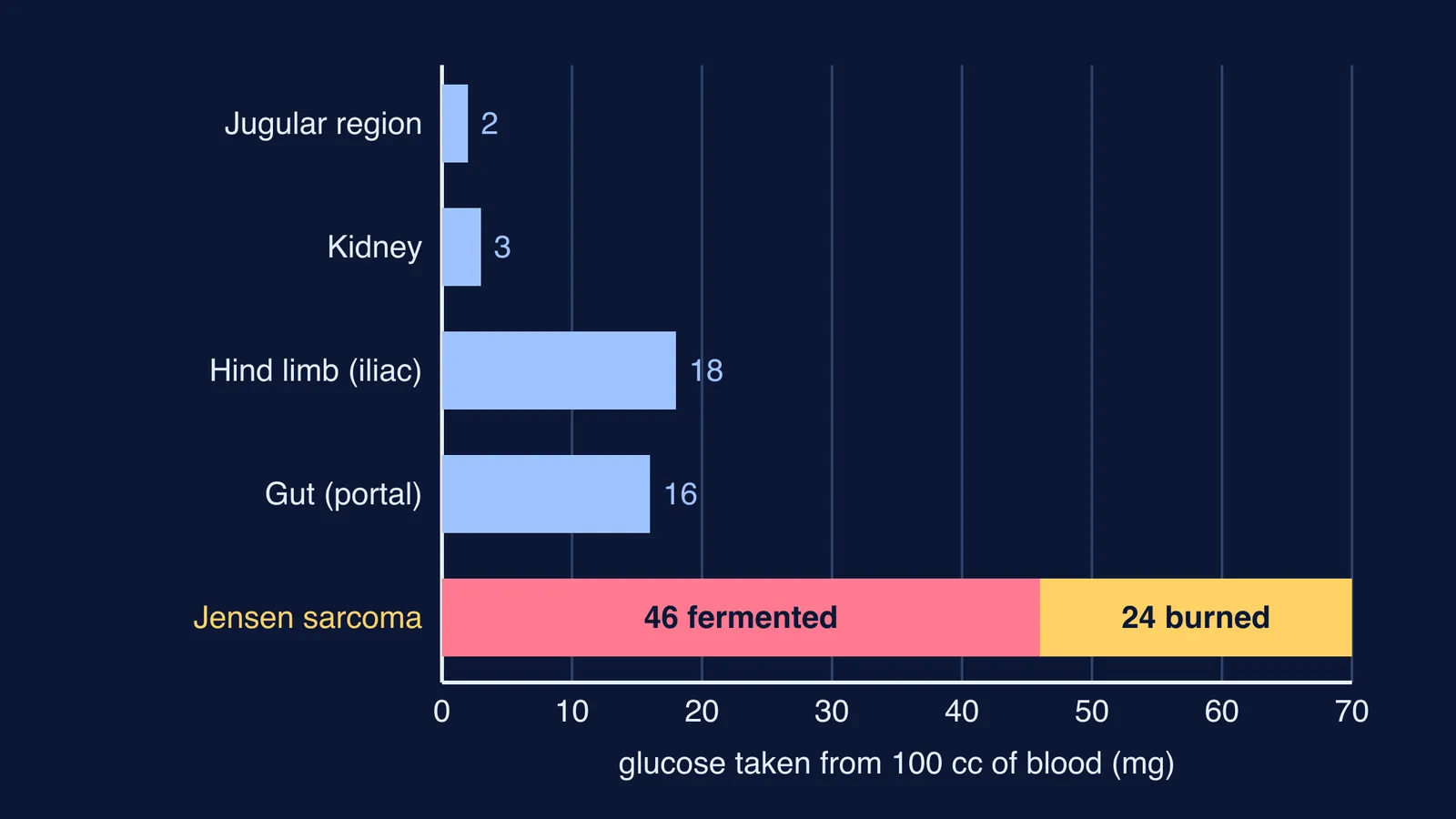
On average, the tumour took 70 mg of glucose out of every 100 cc of blood. In Table I, the normal tissues they sampled took between 2 and 18 mg.
The tumour returned 46 mg of lactic acid to the same 100 cc of blood. Normal organs added no lactic acid; some removed it.
From those two numbers they estimated that 66 per cent of the glucose the tumour used went into fermentation, and the rest into respiration.
Where does the 66 per cent come from? A worked example
You can check the paper's arithmetic with Class 11 chemistry, using its numbers (J Gen Physiol, 1927) and the ATP yields from the review (Science, 2009).
Fermentation: C6H12O6 → 2 C3H6O3. Glucose is 180 g/mol and lactic acid 90 g/mol, so 180 g of glucose gives exactly 180 g of lactic acid.
So 46 mg of lactic acid came from 46 mg of glucose: 46 ÷ 70 ≈ 0.66, or 66 per cent fermented.
The other 70 − 46 = 24 mg was respired.
Now count ATP. Fermented: 46 ÷ 180 ≈ 0.26 mmol glucose × 2 ATP ≈ 0.5 mmol ATP.
Respired: 24 ÷ 180 ≈ 0.13 mmol glucose × up to 36 ATP ≈ 4.8 mmol ATP.
This is a rough upper estimate, but it holds a surprise: even with two-thirds of the glucose fermented, respiration could still have supplied most of the tumour's ATP.
Why would cancer cells waste glucose?
Warburg thought cancer cells had damaged mitochondria, but later work showed that mitochondrial function is not impaired in most cancer cells (Vander Heiden et al., 2009). The review offers another answer: a dividing cell needs more than energy. It needs nucleotides, amino acids and lipids to build a new cell, so glucose is raw material as well as fuel. The review notes that normal fast-dividing tissues share this property, and argues that it is tied to growth, not to cancer alone. The same review describes tumour glucose uptake being measured with FDG-PET scans, which track a glucose look-alike tagged with fluorine-18.
Warburg's team also tested an obvious idea: starve the tumour of sugar. They found that pieces of tumour kept in glucose-free serum with oxygen survived on respiration alone, and argued that even if blood sugar could be removed entirely in living animals, the tumour's life would not be threatened (J Gen Physiol, 1927).
How do you write about it in an exam?
A checklist for a Class 12 biology or NEET-UG answer:
Definition in one line: cancer cells ferment glucose to lactate even when oxygen is available.
The contrast: 2 ATP per glucose from fermentation against up to 36 from full oxidation (Vander Heiden et al., 2009). Use the total your textbook gives.
Who and when: Otto Warburg, with experiments on rat tumours in the 1920s.
Trap 1: it is not anaerobic respiration, because oxygen is present.
Trap 2: mitochondria still work in most cancer cells.
For the wider syllabus picture, read our guide to cancer biology for NEET.
If the steps from glucose to pyruvate to lactate are still blurry, the Fermi Concept Library gives every concept in biology its own lesson and its place in the map, so you can see how glycolysis connects to fermentation.
Next time you see a respiration diagram, ask Warburg's question: where does the glucose go when oxygen is right there?