On this page
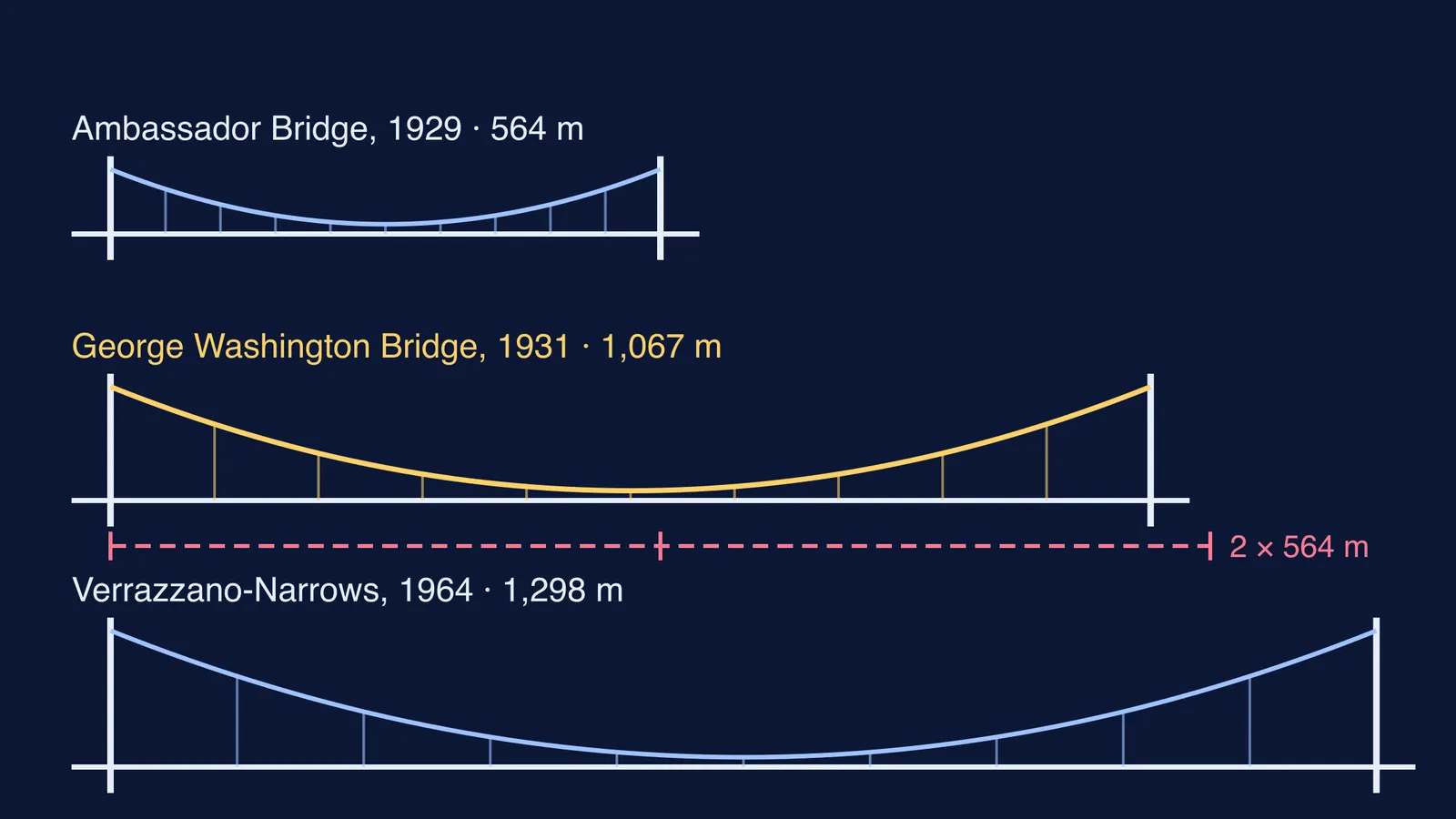
On 25 October 1931, the George Washington Bridge opened to traffic across the Hudson River between New York City and Fort Lee, New Jersey (George Washington Bridge), with Swiss-born Othmar Ammann as chief engineer (Linda Hall Library). Its main span of 3,500 feet, about 1,067 metres, was nearly double that of any earlier suspension bridge, according to the American Society of Civil Engineers. The better story is the physics: how do you make a span that long light enough to build and stiff enough to stand?
How long is the George Washington Bridge's main span?
The main span is 3,500 feet (about 1,067 m) between the two towers (ASCE). The record it broke belonged to Detroit's Ambassador Bridge, whose 1,850-foot (564 m) span opened on 15 November 1929 (Ambassador Bridge). Since 3,500 ÷ 1,850 ≈ 1.89, “nearly double” is the honest phrase.
A few more numbers, from the George Washington Bridge entry:
Each tower stands 604 feet (184 m) tall.
Four main cables, each about 3 feet (0.91 m) across, hold 26,474 wires apiece.
The upper deck carries eight lanes; a lower deck opened on 29 August 1962.
Traffic studies before opening predicted eight million vehicles a year by 1931; today the count is about 110 million a year, reports STRUCTURE magazine.
Who was Othmar Ammann?
Ammann was born on 26 March 1879 in Feuerthalen, Switzerland, and died on 22 September 1965 in Rye, New York (Othmar Ammann). He graduated from the Swiss Federal Institute of Technology in Zurich in 1902, where one of his professors was Wilhelm Ritter, and moved to New York in 1904 (STRUCTURE).
He worked under Gustav Lindenthal on the Hell Gate Bridge, then pushed a lighter, cheaper suspension design for the Hudson that the Port Authority adopted (Linda Hall Library). Ammann went on to the Verrazzano-Narrows Bridge, which opened in 1964 with a 4,260-foot (1,298 m) span, a record again (Othmar Ammann). If you have read about John Roebling's wire rope and the Brooklyn Bridge, Ammann is the next chapter of that story.
How did Ammann make such a long span work?
A suspension bridge deck sits on a stiffening truss. The standard proportion until then, used on shorter long-span bridges, made the truss 1/60 of the span deep; Ammann chose 1/350 (STRUCTURE). Ritter, his professor, taught Claude Navier's 1823 observation that the heavier and longer a suspended span, the less extra stiffness its deck needs.
ASCE says Ammann's stiffening system cut costs by about $10 million (ASCE). The bridge was still allowed to move, by up to five feet sideways and ten feet vertically at mid-span under traffic and heat (STRUCTURE).
Weight helps against traffic, but slender decks must also be checked against wind. After the Tacoma Narrows Bridge failed, Ammann co-wrote the 1941 report “The Failure of the Tacoma Narrows Bridge” with Theodore von Kármán and Glenn B. Woodruff (Othmar Ammann).
What happens to cable tension when you double the span?
Here is a worked example you can do with Class 11 statics. Take a cable carrying a uniform load w (newtons per metre of span) across a span L, with sag d.
Cut the cable at its lowest point. There the tension is horizontal; call it H.
Take moments about the tower top for one half. The load on it is wL/2, acting L/4 from the tower, so H × d = (wL/2) × (L/4).
Rearrange: H = wL²/(8d).
Keep the shape fixed, say a sag of one-tenth of the span (d = L/10). Then H = 1.25 wL.
Use the two spans from ASCE and the Ambassador Bridge entry: 1.25 × 564 ≈ 705 w for 1929, and 1.25 × 1,067 ≈ 1,334 w for 1931.
Same load per metre, same shape, and the horizontal pull is 1.89 times larger. Each cable needs about 1.89 times the cross-section of steel over nearly twice the length, which adds weight, which raises w. That loop is why every tonne Ammann left out of the deck, with its 1/350 depth ratio (STRUCTURE), mattered.
The parabola in step 3 assumes the load is spread evenly along the span. A chain hanging under its own weight alone makes a slightly different curve, which you can compare in is a hanging chain a parabola?. If curves like these make more sense when you can move them, the Fermi Simulation Lab has interactive simulations for ideas that are easier to see than to read. For practice, the Fermi Problem Library has worked problems with a step-by-step solver that explains the reasoning rather than printing an answer.
What can students take from Ammann's bridge?
Compare ratios, not just sizes: 1/350 against 1/60 tells you more than “thin deck”.
Name the assumption behind every formula, like the even load behind the parabola.
Test the maths against reality: design adviser Leon Moisseiff tested a large model of the towers to confirm the mathematical analyses (STRUCTURE).
For the next great span on the other coast, read how Joseph Strauss engineered the Golden Gate Bridge for safety.