

On this page
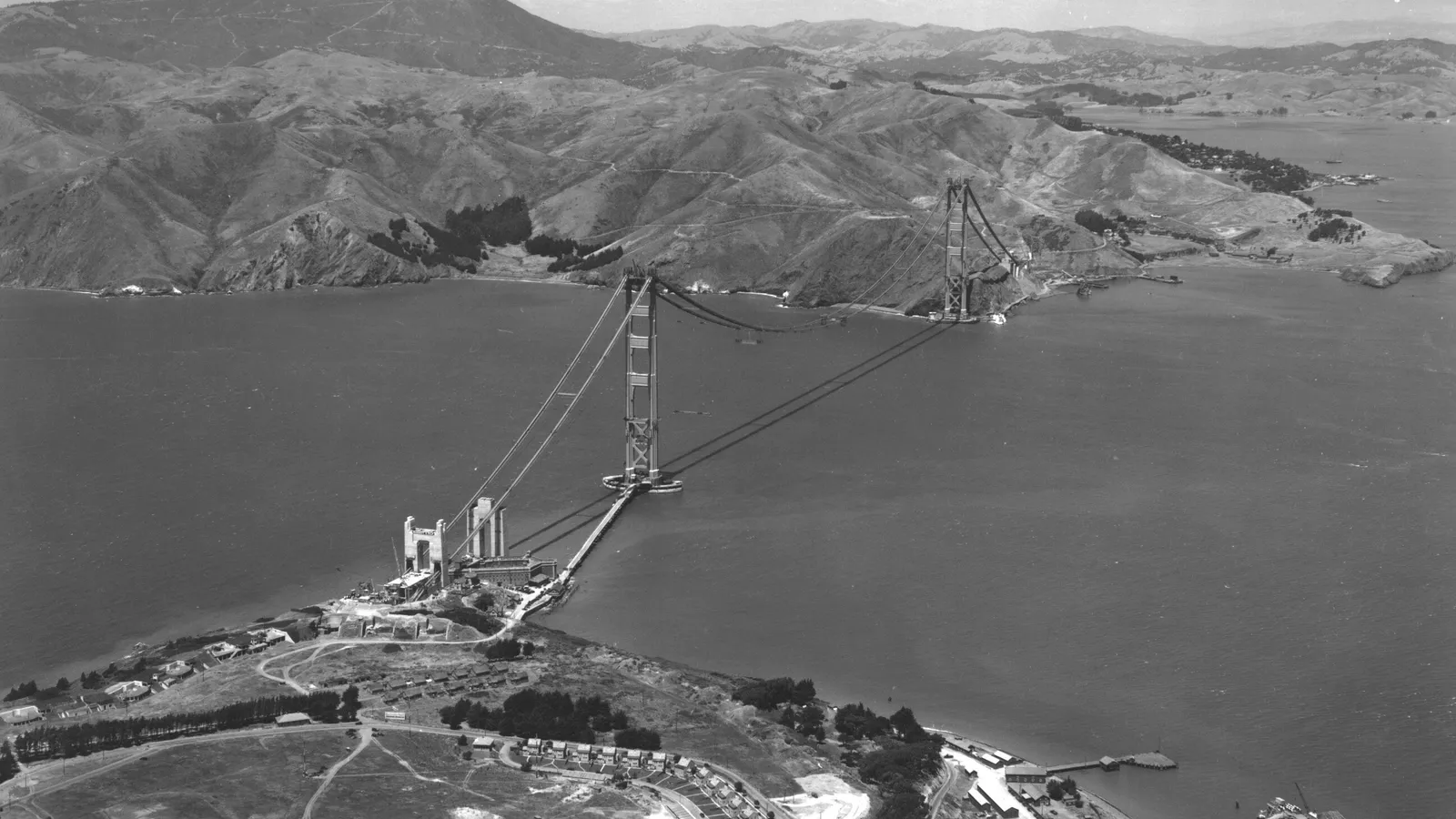
In the middle of the Great Depression, a team led by chief engineer Joseph Strauss hung a road across the mouth of San Francisco Bay. When it opened in 1937, its main span was the longest in the world. Strauss also protected the people building it: he put a net under them and hard hats on their heads.
Who was Joseph Strauss?
According to the Golden Gate Bridge district's profile of Strauss, Joseph Baermann Strauss was born in Cincinnati, Ohio, in 1870 and is credited with building more than 400 bridges. He was also a prolific inventor, and he led the Golden Gate project as chief engineer.
He did not design the bridge alone. The same district page says Leon Moisseiff suggested the suspension span concept, Charles Ellis, Strauss's design engineer, deserves significant credit for the design, and consulting architect Irving Morrow shaped its look, including the colour. Strauss died in May 1938, a year after the opening.
How was the Golden Gate Bridge engineered?
It is a suspension bridge. Two towers carry two main cables, and vertical suspender cables hang the road from them. The weight of the deck pulls the cables into a curve, and the cables pass that pull to the towers and the anchorages on shore.
The district's design and construction statistics give the key numbers:
The main span, the distance between the towers, is 4,200 feet (1,280 m).
Each tower rises 746 feet (227 m) above the water.
Each main cable is 36 3/8 inches (0.92 m) across and holds 27,572 galvanised steel wires.
The wire in both main cables adds up to 80,000 miles (129,000 km).
The load on each tower from the main cables is 61,500 tons.
The American Society of Civil Engineers lists the bridge as a civil engineering landmark and notes it was the longest single span in the world at the time it was built.
If you have read about John Roebling's wire rope and the Brooklyn Bridge, you will recognise the idea: thousands of thin wires bundled into one cable.
What safety measures did Strauss use on the Golden Gate Bridge?
The district's construction history says Strauss insisted on a rigid safety code.
Hard hats. Edward W. Bullard adapted a mining helmet he had developed into an industrial hard hat, and Strauss insisted it be worn on the job.
A safety net. A net of manila rope, 3/8 inch in diameter with a 6-inch square mesh, hung under the bridge floor and reached ten feet beyond the trusses on each side.
The same page records that the net saved 19 men, who called themselves the Halfway-to-Hell Club. PBS American Experience says Strauss invested over $130,000 in the net.
It did not save everyone. Eleven men died during construction, and ten of them were killed on 17 February 1937, when a section of scaffold fell through the net, according to the district's history. The bridge opened to pedestrians on 27 May 1937 and to cars the next day, according to the district's account of opening week.
Why does a safety net save lives?
The net does not make a fall shorter. It makes the stop longer, and that is what matters. Try it with made-up numbers.
A 75 kg worker falls 10 m. Speed on reaching the net: v = √(2gh) = √(2 × 9.8 × 10) ≈ 14 m/s.
The net stretches and stops them over 1.5 m. Average deceleration: a = v² ÷ 2s = 196 ÷ 3 ≈ 65 m/s², about 7 g.
Now stop the same body over 5 cm, like hitting steel. a = 196 ÷ 0.1 = 1,960 m/s², about 200 g.
Same speed, same change in momentum. Stretching the stopping distance 30 times cuts the average deceleration, and so the average stopping force on the body, by about 30 times. A hard hat's inner suspension works on the same principle: it adds a little distance and time to the stop, so the force reaching your head is smaller.
If impulse and stopping distance feel abstract, the Fermi Simulation Lab has interactive simulations for ideas that are easier to see than to read. For practice, the Fermi Problem Library has worked problems with a step-by-step solver that explains the reasoning rather than printing an answer.
What can students learn from Strauss?
You are not building bridges yet, but you can borrow his habit of planning for failure before it happens. Before any big project, lab or exam season, ask:
What is the most likely way this goes wrong?
What is my net? A backup plan, saved files, a revision buffer.
What is my hard hat? A small habit that protects you every day, such as reading a question twice.
Who else did the work? Strauss's story is also about credit: name your teammates.
Other inventors thought this way too. Read how Humphry Davy's safety lamp protected coal miners and how Elisha Otis built an elevator that would not fall.


