

On this page
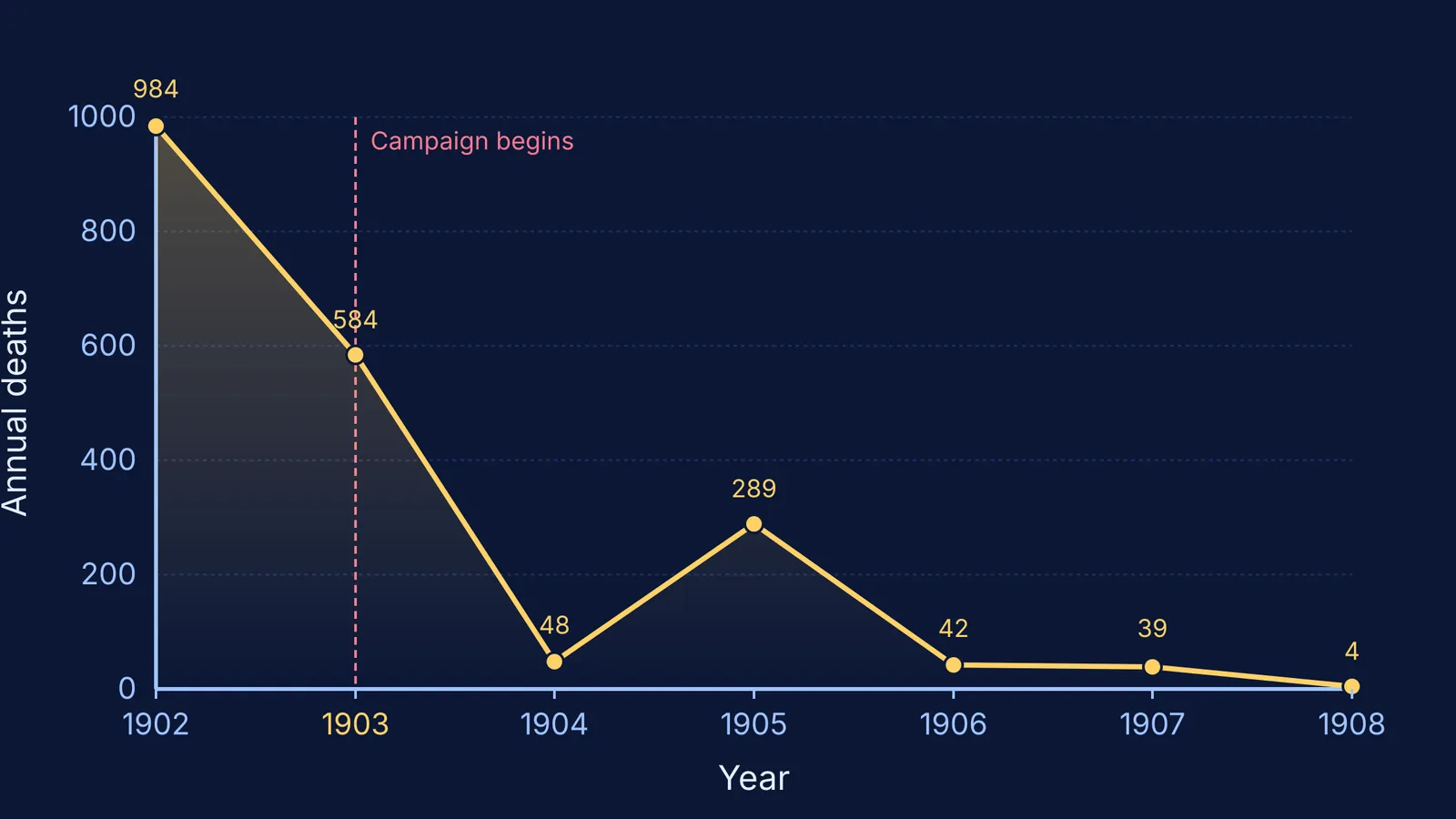
In the late nineteenth century, Rio de Janeiro carried a grim international reputation as the "foreigner's grave." European sailors and immigrants arriving in Brazil encountered annual outbreaks of yellow fever that claimed thousands of lives. According to historical records preserved by the Fundação Oswaldo Cruz, 984 people died of yellow fever in Rio de Janeiro in 1902 alone. Foreign merchant vessels frequently bypassed Guanabara Bay to avoid quarantine, threatening the economic life of the young republic.
At the time, medical consensus attributed yellow fever to miasma: poisonous vapours arising from rotting organic matter and humid soil. Sanitation squads washed streets with carbolic acid, fumigated clothing, and burned tar in public squares to purify the air. These measures failed because they ignored the biological mechanism of infection. While authorities targeted foul odours, mosquitoes continued breeding inside residential cisterns and rain barrels.
Why was Rio de Janeiro called the foreigner's grave?
Yellow fever hit newcomers hardest because long-time residents often acquired immunity during childhood. When non-immune immigrants disembarked at the port, they entered an urban environment teeming with standing water. Miasma theory led doctors to treat the disease as contagious through touch or bad air, diverting resources away from true environmental vectors. Understanding how pathogens spread across populations is essential for grasping epidemic control, as seen in the study of viruses and infectious transmission cycles.
In March 1903, Brazilian President Francisco de Paula Rodrigues Alves appointed 30-year-old physician Oswaldo Cruz as Director General of Public Health. Cruz had spent two years researching microbiology at the Institut Pasteur in Paris from 1897 to 1899, as detailed by Daniel-Ribeiro and Lima (2020). He brought back a rigorous conviction: yellow fever was not caused by toxic air, but was transmitted between humans by a specific mosquito vector, *Stegomyia fasciata* (now classified as *Aedes aegypti*).
Cruz drew on Carlos Finlay's vector hypothesis, which Walter Reed's commission had confirmed in Havana in 1900. If transmission required a mosquito bite, stopping yellow fever did not require purifying the atmosphere of an entire metropolis. It required severing the vector chain.
How did the mata-mosquitos brigades stop yellow fever?
In April 1903, Cruz created the Yellow Fever Prophylaxis Service. Although he calculated that thorough sanitisation required 1,200 inspectors, he launched operations with an initial corps of just 85 men (Daniel-Ribeiro and Lima, 2020). Cruz divided Rio de Janeiro into ten sanitary districts and deployed mobile brigades popularly named the *mata-mosquitos* (mosquito killers).
The brigades executed a coordinated vector suppression protocol:
Larval eradication: Inspectors visited houses daily to inspect cisterns, empty containers, and seal water tanks with fine wire mesh. Water deposits that could not be drained were covered with a thin film of petroleum to suffocate developing larvae.
Adult mosquito fumigation: When a yellow fever case was detected, teams sealed the residence with muslin cloth and burned pyrethrum powder and sulfur to kill adult mosquitoes resting indoors.
Viremic host isolation: Because yellow fever has an incubation period of 3 to 6 days and patients transmit the virus to mosquitoes during the early symptomatic stage (PAHO/WHO, 2024), patients were isolated in screened sickrooms or at São Sebastião Hospital under mosquito netting.
The campaign faced severe resistance. Hostile newspapers published cartoons depicting Cruz as an authoritarian tyrant wielding giant syringes. Tensions culminated in November 1904 during the Vaccine Revolt (*Revolta da Vacina*), a violent uprising sparked by mandatory smallpox vaccination and sanitary home inspections.
Despite public unrest, Cruz maintained the vector control programme. The epidemiological numbers validated his strategy: yellow fever deaths in Rio dropped to 48 in 1904. Following a temporary rebound to 289 deaths in 1905, fatalities fell to 42 in 1906 and 39 in 1907 (Fiocruz, 2024). In March 1907, Cruz reported to the president that yellow fever was no longer epidemic in the capital. Six months later, the XIV International Congress of Hygiene and Demography in Berlin awarded Cruz its gold medal. His institutional foundation in Rio subsequently trained figures like Carlos Chagas and his work on insect vectors, and paved the way for later breakthroughs such as Max Theiler's 17D yellow fever vaccine.
What can students learn from vector control models?
For biology students, Oswaldo Cruz's Rio campaign demonstrates how ecological dynamics govern disease transmission. You can analyze any vector-borne disease through a four-part barrier checklist:
Source reduction: Eliminate larval microhabitats by clearing water receptacles or applying biological controls.
Adult suppression: Target adult vectors during the extrinsic incubation period before they can pass the pathogen.
Transmission barriers: Use physical barriers such as bed nets and window screens to keep vectors away from hosts.
Active surveillance: Map case clusters to deploy targeted interventions before an outbreak expands exponentially.
Connecting pathogen lifecycles to ecological interventions requires rigorous conceptual foundations. The Fermi Concept Library covers every concept in physics, chemistry, biology, mathematics and computing, each with its own lesson and its place in the map. When working through complex transmission problems or multi-step biology questions, Fermi's AI tutor works out what you already know and builds a plan for the session to guide your reasoning step by step. For ideas where dynamic feedback is easier to see than to read, the Fermi Simulation Lab provides interactive simulations that illustrate how changes in vector populations alter infection curves.


