On this page
In 1959, an aviation engineer named Nils Bohlin changed how we drive. Working as Volvo's first chief safety engineer, he invented the three-point seat belt. Before this, cars had lap belts, which often caused severe internal injuries during a crash. Bohlin's design was simple enough to buckle with one hand, but it relied on a profound understanding of physics and human anatomy.
In an unusual move for the automotive industry, Volvo left the patent open. They decided that the invention was too important to keep as a competitive secret, allowing any car manufacturer in the world to use it for free.
Why did earlier seat belts fail?
Before 1959, the most common safety restraint was the two-point lap belt. It fastened across the stomach, much like a modern aeroplane seat belt.
When a car stops abruptly, Newton's first law of motion dictates that the passengers continue moving forward at the car's original speed (similar to how an astronaut moving in space continues moving until acted upon by an external force). The job of a seat belt is to provide an opposing force to stop the body.
The problem with the lap belt was where it applied this force. It sat high on the abdomen, a soft area containing vital organs. During a sudden stop, the body would fold in half over the belt, and passengers would often slide underneath it in a phenomenon known as "submarining". The concentrated force caused severe internal trauma.
How does the three-point seat belt spread crash forces?
Bohlin previously worked on aircraft ejection seats at Saab, so he understood how the human body handles extreme deceleration. He knew that to survive a crash, the restraining force had to be applied to the strongest parts of the skeleton: the pelvis and the ribcage.
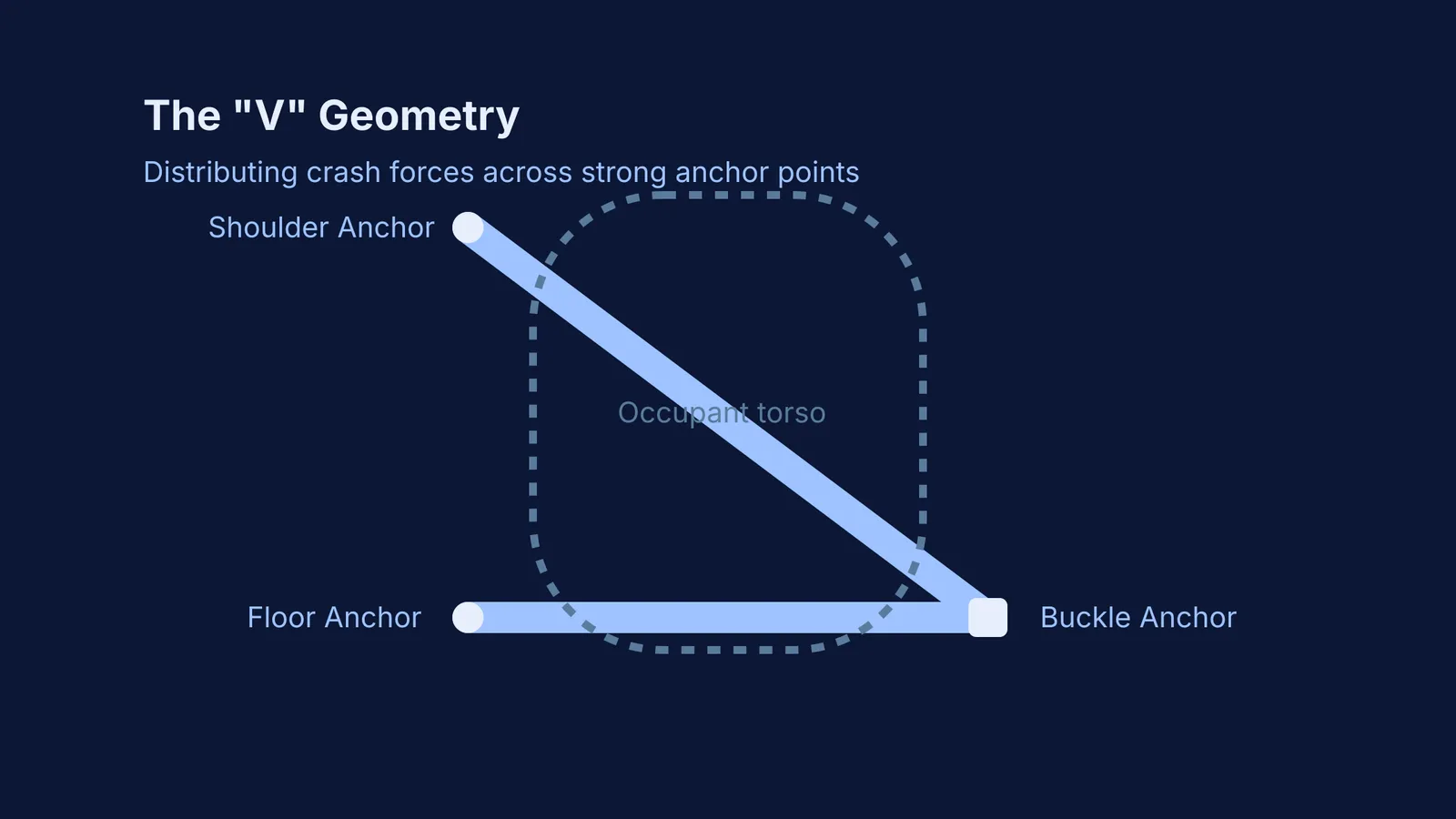
His three-point design consists of a continuous strap forming a "V" shape, anchored at three fixed points to the car's structure.
The Lap Portion: This strap rests low across the iliac crests of the pelvis. The pelvis is the strongest bone structure in the human body, capable of absorbing massive amounts of energy without fracturing. Because it sits low, it prevents the occupant from submarining under the belt.
The Diagonal Portion: This strap crosses the sternum and the ribcage. It stops the upper body from pitching forward, protecting the head and chest from hitting the dashboard. By crossing diagonally, it spreads the stopping force over a wide surface area of the ribs and collarbone, much like resolving a heavy load into smaller components—a concept you can practice with vector addition simulations.
By extending the time it takes the body to stop, the seat belt reduces the peak force exerted on the organs. Modern belts also stretch slightly to further cushion the impact. If you are studying these mechanical principles for your exams and struggle to visualise how forces balance out, the Fermi Simulation Lab lets you run physics experiments to see inertia and deceleration in action.
Volvo's open patent and the 1967 study
Bohlin filed for a U.S. patent on August 17, 1959, which was granted as U.S. Patent No. 3,043,625. However, Volvo management recognised that the design was a matter of life and death. They released the patent rights, making the three-point seat belt available to all competitors.
Despite the open patent, public adoption was slow. People found seat belts uncomfortable and doubted their value. To prove the invention worked, Bohlin conducted a massive study.
In 1967, he published "A Statistical Analysis of 28,000 Accident Cases with Emphasis on Occupant Restraint Value". The study analysed exactly 28,000 traffic accidents involving Volvos in Sweden over a single year. The results were undeniable: no belted occupant was fatally injured in crashes at speeds below 60 mph (provided the passenger compartment remained intact). In contrast, unbelted passengers sustained fatal injuries at much lower speeds.
This rigorous statistical proof convinced lawmakers. By 1968, the United States mandated three-point seat belts in all new cars, setting a global standard that remains today.
A checklist for seat belt safety
When your teenager starts driving, teaching them the physics of seat belts can reinforce why wearing them properly matters. Use this quick checklist:
Check the lap belt: It must sit low and tight across the hips (pelvis), never across the soft stomach.
Check the shoulder belt: It should cross the centre of the chest (sternum) and rest on the shoulder, not rubbing against the neck or tucked under the arm.
Listen for the click: Ensure the buckle is fully engaged at the low anchor point.
Sit upright: Reclining the seat creates a gap between the belt and the body, increasing the stopping distance and the risk of sliding under the lap belt.