

On this page
Hang a weight on a string and it points to the centre of the Earth. Almost. In 1774 Nevil Maskelyne showed that a mountain beside the string tugs it sideways by a tiny, measurable angle, and used that angle to estimate how dense the whole planet is.
What did Maskelyne do on Schiehallion in 1774?
Maskelyne had been Astronomer Royal since 26 February 1765, and he carried out the experiment on Schiehallion in Perthshire in 1774, according to the MacTutor biography from the University of St Andrews. The same biography notes that Bouguer and La Condamine had attempted it more than 30 years earlier, and Bouguer downplayed the 8-arcsecond deflection they saw on Chimborazo.
Maskelyne's own report in the Philosophical Transactions of the Royal Society (1775) explains the choice of mountain. In the MacTutor transcription of that report, he describes a hill "of sufficient height, tolerably detached from other hills, and considerably larger from east to west than from north to south".
His instrument was a zenith sector. As a 2018 paper in History of Geo- and Space Sciences describes it, the telescope pointed straight up, its direction referenced to a plumb line, so Maskelyne could measure the angle between stars and the point directly overhead.
How does a mountain pull a plumb line?
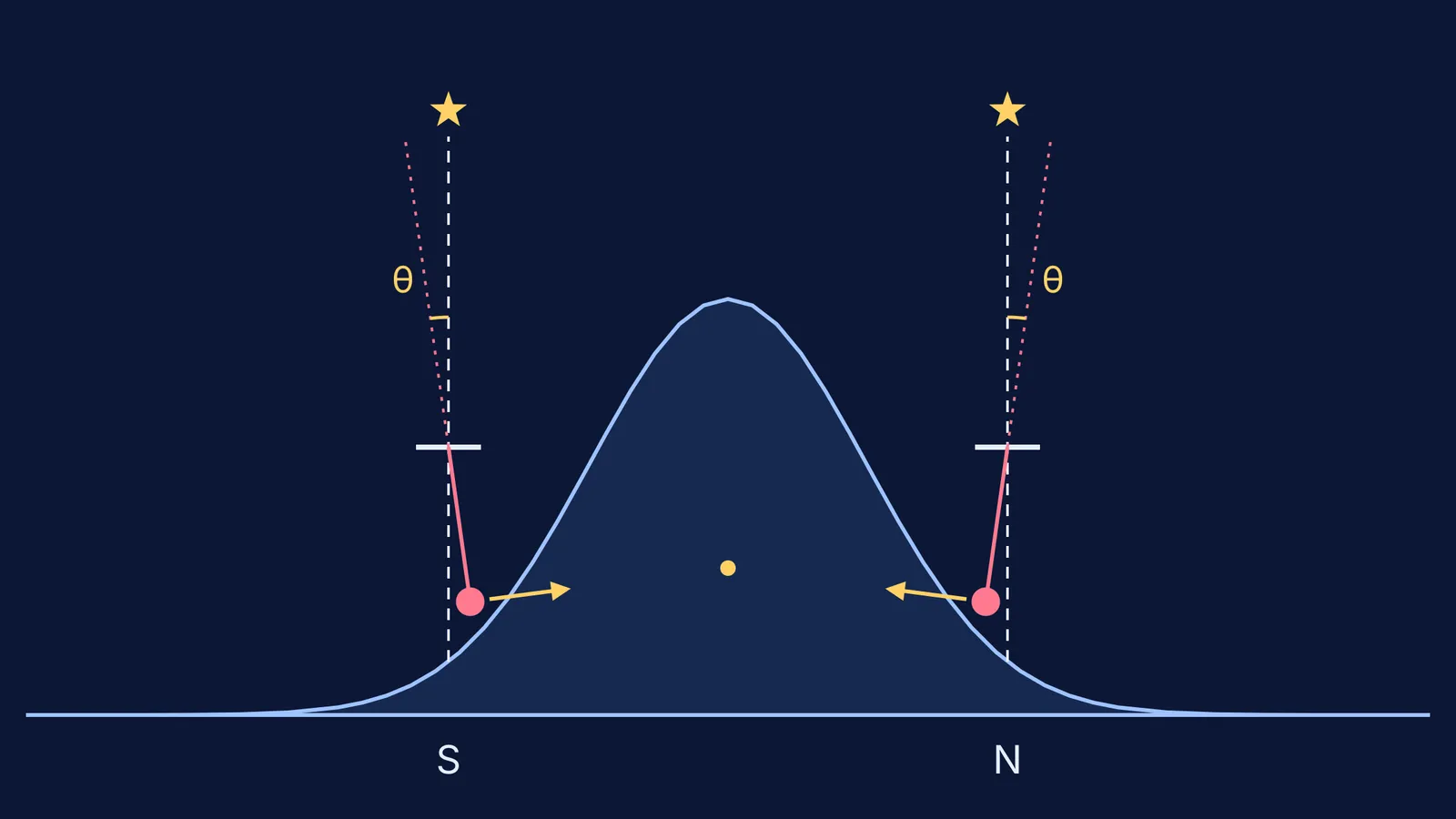
By Newton's inverse-square law of gravity, the mountain attracts the bob. At the south station the bob leans slightly north; at the north station it leans south. Each tilt shifts the apparent overhead point away from the mountain, so latitudes measured from the stars put the two stations further apart than the ground survey does.
In the transcribed 1775 report, the star sightings put the stations 54.6 arcseconds apart in latitude, while the survey gave only 42.94 arcseconds. He wrote that the 11.6-arcsecond difference "is to be attributed to the sum of the 2 contrary attractions of the hill".
As the 2018 paper notes, 11.6 arcseconds is just 0.00322 degrees. That is roughly the angle a 1 mm pencil lead makes when you look at it from 18 metres away.
What did the experiment find about Earth's density?
A survey of the mountain's shape ran from 1774 to 1776 under Maskelyne's direction, and Charles Hutton turned it into a density calculation published in 1778 in the Philosophical Transactions. According to the 2018 paper, Hutton reported a mean Earth density of 4,500 kg per cubic metre, revised it to 4,950 kg per cubic metre in 1821, and today's accepted value is 5,515 kg per cubic metre.
The 1775 report says the mean density of the Earth is "at least double of that at the surface", so the planet's interior must be far denser than its rocks. Hutton's work left another legacy: a 2019 study in the Journal of Maps argues his Schiehallion map may be among the first accurate contour maps.
Can you redo the calculation yourself?
Yes, if you treat the hill as a uniform sphere of radius r and density ρm, with the bob beside it at distance r from its centre. Earth has radius R and mean density ρE.
Sideways pull of the hill: gh = G(4/3)πr³ρm ÷ r² = (4/3)πGρm r
Downward pull of the Earth: g = (4/3)πGρE R
Tilt of the plumb line: θ ≈ gh ÷ g = (ρm ÷ ρE)(r ÷ R)
G cancels, which is why the experiment gives a density ratio without knowing G. Take Earth's radius as 6,371 km from the NASA Earth fact sheet, r = 500 m, and a ratio of one half, as Maskelyne's "at least double" implies. Then θ = 0.5 × 500 ÷ 6,371,000 = 3.9 × 10⁻⁵ radians, or about 8 arcseconds. Two stations give about 16 arcseconds, the same order of magnitude as the 11.6 he measured, according to the 1775 report. A real ridge is not a ball, which is why a detailed survey was needed.
Now run it backwards: G = 3g ÷ (4πρE R). With NASA's g = 9.820 m/s² and mean density 5,513 kg per cubic metre, G comes out at 6.67 × 10⁻¹¹ N m² kg⁻². Put in Hutton's 4,500 from the 2018 paper instead and you get 8.2 × 10⁻¹¹, more than 20% too high. See also how to find the density of Earth from g and its radius and the difference between small g and big G.
How can you use this in gravitation problems?
The same method works for ratio questions:
Write both forces in the same form before dividing, so G and π cancel.
Convert the angle from radians to arcseconds before comparing it with a measured tilt.
Use tan θ ≈ θ only for small angles.
Ask what was actually measured: Maskelyne measured angles, not masses.
If the tilting plumb line is hard to picture, the Fermi Simulation Lab has interactive simulations for ideas that are easier to see than to read. To practise ratio problems like this one, the Fermi Problem Library has worked problems with a step-by-step solver that explains the reasoning rather than printing an answer.
A nudge far too small to see by eye was enough to estimate the density of a whole planet.


