

On this page
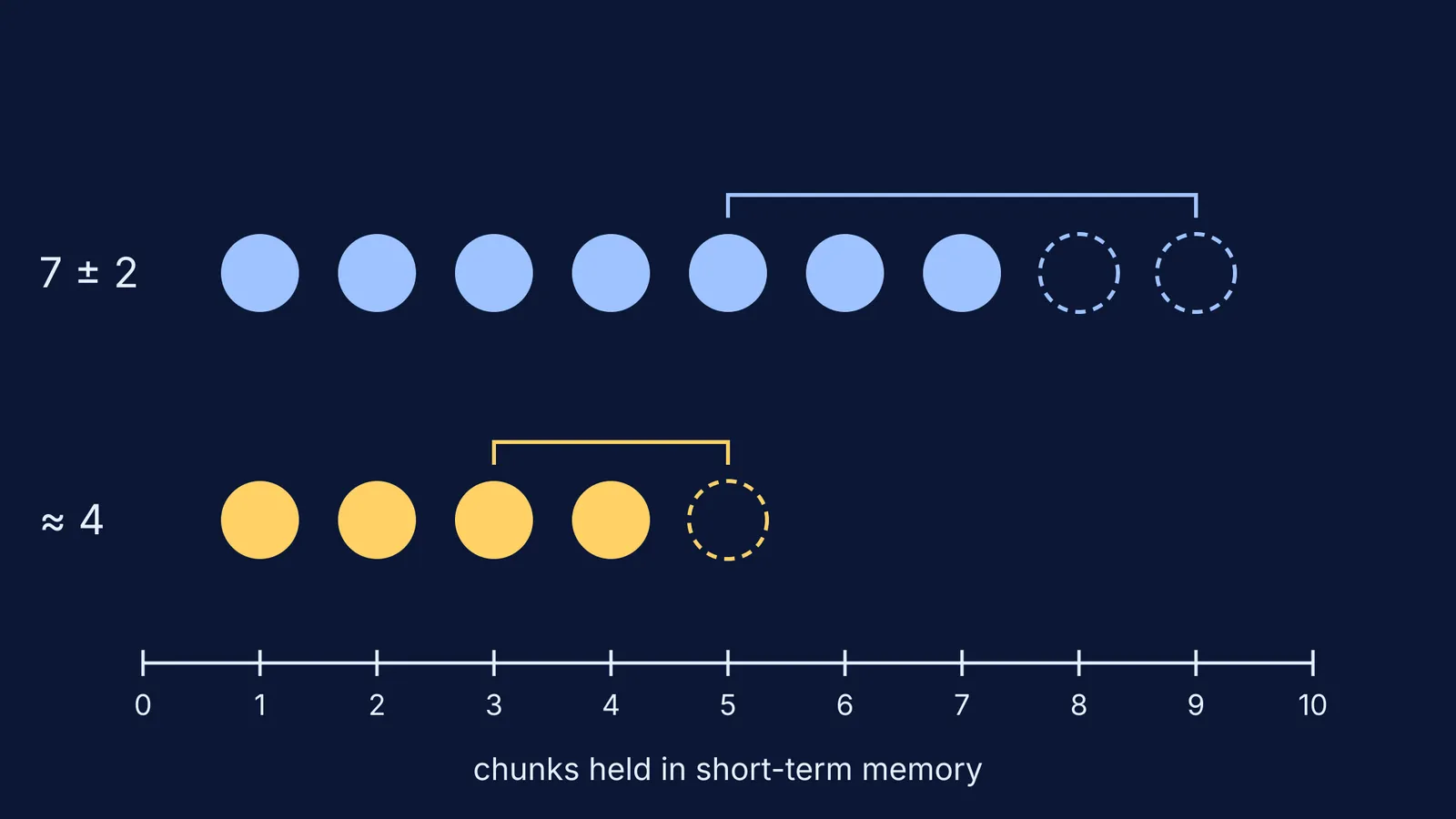
Most of us have heard that the mind can hold "seven, plus or minus two" things at once. But in 2001 the psychologist Nelson Cowan, of the University of Missouri, brought together a wide variety of memory data and argued that the real limit is smaller: about four. If you are a student working through a long JEE Main or board-exam problem, that smaller number helps explain why you lose track halfway.
Is working memory really seven items or four?
The seven comes from George Miller's paper "The magical number seven, plus or minus two", published in Psychological Review in 1956. As Cowan summarises it, Miller gathered evidence that people can remember about seven chunks in short-term memory tasks.
Cowan's target article, "The magical number 4 in short-term memory" in Behavioral and Brain Sciences (2001), took a second look. He wrote that Miller's number "was meant more as a rough estimate and a rhetorical device than as a real capacity limit." After bringing together a wide variety of data, he concluded that a single, central capacity limit averages about four chunks.
Why can people sometimes repeat back more than four things? When they can quietly rehearse items, or group them into bigger units using what they already know, the count goes up. Cowan focused on conditions where that is not possible, for example when there is too much information at once, or when steps are taken to block grouping items into larger chunks. Under those conditions, the limit he found was around four.
In a later summary, Cowan (2010) in Current Directions in Psychological Science described the central store as limited to 3 to 5 meaningful items for young adults, and noted that tasks can be completed only when you can hold enough information while you process it.
What is a chunk?
A chunk is a unit of information you treat as one thing because you already know it as a whole. For a Class 6 student, "v² = u² + 2as" may be several separate symbols. For a Class 12 student who has used it many times, it is one chunk.
This is why experts seem to hold more in their heads: they are not holding more chunks, but each chunk carries more. Our post on Adriaan de Groot and how chess masters remember real positions shows the same idea on a chessboard. For the bigger picture of how short-term and long-term memory fit together, see the Atkinson-Shiffrin multi-store memory model.
Why does a four-chunk limit matter for long problems?
Take a standard Class 11 question: a 2 kg block slides 2 m down a 30° incline with friction coefficient 0.2, starting from rest. Find its speed (take g = 10 m/s²).
Count what you must juggle: mass, angle, friction coefficient, distance, g, then the normal force, the friction force, the net force and the acceleration. That is nine items, well past four if you try to hold them all in your head. Doing it mentally is how a sin turns into a cos, or the friction term vanishes.
Written down, each line holds only what you need right now:
Normal force: N = mg cos 30° = 20 × 0.866 = 17.3 N
Friction: f = 0.2 × 17.3 = 3.46 N
Pull down the slope: mg sin 30° = 20 × 0.5 = 10 N
Net force: 10 − 3.46 = 6.54 N, so a = 6.54 ÷ 2 = 3.27 m/s²
Speed: v² = 2as = 2 × 3.27 × 2 = 13.1, so v ≈ 3.6 m/s
At every step you look at one or two numbers from the page and produce one new number. The paper does the holding; your working memory does the thinking.
How should you write down a big problem?
Use this four-part routine for any problem longer than three steps:
List the givens with units in one column before you calculate anything.
Write the target at the top: "find v". This stops you solving for the wrong thing.
One relation per line. Each line should use known values and produce one new value.
Box each intermediate result so you can find it again without recomputing.
Parents can help without knowing the physics. A simple question works: "Can you show me where on the page each number came from?" If the answer is "I did it in my head", that is the step to slow down.
If you photograph your working to get feedback, our guide on photographing handwritten rough work for AI shows how to keep it readable.
Where to practise
The Fermi Problem Library has worked problems with a step-by-step solver that explains the reasoning rather than printing an answer, so you can compare your lines with each step. And Fermi's AI tutor works through problems alongside you, writing on a board as it goes, which is the same habit of thinking on the page.
Next time a problem feels too big, do not try harder to hold it. Write it down, one line at a time.


