

On this page
Show a chess master a real game position for five seconds and they can set most of it back up from memory. Scatter the same pieces at random and they do about as badly as you would. That contrast, which grew out of the work of the Dutch psychologist Adriaan de Groot, shows how expertise works: experts do not have better memories, they have better patterns.
Who was Adriaan de Groot?
Adriaan de Groot (1914-2006) was both a chess master and a psychologist; he played for the Netherlands at the Chess Olympiads of 1937 and 1939. His 1946 doctoral thesis, Het denken van den schaker, appeared in English in 1965 as Thought and Choice in Chess. He asked players to think aloud while choosing a move, and tested how much of a position they remembered after a brief look.
What did de Groot's chess memory experiment find?
As Chase and Simon summarised it in 197390004-2), de Groot "was unable to find any gross differences" between masters and weaker players in how many moves they considered or how deeply they searched. Masters simply came up with the right moves to consider.
The memory test showed where the difference lay. According to the same paper, de Groot's grandmaster and master subjects could replace about 23 or 24 pieces out of 25 correctly after a 5-second view, and there was a sharp drop-off for players below master level.
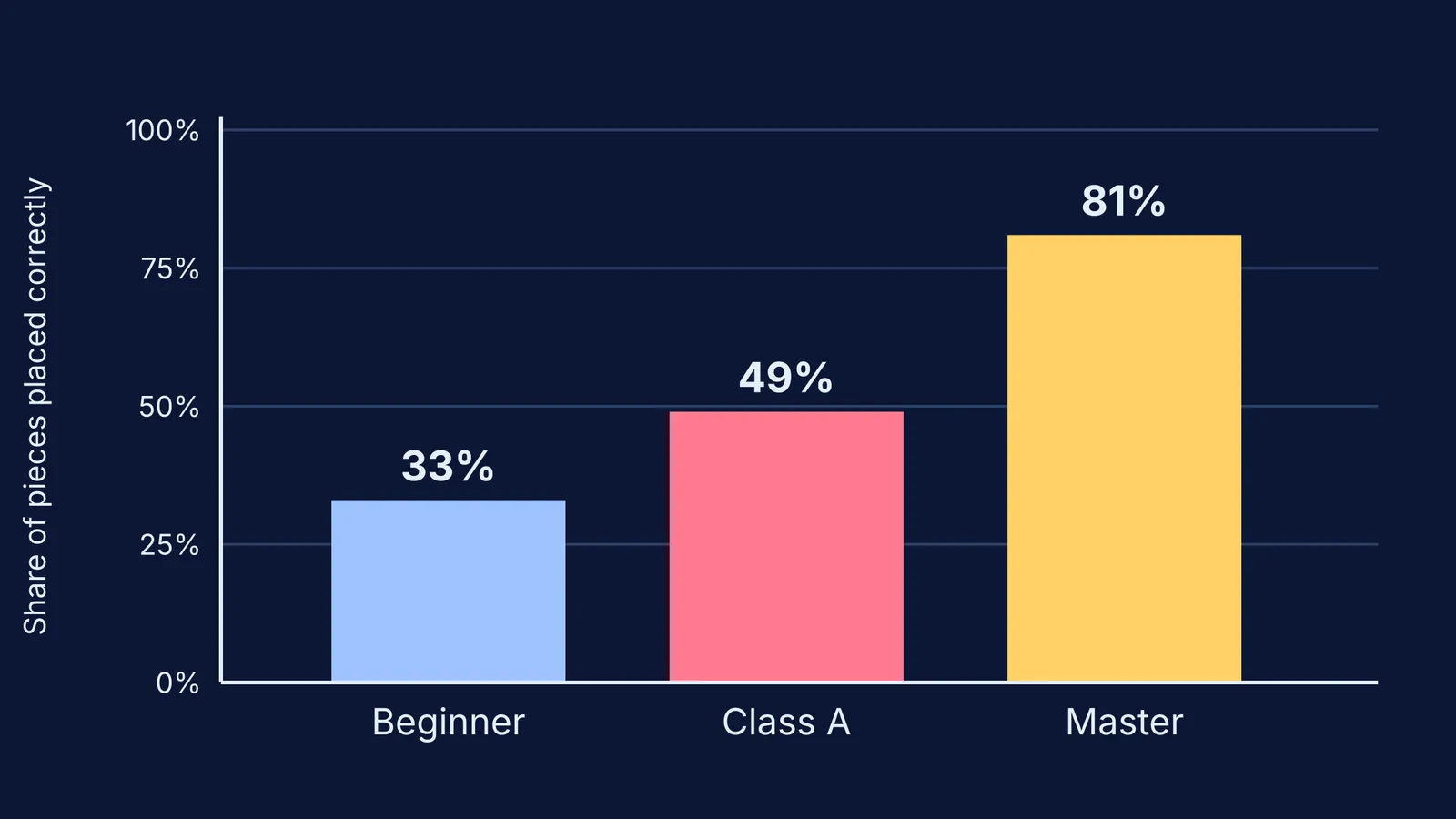
Chase and Simon repeated the test with three players: a master, a "class A" player and a beginner. On real middle-game positions, the master placed about 16 pieces correctly on the first try, the class A player about 8 and the beginner about 4 (Chase and Simon, 197390004-2)). On nine new positions from a book of chess puzzles taken from real master games, they scored 33%, 49% and 81% correct, beginner to master.
Why do chess masters forget random positions?
When Chase and Simon scattered the same pieces randomly, "there was no relation at all between memory of the position and playing strength" (Chase and Simon, 197390004-2)). On the first try, all three players did worse on random boards than the beginner did on real ones.
So the master's memory is not bigger. Their reasoning: if a master remembers 20 or more pieces but has room for only about five chunks in short-term memory, each chunk must hold four or five pieces bound into one familiar structure. When they measured it, the master recalled both more chunks and larger chunks than the weaker players. A chunk is a group of items you recognise and store as a single unit. In the master's recall of 14 positions, over 75% of chunks belonged to just three familiar types: pawn chains, castled-king positions and clusters of same-coloured pieces.
This builds on the limited span described in George Miller's magical number seven and how chunking helps you. A random board has no chunks, so the master is back to remembering single pieces, like everyone else.
Does the same thing happen in physics and maths?
In a 1981 study by Chi, Feltovich and Glaser, physics experts sorted problems by the principle underneath them, while novices grouped them by the problem's literal features.
For a JEE Main or board-exam student, that is the difference between seeing "a block on an incline" and seeing "energy conservation with friction". The second is the chunk that tells you how to start.
How can you build patterns like a chess master?
Patterns come from seeing many real examples and noticing what they share.
Pick 8-10 solved problems from one chapter, mixed in order.
For each, cover the solution and spend 30 seconds writing only the first line: which principle applies, and why.
Uncover the solution and check your principle, not your arithmetic.
Sort the problems into piles by principle, then write one sentence per pile naming the cue that gave it away.
A worked example from mechanics:
A ball rolls down a ramp and you need its speed at the bottom. Cue: heights and speeds, no time asked. Pattern: energy conservation.
Two trolleys collide and stick. Cue: "stick together". Pattern: momentum conservation, with kinetic energy lost.
A block is pulled up a rough slope and you need its acceleration. Cue: forces and acceleration. Pattern: Newton's second law along the slope.
A bead slides on a frictionless loop. Cue: heights and speeds again. Pattern: energy conservation, even though it looks nothing like the ramp.
The first and last problems look different but share a chunk, which is the skill Chi's experts showed.
If you get stuck on step 3 because you cannot tell why a method was chosen, the Fermi Problem Library has worked problems with a step-by-step solver that explains the reasoning rather than printing an answer. Solved examples are also kinder on working memory, as we explain in John Sweller's cognitive load theory: why solved examples help.
Patterns take time and feedback to build; for what that practice looks like and where its limits are, read Ericsson's deliberate practice: what it is and what critics found. Start with one chapter this week.


