

On this page
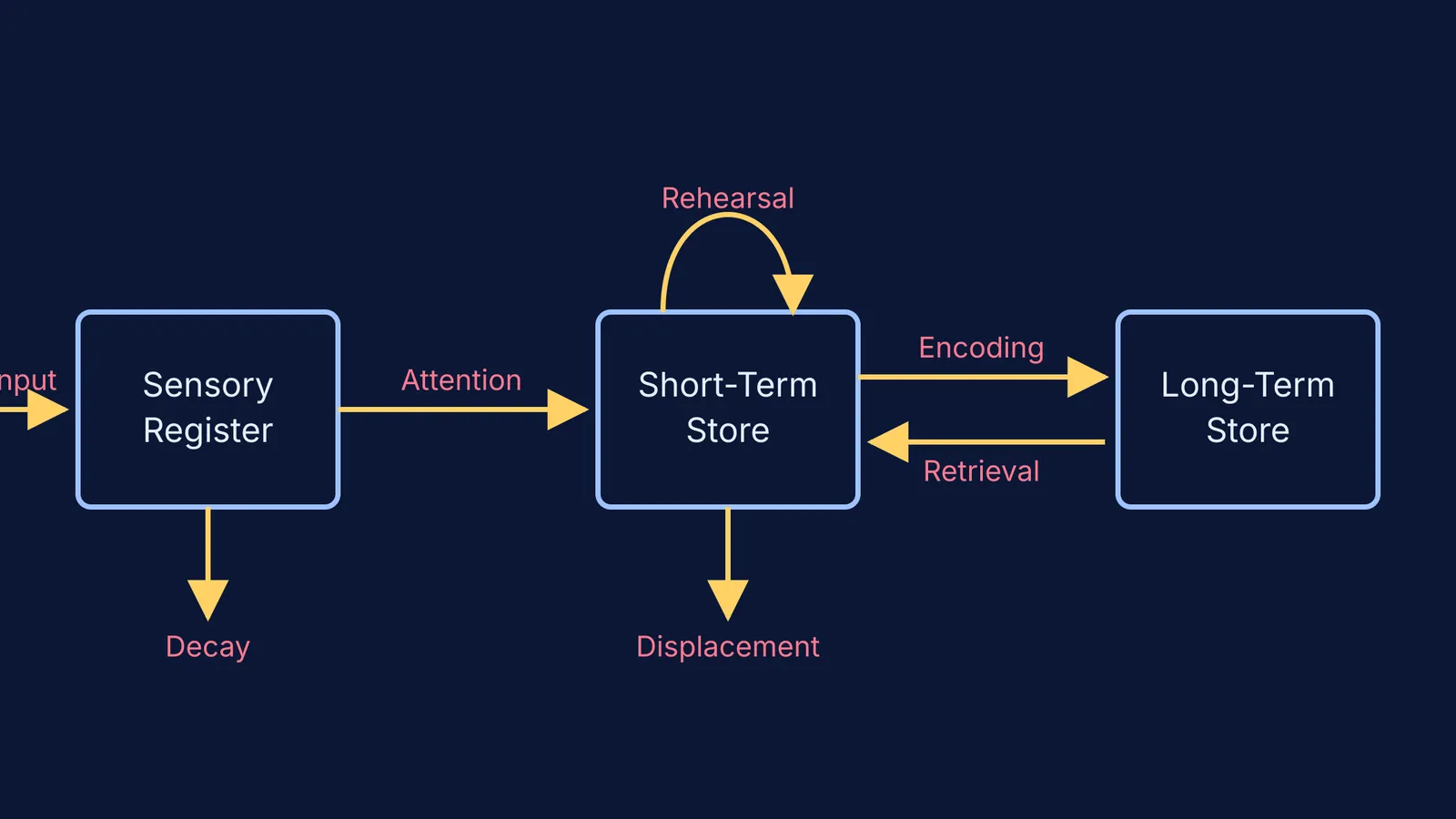
Richard Atkinson and Richard Shiffrin proposed the multi-store memory model in 1968 to explain how the brain processes and retains information. It describes memory as a flow across three stages: the sensory register (0.5 to 20 seconds), the short-term store (18–30 seconds), and the potentially limitless long-term store.
When you sit down to study for an exam, you are essentially trying to move facts from a textbook page into permanent storage in your brain. The Atkinson-Shiffrin model60422-3) maps out exactly how this happens—and where the process breaks down when you forget a formula on test day.
What is the Atkinson-Shiffrin multi-store memory model?
Published in 1968 in *The Psychology of Learning and Motivation*, the model compares the human mind to an information processing system, much like a computer. It suggests that memories are not formed instantly. Instead, environmental input passes sequentially through three separate, interconnected stores, provided you apply the right control processes like attention and rehearsal to push the data forward.
Each memory store differs fundamentally in three ways. The first is capacity: how much information the store can hold at one time. The second is duration: how long the information survives before it decays. Finally, encoding defines the format the brain uses to hold the data, such as a visual image, a sound, or a deep semantic meaning.
How does the sensory register work?
Every sight, sound, smell and touch around you lands first in the sensory register. Its capacity is enormous. It captures a highly detailed, raw snapshot of your entire environment, but this data fades almost immediately.
According to a broad summary of the Atkinson-Shiffrin memory model, the sensory register holds visual information (iconic memory) for roughly 0.5 to 1.0 seconds, and auditory information (echoic memory) for up to 20 seconds. If you do not actively pay attention to the sensory input within that tiny window, it decays rapidly and is permanently lost.
This strict filtering mechanism is why studying in a noisy room, or with a mobile phone buzzing near your notes, is incredibly inefficient. As the phone on your desk study showed, distracting sensory inputs steal the precise attention needed to move important information to the next stage. Your brain simply discards the textbook words because your attention was directed elsewhere.
How large is the short-term store?
When you intentionally pay attention to a piece of information from the sensory register, it moves into the short-term store. This is your brain's active workspace, where you hold the ideas you are currently thinking about.
However, the short-term store is a severe cognitive bottleneck. According to the same Atkinson-Shiffrin model review, it can only hold about 7 items at a time, and it retains information for just 18 to 30 seconds without active rehearsal. Information here is primarily encoded acoustically, meaning we often hold it by silently repeating the sound of the words.
If new information keeps pouring in—for example, during a fast-paced mathematics lecture—old items are pushed out, or displaced, before they can be saved. Later researchers, realising that this workspace is actively manipulated rather than just a passive holding pen, refined this stage into what we now know as Alan Baddeley's working memory model.
Because this workspace is so small, attempting to learn complex topics all at once easily causes a cognitive overload. When you use Fermi's AI tutor, it naturally notices where you are stuck and builds a plan for the session. It deliberately breaks problems down so you do not overwhelm your short-term capacity with too many unknown steps simultaneously.
How does information reach the long-term store?
To save a fact permanently, you must move it from the short-term store into the long-term store. The bridge between these two stages is rehearsal. The long-term store has a practically limitless capacity, and information can stay there for a lifetime, usually encoded by its deep semantic meaning.
However, not all rehearsal techniques are equal.
If you simply re-read your notes or highlight passages, you are mostly performing maintenance rehearsal. The information cycles in the short-term store but rarely makes the leap to permanent storage. Active problem solving, on the other hand, forces elaborative rehearsal. The Fermi Problem Library has worked problems with a step-by-step solver that explains the reasoning rather than printing an answer, effectively guiding you to make the deep semantic connections necessary for long-term retention.
Even when information successfully reaches the long-term store, you might still struggle to pull it back into your active mind during a stressful test. The famous cognitive psychologist Endel Tulving showed that forgetting is very often a failure of retrieval rather than a true loss of the memory itself. The memory exists, but the pathway to retrieve it into the short-term store has grown weak. Practising under realistic exam conditions and using self-testing strengthens these retrieval pathways, ensuring the flow of the Atkinson-Shiffrin model works efficiently in both directions.
To see how a guided approach can manage your cognitive load while studying, try a session with Fermi's AI tutor.


