On this page
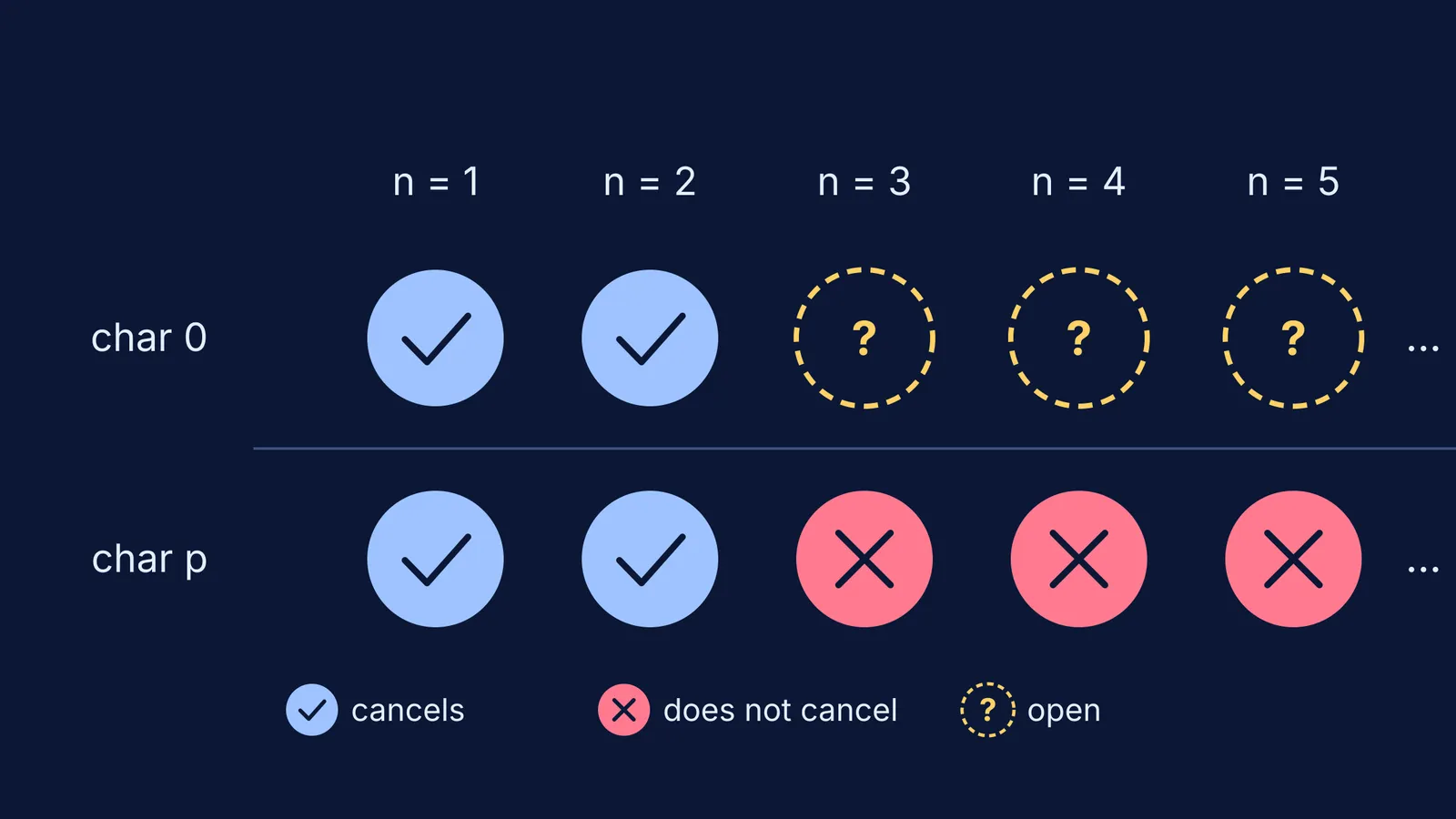
In 2013 and 2014, Neena Gupta, a mathematician now at the Indian Statistical Institute (ISI) in Kolkata, answered half of a question about polynomials that had been open since 1949. She showed that in "positive characteristic", a kind of arithmetic where adding 1 to itself enough times gives 0, the answer to Zariski's cancellation problem is no.
What is the Zariski cancellation problem?
The problem was posed by Oscar Zariski, one of the founders of modern algebraic geometry, in 1949, according to the ICTP announcement of Gupta's 2021 Ramanujan Prize.
In plain words: take a shape V defined by polynomial equations. Make a "cylinder" over it by adding one free direction, V × (a line). Suppose that cylinder turns out to be ordinary (n+1)-dimensional space. Must V itself be ordinary n-dimensional space? Gupta's own survey for the 2022 International Congress of Mathematicians states it in algebra: if a ring B with one extra variable added becomes the polynomial ring in n+1 variables, is B already the polynomial ring in n variables?
It is called cancellation because it asks whether you may cancel the extra line from both sides, the way you cancel 2 from 2a = 2b.
What did Neena Gupta prove?
Her first paper, published in Inventiones Mathematicae (online February 2013, volume 195 in January 2014), proved that a three-dimensional example built by Teruo Asanuma does not cancel. The arXiv version's abstract says that Asanuma's algebra A is not isomorphic to the polynomial ring in 3 variables, although A with one extra variable is isomorphic to the polynomial ring in 4 variables.
A second paper, in Advances in Mathematics in October 2014, went further: its abstract says that over any field of positive characteristic, affine n-space is not cancellative for any n greater than 2. A third paper, in Compositio Mathematica in 2014, studied the wider family of threefolds xᵐy = F(x, z, t).
A worked example you can check
In the Inventiones paper, Asanuma's threefold is the solution set of x^m y + z^(p^e) + t + t^(sp) = 0 over a field of characteristic p, where m, e and s are positive whole numbers. The conditions are that pᵉ does not divide sp and sp does not divide pᵉ, and Gupta's no-answer needs m > 1.
Pick p = 2, so 1 + 1 = 0 in this arithmetic.
Try e = 1, s = 1: pᵉ = 2 and sp = 2. Each divides the other, so this choice fails.
Try e = 2, s = 3: pᵉ = 4 and sp = 6. Neither divides the other, so it passes.
Take m = 2. You get x²y + z⁴ + t + t⁶ = 0.
That one equation describes a shape that is not ordinary 3-space, even though its cylinder is ordinary 4-space.
Is the Zariski cancellation problem fully solved?
Not yet. Her 2022 survey lists the earlier results. Abhyankar, Eakin and Heinzer proved cancellation for the line. Fujita, Miyanishi and Sugie proved it for the plane in characteristic zero, and Peter Russell over perfect fields of any characteristic, a condition later dropped. The same survey says the problem "is still a challenging problem in characteristic zero", which includes the real and complex numbers.
So, as of that survey, dimension 3 and above over the complex numbers was still open. Shreeram Abhyankar, who proved the first case with Eakin and Heinzer, is the subject of our piece on Abhyankar and the algebra of curves with sharp points.
Who is Neena Gupta?
Gupta's 2022 survey gives her address as the Statistics and Mathematics Unit at ISI Kolkata, the institute whose founding is told in our post on P. C. Mahalanobis and the ISI.
The ICTP announcement says her solution earned her the Indian National Science Academy's 2014 Young Scientists Award. INSA described it as "one of the best works in algebraic geometry in recent years done anywhere". The same page says she was the third woman to receive the Ramanujan Prize, first awarded in 2005. Her Wikipedia entry records the Shanti Swarup Bhatnagar Prize in 2019 and the Infosys Prize in Mathematical Sciences in 2024. It also lists a degree from Bethune College and a PhD from ISI in 2011.
How can you read a research result like this?
Ask these four questions of any theorem you read:
What is the exact question, in one sentence?
Over which numbers? Here, characteristic p against characteristic 0 changes the answer.
Which cases are settled? Here: dimensions 1 and 2 over any field, and 3 or more in characteristic p.
What is still open? Here: dimension 3 or more in characteristic 0.
If "field" or "ring" stops you, the Fermi Concept Library has every concept in mathematics with its own lesson and its place in the map, so you can fill that gap and come back. For a route into this kind of maths after Class 12, see our guide to ISI and CMI entrance exams.