On this page
Every time you twist open a cold drink and hear the hiss, you are holding an idea from Nathaniel Wyeth, an engineer at DuPont. In 1967 he asked why soft drinks did not come in plastic bottles, and a colleague told him plastic was not strong enough: the gas would make the bottles expand and explode, according to MIT Technology Review. Wyeth's answer was to stretch the plastic before it ever held a drink.
Who invented the plastic PET bottle?
US patent 3,733,309, titled "Biaxially oriented poly(ethylene terephthalate) bottle", names N. Wyeth and R. Roseveare as inventors and DuPont as the owner; it was filed on 30 November 1970 and granted on 15 May 1973 (Google Patents record). The patent's abstract says the bottles could hold liquids at pressures as high as about 100 psi gauge at about 50 °C without significant deformation, making them useful for beer, carbonated drinks and aerosols.
Wyeth was born near Chadds Ford, Pennsylvania, the son of the illustrator N. C. Wyeth, studied engineering at the University of Pennsylvania, and died on 4 July 1990 at 78 (Lemelson-MIT). He joined DuPont in 1936, became its first engineering fellow in 1963, and invented or co-invented 25 products and processes (The Chemical Engineer).
Wyeth did not invent PET itself. John Rex Whinfield and James Tennant Dickson patented the polymer in 1941 at the Calico Printers' Association in Manchester (Wikipedia: Polyethylene terephthalate). PET is a polyester made by condensing ethylene glycol with terephthalic acid, with water given off. Our post on making terephthalic acid from 4-methylacetophenone shows one route to that acid.
Why did early plastic bottles burst?
A fizzy drink holds carbon dioxide dissolved under pressure (the same gas that gives soda water its slightly sour taste). Wyeth tested the problem at home by filling a plastic detergent bottle with ginger ale and leaving it in the fridge. By morning the bottle had ballooned and wedged itself between the shelves (MIT Technology Review).
The colleague had been right about ordinary plastic. Wyeth first worked with polypropylene and, as his final improvement, replaced it with PET (Lemelson-MIT). He estimated he made around 10,000 attempts. When success came, he and his assistant opened the mould expecting more shapeless globs of resin and found a crystal-clear bottle instead (The Chemical Engineer).
How does stretching make PET strong enough for fizzy drinks?
Wyeth knew that stretching nylon threads makes them stronger, because it forces the long molecules to line up (MIT Technology Review). A thread only needs strength along its length. A bottle wall needs it in two directions at once: around the bottle and along it.
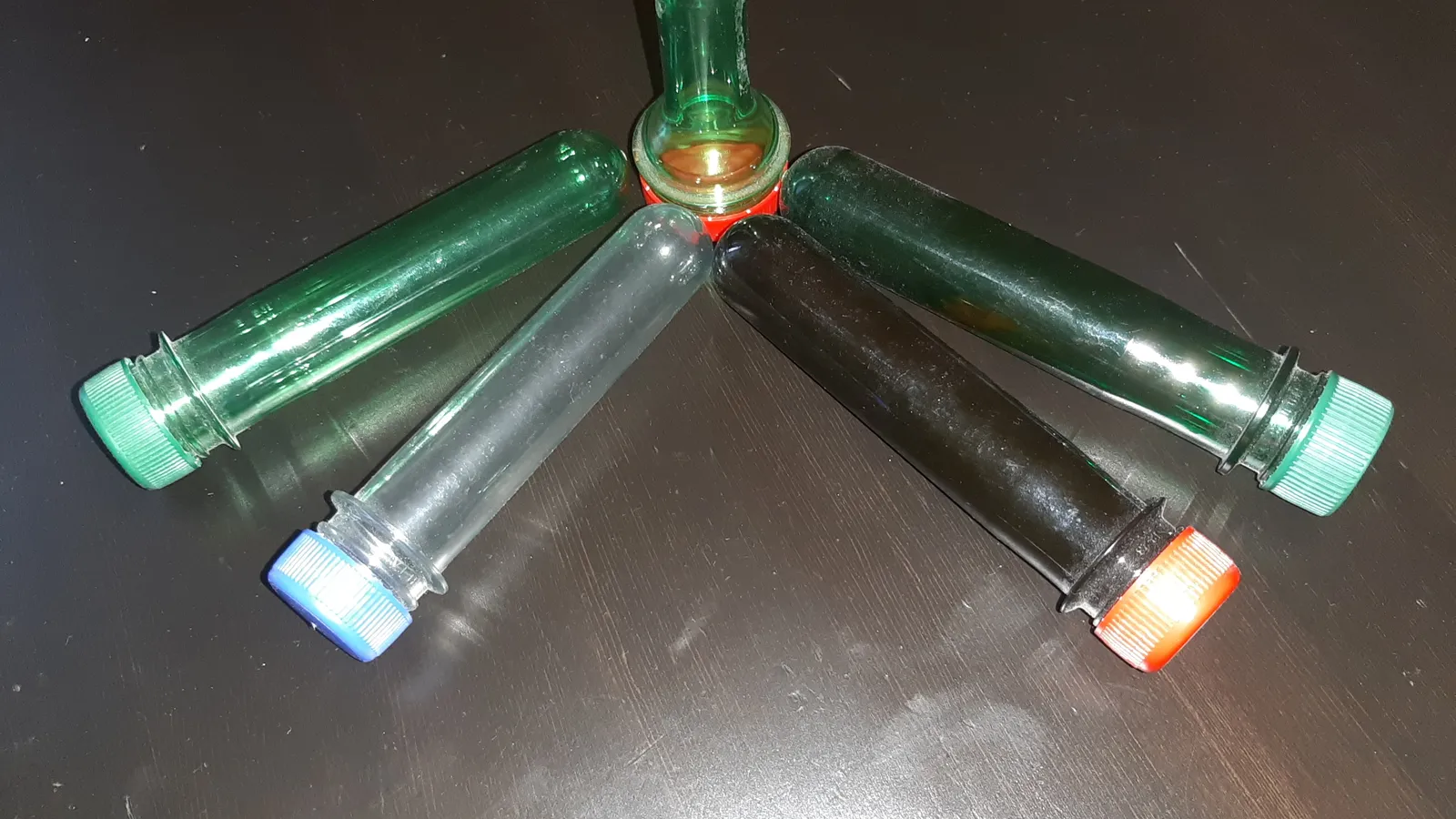
His solution was a mould shaped like a test tube, with screw threads running not in a single spiral but in a diamond criss-cross pattern. Plastic pushed through it had its molecules lined up in two dimensions rather than one (Lemelson-MIT). The photo at the top shows modern PET preforms, the test-tube shapes that factories heat and blow into bottles, with the threaded neck already formed.
Worked example: how hard does the gas push on the wall?
You can do this in five lines with Class 11 ideas: pressure, area and a force balance. We take the patent's top figure of 100 psi gauge. The bottle size below is our own illustrative choice, not from the patent.
Convert units: NIST gives 1 psi = 6,894.757 Pa (NIST SI guide, Appendix B.9), so 100 psi is about 689 kPa, roughly 6.8 times atmospheric pressure (101.325 kPa). Because it is gauge pressure, it is measured above the air outside; see gauge pressure vs absolute pressure if that distinction is new.
Pick a bottle: radius r = 5 cm = 0.05 m, wall thickness t = 0.4 mm = 0.0004 m.
Hoop stress (around the bottle) for a thin cylinder is σ = Pr/t = 689,476 × 0.05 / 0.0004 ≈ 86 MPa.
Axial stress (along the bottle) is σ = Pr/2t ≈ 43 MPa.
Compare: the wall is pulled twice as hard around its girth as along its length.
That factor of two is the point. A material stretched only lengthwise, like a nylon thread, would be strong in the easier direction and weak in the harder one.
If the jump from gas pressure to wall stress is hard to picture, the Fermi Simulation Lab has interactive simulations for ideas that are easier to see than to read.
What can you check on a bottle at home?
Squeeze a sealed fizzy bottle, then the same bottle after opening: the firmness you lose is the gas pressure you just calculated.
Compare the neck with the body: the neck keeps the preform's shape, while the body wall was blown out thin.
Hold an empty bottle to the light: Wyeth's first successful bottle was crystal-clear too.
When you are done, recycle it. PET soda bottles were first recycled in 1977 and are now perhaps the most commonly recycled household products (Lemelson-MIT).
Wyeth's lesson: line up the molecules where the stress is. If polyesters, condensation polymers or hoop stress are gaps for you, the Fermi Concept Library gives each concept its own lesson and shows where it sits in the map.