

On this page
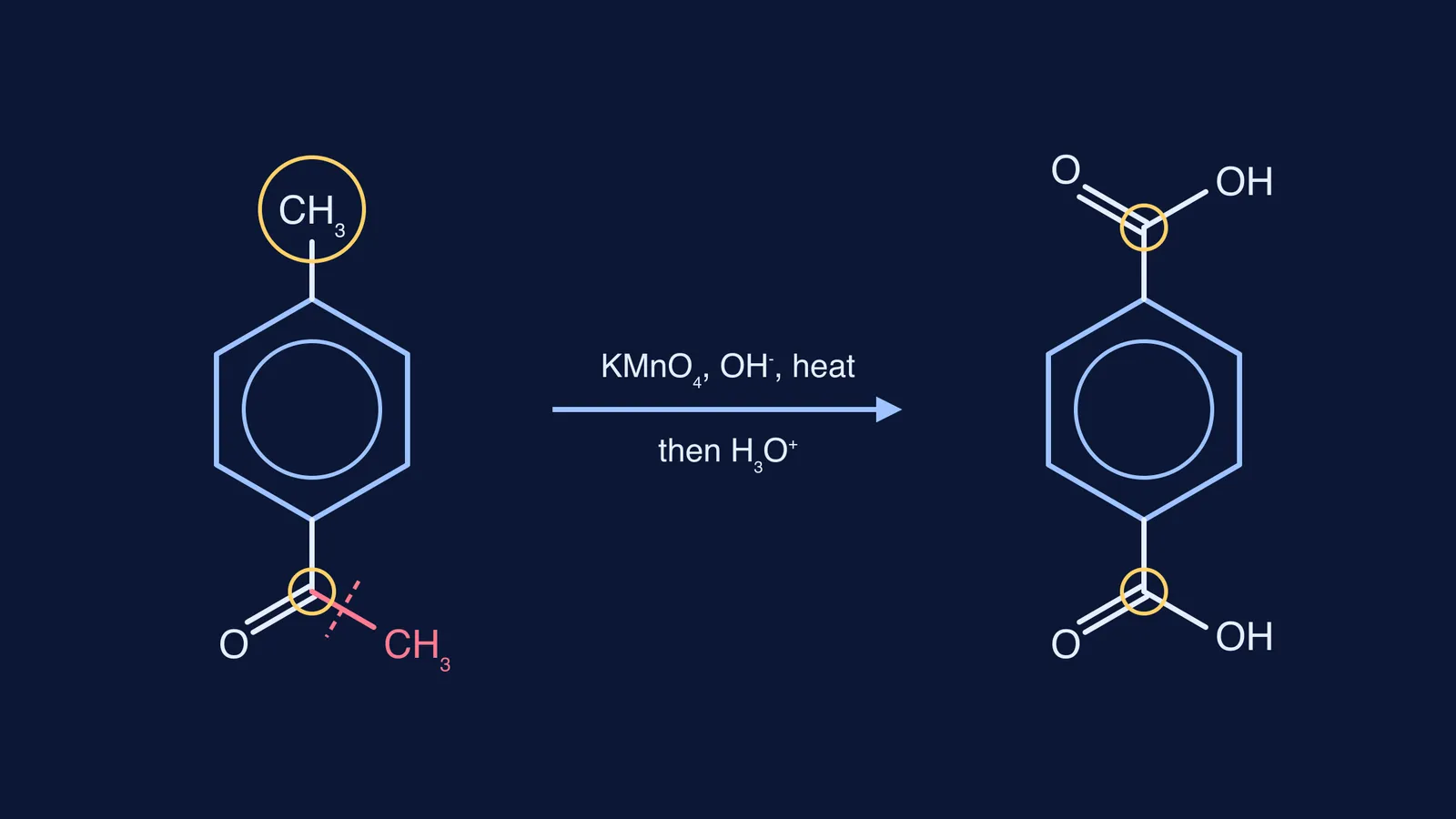
Asked to turn 4-methylacetophenone into benzene-1,4-dicarboxylic acid? The expected answer is one oxidation: heat with alkaline potassium permanganate, then acidify. What is being tested is whether you see that both groups on the ring end up as –COOH.
What reagent converts 4-methylacetophenone to terephthalic acid?
Hot alkaline KMnO4, followed by dilute acid. PubChem lists 4-methylacetophenone, IUPAC name 1-(4-methylphenyl)ethanone, as C9H10O. PubChem lists terephthalic acid as C8H6O4. The ring and its para pattern stay, one carbon leaves, and both side chains become carboxyl groups.
Heat 4-methylacetophenone with KMnO4 and KOH. Both side chains are oxidised, giving the dipotassium salt of terephthalic acid.
Acidify with dilute acid (H3O+). The carboxylate ions take up protons and terephthalic acid separates.
Industry makes the same acid by a related route: LibreTexts' organic chemistry text/16%3A_Chemistry_of_Benzene_-_Electrophilic_Aromatic_Substitution/16.08%3A_Oxidation_of_Aromatic_Compounds) says about 118 million tons a year are produced worldwide by air oxidation of p-xylene with a cobalt catalyst.
Why does KMnO4 oxidise both the methyl and the acetyl group?
Because each side chain is joined to the ring through a benzylic carbon, the carbon directly attached to the ring, and that carbon is the one that ends up as –COOH. The NCERT Class 12 chemistry textbook, Unit 8 states that with chromic acid or acidic or alkaline KMnO4 "the entire side chain is oxidised to the carboxyl group irrespective of length of the side chain". The answer to its intext question 8.7 shows acetophenone going to potassium benzoate with KMnO4–KOH, then to benzoic acid with H3O+.
The methyl group. Its carbon is benzylic and carries three hydrogens. The LibreTexts chapter/16%3A_Chemistry_of_Benzene_-_Electrophilic_Aromatic_Substitution/16.08%3A_Oxidation_of_Aromatic_Compounds) explains that side-chain oxidation starts at the C–H bonds next to the ring and passes through benzylic radicals. This carbon is oxidised all the way to –COOH.
The acetyl group. Its benzylic carbon is the C=O carbon, already part-way to a carboxyl. The bond to the terminal CH3 is broken, the CH3 carbon leaves the molecule, and the benzylic carbon becomes –COOH. In the discussion under the Master Organic Chemistry reaction guide on KMnO4 side-chain oxidation, the author explains that acetophenone reacts through its enol form.
If benzylic carbons still feel shaky, the Fermi Concept Library gives every chemistry concept its own lesson and shows where it sits in the map.
Worked example: how many KMnO4 per molecule?
Some questions ask for the mole ratio. Track the oxidation state of each carbon that changes (our guide on finding the oxidation state of carbon in organic compounds shows the method).
Ring methyl carbon: −3 in CH3, +3 in COO−. That is 6 electrons.
Acetyl C=O carbon: +2 in the ketone, +3 in COO−. That is 1 electron.
Acetyl CH3 carbon: −3, leaving as carbonate (+4) in the alkaline solution. That is 7 electrons.
Total: 14 electrons lost per molecule.
In neutral or faintly alkaline solution, the NCERT d- and f-block chapter shows permanganate being reduced to MnO2, a change from +7 to +4, so each MnO4− takes 3 electrons. Three molecules lose 42 electrons, which 14 permanganate ions accept:
3 C9H10O + 14 MnO4− → 3 C6H4(COO)2^2− + 3 CO3^2− + 14 MnO2 + 2 OH− + 8 H2O
Check: 27 carbons, 30 hydrogens, 59 oxygens and a charge of −14 on each side. We balanced this ourselves by electron count, assuming permanganate stops at MnO2 and the lost carbon ends as carbonate.
When does KMnO4 side-chain oxidation fail?
When the ring-attached carbon has no hydrogen and no oxygen. LibreTexts notes that tert-butylbenzene "has no benzylic hydrogens, however, and is therefore inert", and NCERT says primary and secondary alkyl groups are oxidised while a tertiary group is not affected. A quick decision list:
–CH3, –CH2CH3, –CH2CH2CH3: benzylic H present, becomes –COOH.
–COCH3: benzylic carbon is already a carbonyl, becomes –COOH.
–C(CH3)3: no benzylic H, left unchanged.
By the same rule, 4-tert-butylacetophenone would give 4-tert-butylbenzoic acid. The reagent matters too. NCERT's haloform section says sodium hypohalite oxidises methyl ketones to the salt of an acid with one carbon fewer, the methyl becoming haloform. So iodoform conditions give 4-methylbenzoic acid and leave the ring methyl alone; see our explainer on the haloform reaction mechanism.
How should you write this answer in a board exam or JEE?
Draw CH3 and COCH3 para to each other.
Circle the ring-attached carbon in each side chain.
Write KMnO4/KOH, heat over the first arrow and H3O+ over the second.
Draw the dipotassium salt, then the acid, named benzene-1,4-dicarboxylic acid (terephthalic acid).
If asked why: each side chain's benzylic carbon is oxidised to –COOH whatever the chain length.
For the single-group cases this builds on, read our explainer on KMnO4 oxidation of alkylbenzenes. To practise more conversions like this one, the Fermi Problem Library has worked problems with a step-by-step solver that explains the reasoning rather than printing an answer.


