On this page
Most gene discoveries are told as lab stories. The hunt for the Huntington's disease gene started with a family tree, drawn by hand in villages on the shores of a lake in Venezuela. The person drawing it was Nancy Wexler, a psychologist who had her own reason to care about the answer.
Who was Nancy Wexler and why did she go to Venezuela?
In a 2016 interview with the Lasker Foundation, Wexler said her mother was diagnosed with Huntington's disease in 1968, the same year her father set up the Hereditary Disease Foundation. Her mother died of the disease in 1978, according to the Franklin Institute's laureate profile, which also notes Wexler's PhD in clinical psychology from the University of Michigan in 1974.
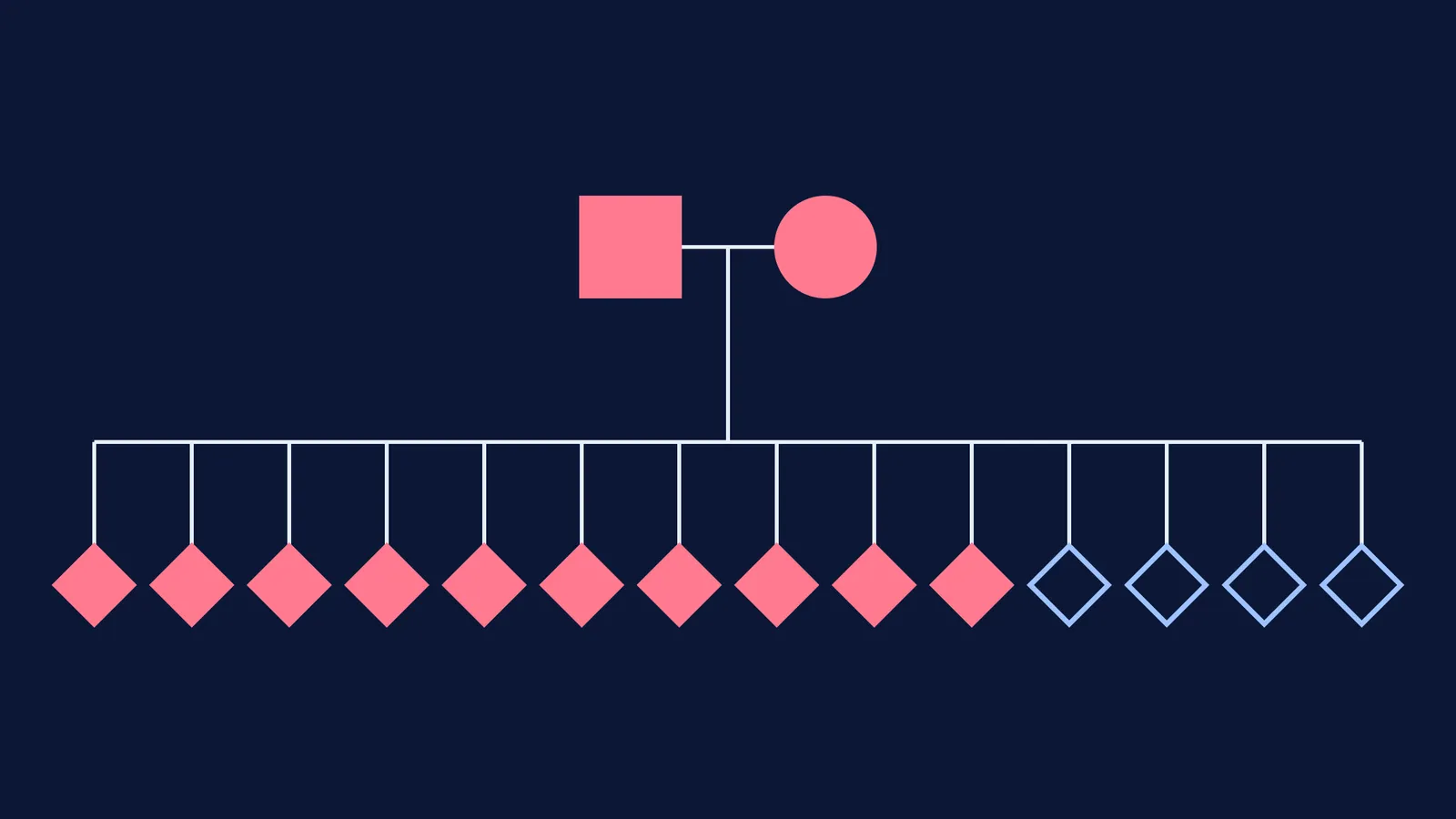
In July 1979 she went to Venezuela because she had heard of a community on Lake Maracaibo where people with Huntington's were intermarrying, as she told the Lasker Foundation. In one stilt village her team found a couple who both had the disease: they had 14 living children, and 10 of them developed it.
Over the following years her team built a pedigree of over 18,000 individuals and collected over 4,000 blood samples, the Lasker Foundation records.
How did family data from Venezuela find the Huntington's gene?
The method was genetic linkage. If a stretch of DNA sits close to the disease gene on the same chromosome, it tends to be passed down together with the disease. Track enough relatives and the pattern stands out from chance.
In 1983, James Gusella, Wexler and colleagues reported in Nature that the Huntington's disease gene is linked to a DNA marker that maps to human chromosome 4. Wexler later described the moment the Venezuelan DNA was tested: "It was screamingly significant. There was no possibility that it was by chance" (Lasker Foundation).
Finding the gene itself took another ten years. In 1993 the Huntington's Disease Collaborative Research Group described a new gene in region 4p16.3 in Cell90585-E). It contains a CAG repeat that was longer than the normal range on Huntington's chromosomes in all 75 disease families they examined.
The Venezuelan families kept teaching. A 2004 study in PNAS described Venezuelan kindreds of 18,149 people spanning 10 generations. It found that, beyond CAG repeat length, both other genes and the environment help shape the age at which symptoms begin.
What does autosomal dominant mean for Huntington's disease?
Autosomal dominant means one altered copy of a gene, on a non-sex chromosome, is enough to cause the condition (MedlinePlus Genetics).
Each child of a person with Huntington's disease has a 50% chance of inheriting the variant, according to the Penn Huntington's Disease Center.
The gene is HTT. People with 40 or more CAG repeats almost always develop the disorder, while 36 to 39 repeats may or may not cause symptoms (MedlinePlus Genetics).
If the difference between dominant and common confuses you, read why dominant does not mean more common. A large, closely related community is also a good prompt to revise the founder effect and how it differs from a bottleneck.
How do you check a dominant pedigree like a gene hunter?
Use Wexler's hammock family as a worked example. Call the disease allele H and the normal allele h.
Both parents were affected, so each carried at least one H. Wexler told the Lasker Foundation that some of the children were homozygotes, which fits both parents being Hh. The cross is Hh x Hh.
The offspring split 1 HH : 2 Hh : 1 hh. Three of four children carry at least one H.
Expected affected children: 14 x 3/4 = 10.5.
Observed: 10 of 14, close to the prediction, as real small families usually are.
Now change one parent to hh (unaffected). The cross becomes Hh x hh, so half the children are Hh. Out of 14, you would expect about 7 affected. This is the 50% rule from the section above.
A quick checklist for any pedigree question:
Does every affected child have at least one affected parent? Dominant traits usually do not skip generations.
Are males and females affected about equally? That points to an autosome, not the X.
Do two affected parents ever have an unaffected child? Only a dominant trait allows that.
For more practice, see how to tell if a pedigree is dominant or recessive. If a step like the 1:2:1 split feels shaky, the Fermi Concept Library has a lesson for every biology concept, and the Fermi Problem Library has worked problems with a step-by-step solver that explains the reasoning.
What can students take from Wexler's work?
The chromosome 4 result needed patient fieldwork, careful records and many collaborators. When you draw a pedigree in an exam, you are using the same logic that pointed scientists to the Huntington's gene.
Try it tonight: draw a three-generation pedigree for a dominant trait from memory, then check it against the three questions above.