

On this page
Evolution is not always driven by natural selection. Sometimes, survival comes down to pure luck.
When random events shift the allele frequencies of a population, biologists call it genetic drift. Unlike natural selection—which pushes traits in specific, advantageous directions (see stabilising, directional and disruptive selection)—genetic drift is blind. It has the strongest impact when a population is small.
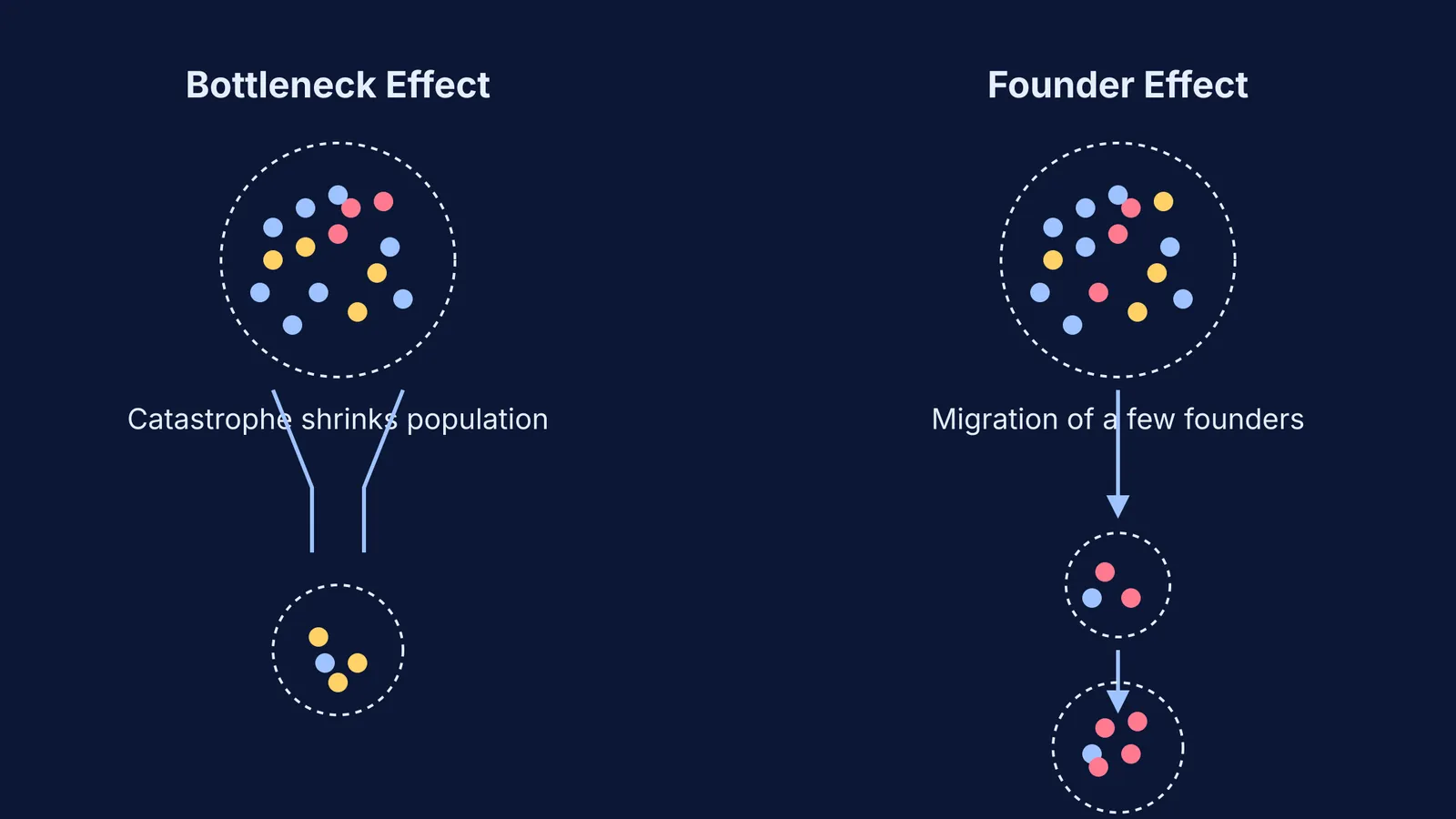
Two of the most famous drivers of genetic drift are the bottleneck effect and the founder effect. They explain how extremely rare traits can suddenly become dominant in a group.
What is the bottleneck effect?
The bottleneck effect occurs when a catastrophe drastically reduces a population's size for at least one generation. Disease, famine or hunting can wipe out most individuals, leaving only a tiny handful of survivors.
By pure chance, those few survivors will not have the exact same genetic makeup as the original, larger population. When they reproduce, their specific alleles form the basis for all future generations.
A classic example is the northern elephant seal. In the late 19th century, commercial hunters slaughtered the seals for their blubber, driving the species to the brink of extinction. Researchers estimate that the population fell to as few as 20 to 40 individuals on Guadalupe Island, Mexico.
Today, the population has rebounded to over 200,000 seals. However, because they all descended from that tiny surviving group, the entire modern population shares an extremely low level of genetic variation.
What is the founder effect?
The founder effect happens when a small group of individuals breaks off from a larger population to establish a new, isolated colony.
Because the migrating group is small, it is highly unlikely to carry a perfect, representative sample of the original population's genes. If one of the "founders" happens to carry a rare recessive allele, that allele will be passed down to a disproportionately large percentage of the new colony.
We often see this in human history. A well-known example is the Old Order Amish population of Lancaster County, Pennsylvania. Because of the founder effect and a tendency to marry within their community, Ellis-van Creveld syndrome—a condition causing short stature and extra fingers (polydactyly)—is much more common here than the estimated 1 in 60,000 to 200,000 newborns in the general population. These isolated populations are vital for studying Mendelian disorders because they make rare inheritance patterns visible.
How did a typhoon alter the Pingelapese?
Sometimes, a bottleneck and a founder effect happen in sequence.
In 1775, a devastating typhoon struck the Pingelap Atoll in the Pacific Ocean, killing almost everyone. The disaster acted as a severe bottleneck, leaving just 20 survivors.
Among those survivors was the island's ruler, who carried a rare recessive gene for achromatopsia, a condition causing complete color blindness. He and the other 19 survivors became the founders of the repopulated island.
Today, the disorder is prevalent in almost 10% of the island's population, and many more are carriers. By comparison, in the United States, the condition affects only about 1 in 33,000 people. A natural disaster shrank the gene pool, and the few remaining founders permanently altered the island's genetic future.
Why does genetic drift matter?
Biologists like Sewall Wright showed that small populations wander genetically. In large populations, random shifts in one direction tend to be cancelled out by shifts in the other. But in a group of 20, the loss of a single individual can erase an entire allele from the gene pool forever.
If you have concept gaps when revising how allele frequencies shift over generations, the Fermi Concept Library contains every concept in physics, chemistry, biology, mathematics and computing, each with its own lesson and its place in the map.
Understanding how population size dictates evolutionary change is a foundational concept in biology, reminding us that nature is shaped just as much by history and chance as it is by survival of the fittest.


