

On this page
In 1974, ISRO signed an agreement with the French company Société Européenne de Propulsion (SEP) that A.E. Muthunayagam, founder director of ISRO's Liquid Propulsion Systems Centre, calls "the really major breakthrough in liquid propulsion systems". He describes the deal in a collection of memoirs on India and France in space compiled by Pranav Sharma of the BM Birla Science Centre. No funds changed hands. SEP transferred its Viking liquid-engine technology, and in return ISRO supplied 7,000 pressure transducers and 100 man-years of engineering work for France's Ariane rocket. (Another memoir in the same collection puts the transducer figure at 10,000.)
Muthunayagam writes that the technology acquisition programme "was successfully carried out under the leadership of my colleague S. Nambinarayanan", and that around forty engineers took part. Indian engineers sat in design reviews, took part in inspection of hardware, and joined assembly and testing at SEP's facilities. The Indian version of the engine was called Vikas.
Who is Nambi Narayanan?
S. Nambi Narayanan is a Princeton-educated former ISRO scientist who urged ISRO to develop liquid-fuelled engines, according to a WION profile of the Vikas engine. Accounts differ on who chose the name: WION credits the Indian negotiating team he led, while Muthunayagam credits T.N. Seshan, who signed for ISRO. Both say that "Vikas" means development and also echoes Vikram A. Sarabhai, the founder of India's space programme.
Narayanan was later arrested. On 14 September 2018, the Supreme Court awarded him Rs 50 lakh in compensation for wrongful arrest, as reported by Bar and Bench. In January 2019 he was named for the Padma Bhushan in science and engineering (space), according to Scroll's list of the awards.
What is the Vikas engine and what does it power?
The Vikas engine is the Earth-storable liquid rocket engine, developed by the Liquid Propulsion Systems Centre, that powers the second stage of the PSLV, according to ISRO's PSLV page. It burns UDMH (unsymmetrical dimethylhydrazine) as fuel with nitrogen tetroxide as oxidiser. ISRO lists its maximum thrust as 799 kN. PSLV has four stages, and its first successful launch came in October 1994.
Building the engine in India took years. N. Narayanamoorthy, a senior launch vehicle adviser at VSSC, recalls in the same memoir collection that the first engine was realised towards the end of 1989. The test facility at Mahendragiri was not ready, so the engine was tested at SEP in France, and it performed satisfactorily at the very first attempt.
For the very cold alternative, see our explainer on what a cryogenic rocket engine is.
How does Newton's third law make a rocket move?
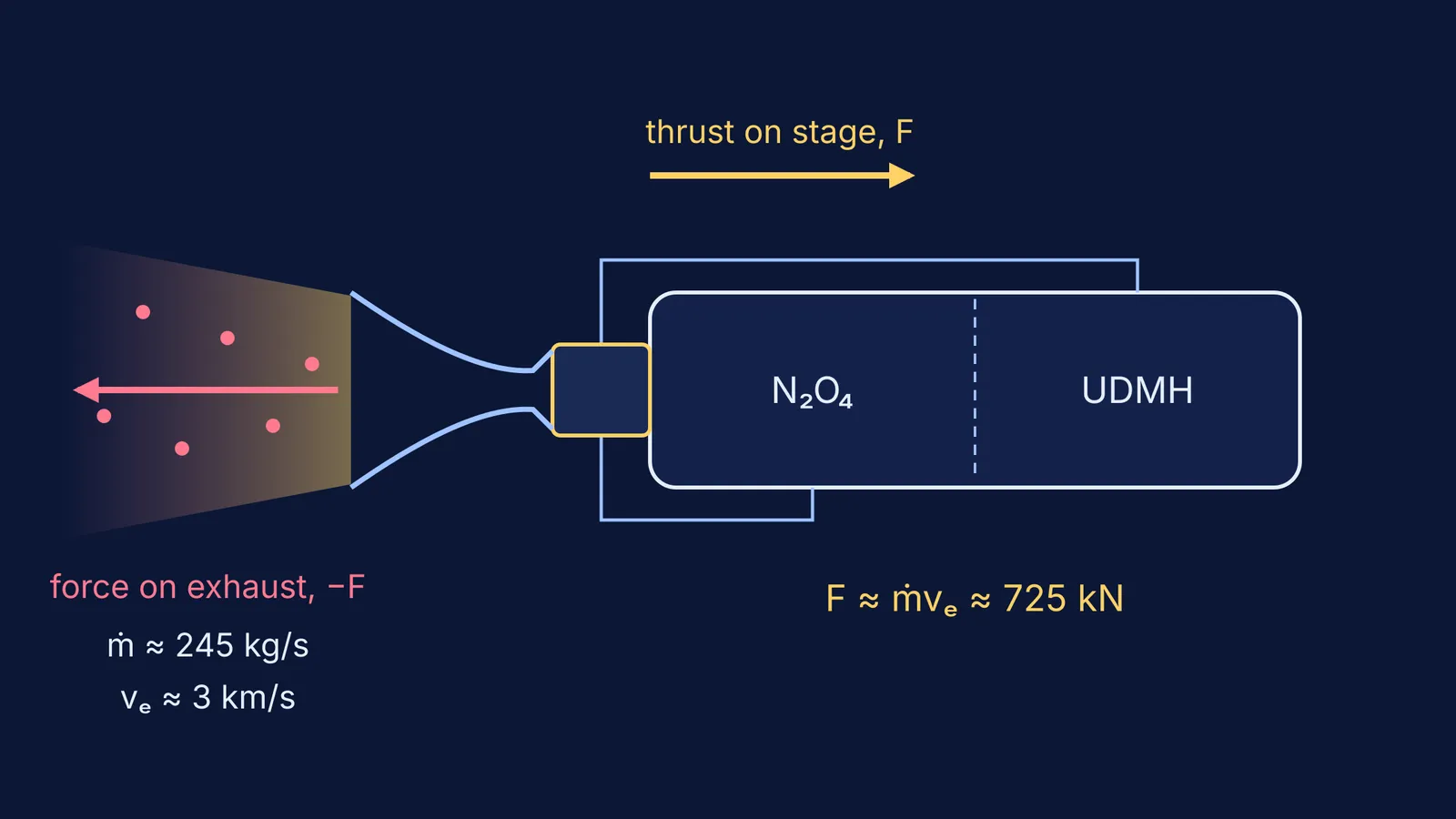
NASA's Glenn Research Center puts it in one line: "Thrust is produced according to Newton's third law of motion" (NASA rocket thrust equation). Inside Vikas, UDMH and nitrogen tetroxide burn in the combustion chamber, and the nozzle accelerates the hot gas out of the back. The engine pushes on the gas; the gas pushes back on the engine with an equal and opposite force. That push is the thrust.
The same NASA page gives the thrust equation, F = ṁvₑ + Aₑ(pₑ − p₀). Here ṁ is the mass of gas leaving each second, vₑ is its exit speed, and the second term is a pressure correction at the nozzle exit. Because the rocket carries its own oxidiser, it can make thrust in a vacuum, with no air to push against. You can see the same idea on a string in our post on how a balloon rocket moves.
Worked example: how fast does Vikas throw out its exhaust?
ISRO's PSLV-C4 mission page says the second stage carries 40 tonnes of propellant, gives a maximum thrust of about 725 kN and burns for 163 seconds. That is enough for a Class 11 estimate.
Mass flow rate: ṁ ≈ 40,000 kg ÷ 163 s ≈ 245 kg/s. About a quarter of a tonne of gas leaves the nozzle every second.
Drop the pressure term and rearrange F ≈ ṁvₑ to get vₑ ≈ F ÷ ṁ.
Exhaust speed: vₑ ≈ 725,000 N ÷ 245 kg/s ≈ 2,950 m/s, or roughly 3 km/s.
Read it as momentum: each second the engine gives 245 kg of gas about 3 km/s of backward speed, so it pushes on the gas with a force of about 725 kN. By the third law, the gas pushes the stage forwards with an equal force.
If turning a force into momentum per second feels slippery, the Fermi Problem Library has worked problems with a step-by-step solver that explains the reasoning rather than printing an answer.
What can students take from Narayanan's story?
The Vikas engine came from a trade of skill rather than money. Indian engineers learnt the engine by working on someone else's rocket, then spent years turning drawings into hardware at home. If you are curious about that kind of work, see our guide on how to become a scientist at ISRO or DRDO.
When you sit down to revise the third law, Fermi's AI tutor can work out what you already know and build a plan for the session, so you begin with a clear next step.


