

On this page
When Chandrayaan-2 lifted off on 22 July 2019, the person responsible for the whole project was its project director, Muthayya Vanitha. Gulf News described her as the first female project director of an Indian interplanetary mission. ISRO chairman K Sivan made the same distinction before launch: The Better India reports him saying it was the first planetary mission with women in charge, while ISRO had already had women project directors for communication and other satellites. Her story shows what an ISRO engineering career looks like from the inside.
Who is Muthayya Vanitha?
Vanitha graduated from the College of Engineering, Guindy, in the class of 1985, specialising in electronics and communication, according to Gulf News. She started at entry level and worked her way up. In her own words to Gulf News: "I joined here as junior-most engineer. So I worked in the laboratory, testing carts, making hardware, designing developing and then reached a managerial position."
Before the Moon, her speciality was data. The Better India reports that she headed the telemetry and telecommand divisions in the digital systems group at ISRO's Satellite Centre, now the U R Rao Satellite Centre, and was deputy project director for data systems on the Cartosat-1, Oceansat-2 and Megha-Tropiques remote-sensing satellites. The same report says the Astronomical Society of India gave her its Best Woman Scientist Award in 2006.
After Chandrayaan-2, an ISRO order designated her deputy director of the Payload, Data Management and Space Astronomy area, LatestLY reported in December 2019.
What does a project director do on a mission like Chandrayaan-2?
As project director, Vanitha was responsible for "the entire project from its inception to completion", while mission director Ritu Karidhal oversaw the mission and coordinated between the agencies involved, The Better India wrote. You can read about Karidhal's earlier work in how Ritu Karidhal planned Mangalyaan's path to Mars.
Chandrayaan-2 had three parts, according to ISRO's spacecraft page: an orbiter of 2,379 kg, the Vikram lander of 1,471 kg, and the Pragyan rover of 27 kg. The orbiter carries eight scientific instruments, ISRO says.
She did not say yes at once. The News Minute reported that she was hesitant and needed persuading. M Annadurai, project director of Chandrayaan-1, said the role "involves nearly 18 hours of work a day at its peak", and made an extra effort to convince her because of her problem-solving and team management skills. He later told Gulf News: "I have seen her capability. She also met the challenge."
Did Chandrayaan-2 succeed?
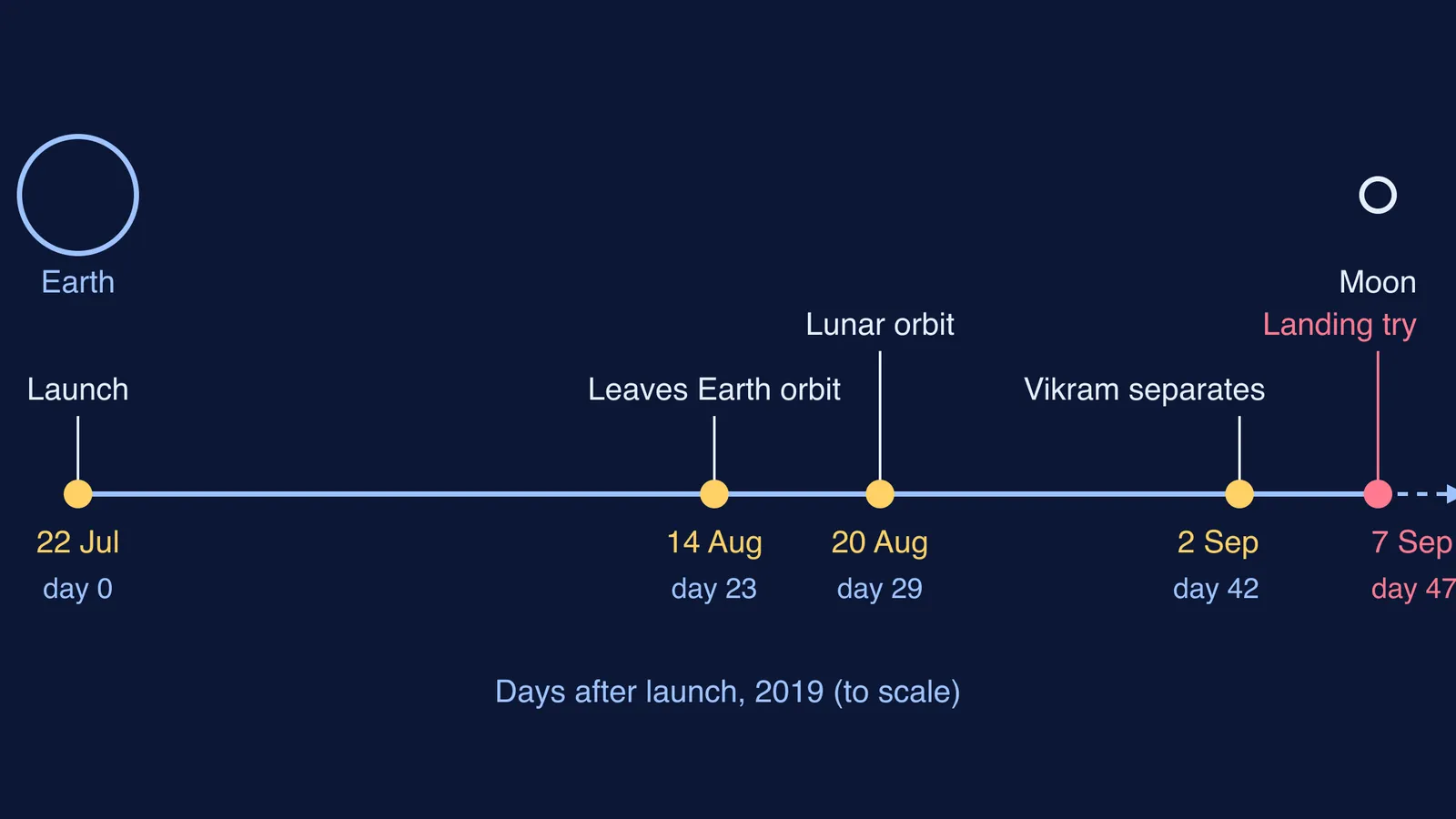
Partly, and the details matter. ISRO's mission page records that the spacecraft entered lunar orbit on 20 August 2019 and Vikram separated from the orbiter on 2 September. The landing was attempted on 7 September 2019, says ISRO's FAQ.
Vikram's descent was normal down to an altitude of 2.1 km, after which communication with the ground was lost, according to ISRO. The orbiter kept working: ISRO says precise launch and mission management ensured it a life of almost seven years instead of the planned one year.
ISRO calls the next mission, Chandrayaan-3, "a follow-on mission to Chandrayaan-2" to demonstrate safe landing and roving, with the Chandrayaan-2 orbiter planned as a contingency communication link (ISRO). The physics of how that landing worked is in Chandrayaan-3 explained.
How can a student follow Vanitha's route?
Her path had no shortcut, but it had a clear shape:
Class 11-12: get the physics and maths of signals solid. Waves, electromagnetic waves, electromagnetic induction and semiconductors are the school roots of telemetry work.
Pick a degree that builds hardware skills. She studied electronics and communication; electrical, aerospace and computer engineering also feed space work.
Expect to start at the bench. She began with lab work, testing and building hardware before managing anything.
Specialise, then widen. Her work in data systems, including deputy roles on satellites, came before she led a whole mission.
Learn the recruitment route early. Our guide on how to become a scientist at ISRO or DRDO sets out the steps.
When a topic in step 1 will not stick, the Fermi Concept Library gives every concept in physics and mathematics its own lesson and its place in the map, so you can see where a chapter like semiconductors fits. For ideas that are easier to see than to read, try the Fermi Simulation Lab.
How do you review a test that went badly?
Borrow the logic of the Vikram data: find the last point where everything went normally. After your next test that goes badly, answer four questions on one page:
Where did things go normally, and up to which question?
At what exact point did it go wrong?
Was it a concept gap, a method slip or time?
What one change will you test next time?
Start with step 1 of her route this week.


