

On this page
Smallpox was one of the most devastating diseases in human history, fatal in up to 30% of cases. Yet decades before the first modern vaccine, an English aristocrat named Lady Mary Wortley Montagu influenced the course of medical history. She introduced the practice of smallpox inoculation to Western medicine, saving many lives and laying the groundwork for the field of immunology.
Her drive was deeply personal. Born in 1689, she lost her younger brother William to the disease in 1713. In December 1715, she contracted smallpox herself. While she survived, the illness left her face severely scarred.
Who was Lady Mary Wortley Montagu and how did she discover inoculation?
In 1717, Lady Mary traveled to Constantinople (modern-day Istanbul) when her husband was appointed as the British Ambassador to the Ottoman Empire. There, she witnessed a local preventative practice known as "engrafting" or variolation.
According to her detailed letters, local women would perform the operation every autumn. They took a tiny amount of infectious material from a patient suffering from a mild case of smallpox and scratched it into the skin of a healthy person. This deliberate exposure typically resulted in a mild, localized infection that granted the patient lifelong immunity.
Convinced of its efficacy, she made a major decision. In March 1718, she had the embassy surgeon inoculate her five-year-old son, Edward, making him the first English person to undergo the procedure.
How did inoculation spread in Britain?
Lady Mary returned to England, bringing her knowledge with her. During a severe smallpox epidemic in April 1721, she had her three-year-old daughter, Mary, inoculated in London. This marked the first time the operation was performed on English soil.
The medical establishment and clergy fiercely opposed her. They viewed the practice as a dangerous, unproven "folk treatment." To prove its safety, Lady Mary used her social influence to persuade Caroline, Princess of Wales, to support clinical trials. The procedure was successfully tested on prisoners—who all survived—and subsequently on orphans. Once its safety was demonstrated, the royal children were inoculated, which helped the practice gain social acceptance across Britain.
Framework: The evolution of immunological defense
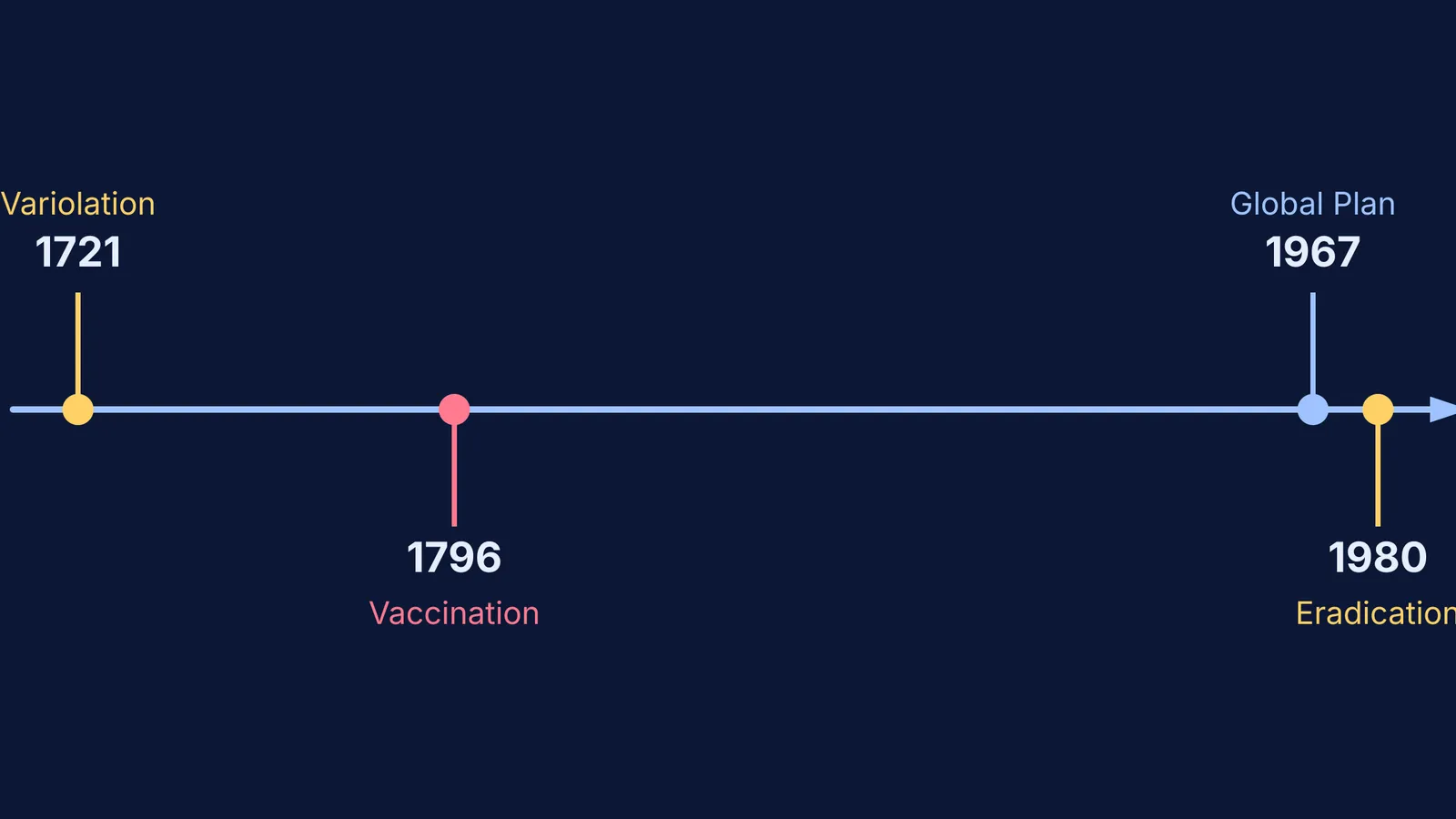
The transition from Lady Mary's observations to modern public health involved three distinct stages of biological strategy. Understanding these stages clarifies how early medicine evolved into modern immunology:
Variolation (The Montagu Era, 1721): The deliberate introduction of the target pathogen (live *variola* virus). It relied on the hope that a small dose through the skin would cause a localized, survivable infection, granting lifelong immunity. The risk was that the patient could still die or spark an outbreak.
Cross-Immunity (The Jenner Era, 1796): The introduction of a related, less virulent pathogen (cowpox virus). It safely trained the immune system to recognize shared antigens without the risk of causing the actual disease.
Global Surveillance (The WHO Era, 1967–1980): The combination of a highly effective vaccine with "ring vaccination"—isolating outbreaks and vaccinating every contact in a circle around the infected person. This strategy permanently broke the chain of transmission.
This framework shows how the core idea of immunological memory was first proven by Montagu, refined by Jenner, and ultimately used to eliminate the disease. If you are preparing for a biology exam and need to visualise how memory B cells and T cells respond to these different types of exposure, you can run an interactive simulation in the Fermi Simulation Lab.
How did her work pave the way for Edward Jenner?
Variolation carried risks, as the live smallpox virus could sometimes trigger a severe case. However, it was the best defense available and established the core concept of induced immunity.
This foundational idea paved the way for Edward Jenner. In 1796, Jenner (who had been variolated as a child) developed a much safer method using the related but far milder cowpox virus. This new process, termed "vaccination," eventually replaced variolation. When biology students study the cellular mechanics of antibodies and immunity today, they can trace these exact processes in the Fermi Concept Library. The shift from Montagu's variolation to Jenner's vaccination marked the birth of modern preventative medicine, echoing the later breakthroughs of Max Theiler and the vaccine against yellow fever, Kendrick, Eldering and the whooping cough vaccine, and Gerhard Armauer Hansen and the cause of leprosy.
When was smallpox finally eradicated?
The global fight against smallpox culminated in the 20th century. The World Health Organization launched an intensified eradication plan in 1967, relying on widespread immunization and rigorous surveillance.
The last known naturally occurring case was recorded in Somalia in 1977. By December 1979, a global commission certified the eradication, and the WHO officially declared smallpox eradicated in 1980. To this day, smallpox remains the only infectious disease affecting humans to have been completely wiped out. This success is rooted in the early interventions of pioneers like Lady Mary Wortley Montagu, who refused to accept the devastation of the disease.


