On this page
Mary Sherman was born on November 4, 1921, on a farm near Ray, North Dakota. Kept out of school to work on the farm until social services intervened when she was nine, she caught up rapidly and graduated as high school valedictorian in 1939, as documented in her biographical records. She studied chemistry at DeSales College before pausing her degree during the Second World War to manufacture explosives like TNT and pentolite at the Plum Brook Ordnance Works in Ohio.
In 1947, she applied to North American Aviation in California. Out of 900 engineers in the company's rocket division, she was the only woman and one of the few without a degree. Promoted to Theoretical Performance Specialist, she spent years calculating theoretical exhaust velocities, chamber pressures, and combustion temperatures by hand to predict propellant behaviour.
Why did the Redstone rocket need a new propellant?
In the mid-1950s, the United States was racing to place an artificial satellite into orbit. The Army Ballistic Missile Agency, directed by Wernher von Braun, relied on the Redstone missile, but its baseline propulsion was inadequate. Its engine burned 75% ethyl alcohol and 25% water with liquid oxygen (LOX). Diluting the alcohol with water lowered combustion temperatures to 3,230 K to keep the engine's regenerative cooling jacket from melting, as recorded in Astronautix propellant records.
To reach orbit, von Braun's team extended the fuel tanks and added three solid-fuel upper stages, creating the Juno I rocket. However, the rocket still fell short of orbital velocity because the water-diluted fuel limited operational sea-level specific impulse to 235 seconds. With no time to redesign the engine, the Army contracted Rocketdyne to deliver a drop-in replacement fuel that boosted thrust by at least 8%, as detailed in the Jupiter-C development history.
How did Mary Sherman Morgan formulate Hydyne?
Rocketdyne assigned the project to Mary Sherman Morgan. After calculating the performance of dozens of potential propellants, she formulated a synthetic blend of 60% unsymmetrical dimethylhydrazine (UDMH) and 40% diethylenetriamine (DETA), designated Hydyne.
UDMH provided high combustion energy, while DETA raised fuel density to 0.86 g/cm³ and stabilized flow through the regenerative cooling tubes. Burning Hydyne with liquid oxygen delivered a 12% increase in thrust and a theoretical sea-level specific impulse of 306 seconds, as recorded in Astronautix's LOX/Hydyne specifications.
On January 31, 1958, a Juno I powered by Hydyne lifted off from Cape Canaveral. According to NASA mission history, Explorer 1 achieved orbit with a perigee of 224 miles and an apogee of 1,575 miles, discovering the Van Allen radiation belts.
Why did a 12% thrust boost make orbital velocity possible?
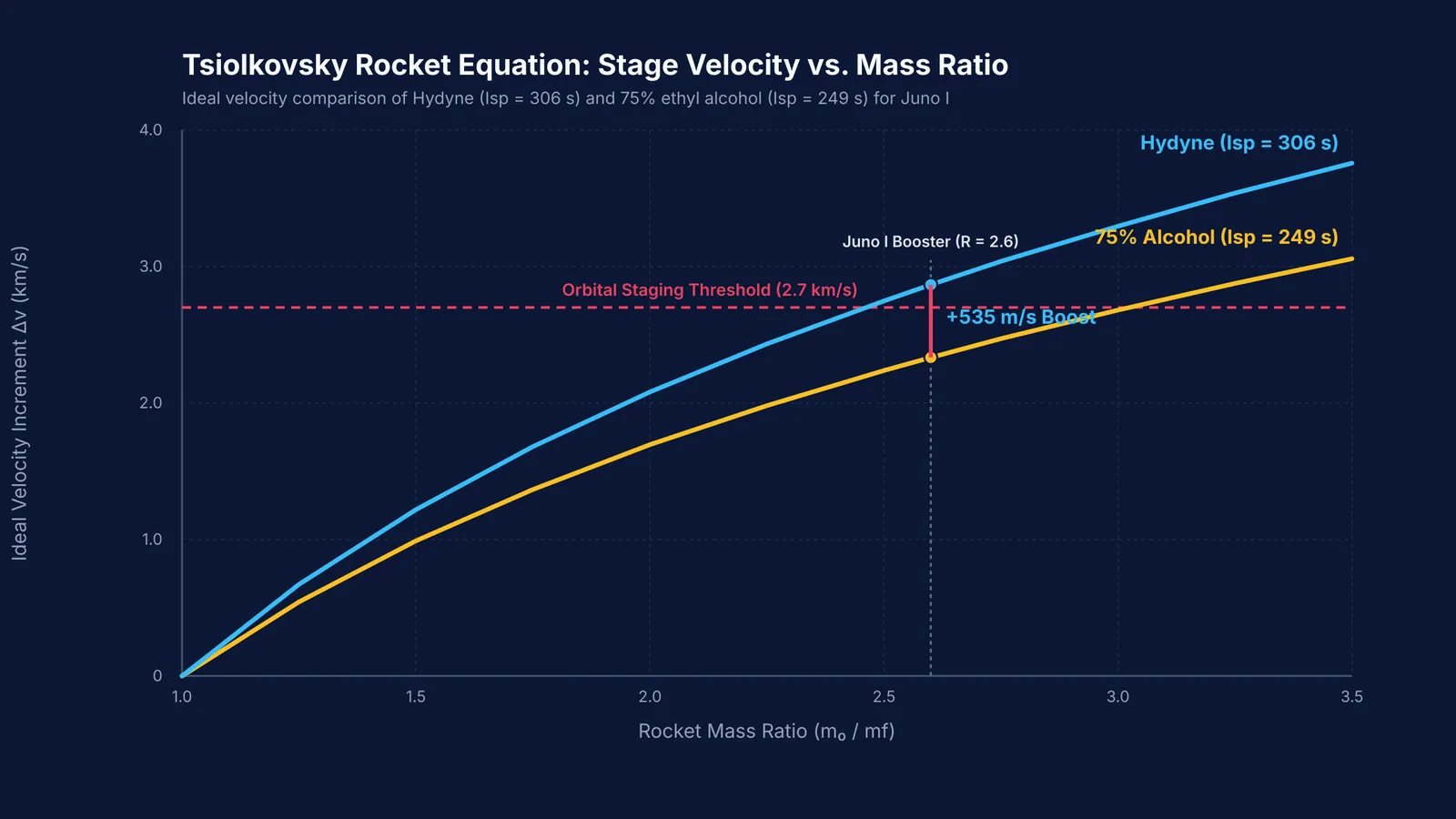
Tsiolkovsky's rocket equation explains why Morgan's 12% boost in thrust made orbit possible:
Δv = I_sp × g₀ × ln(m₀ / m_f)
Here, I_sp is specific impulse, g₀ is 9.81 m/s², and m₀ / m_f is the mass ratio (approximately 2.6 for the booster, giving ln(2.6) ≈ 0.956). You can review how a rocket engine expels mass to produce thrust to understand this momentum balance.
In ideal staging calculations, raising theoretical sea-level specific impulse from 249 seconds to 306 seconds shifts ideal stage velocity from Δv = 249 × 9.81 × 0.956 ≈ 2,335 m/s to Δv = 306 × 9.81 × 0.956 ≈ 2,870 m/s, as documented in Astronautix's LOX/Hydyne specifications.
After accounting for roughly 520 m/s lost to atmospheric drag and gravity during ascent, the propellant upgrade lifted booster burnout speed from 1,815 m/s to 2,350 m/s. That 535 m/s gain carried the upper stages into the upper atmosphere at the precise speed required to achieve the 7,800 m/s orbital velocity. You can test how mass ratios govern orbit in an interactive planetary orbits simulation.
How do aerospace engineers evaluate rocket propellants?
Evaluating rocket fuels requires balancing four engineering factors:
Specific impulse: Exhaust velocity dictates the velocity gained per kilogram of fuel.
Density impulse: Denser fuels allow smaller tanks, cutting vehicle dry mass.
Cooling performance: Fuel circulating through the nozzle jacket must absorb heat without boiling or polymerising.
Handling stability: Propellants must ignite reliably without degrading during storage.
Chemical energy release depends on bond enthalpies when reactants form stable exhaust molecules like steam and nitrogen. You can examine these thermal principles in this guide to enthalpy changes during combustion reactions.
Morgan's propellant research helped establish amine fuels in rocketry, including at India's Liquid Propulsion Systems Centre and ISRO launcher programs. For students tackling competitive exams like JEE Advanced, problems connecting mechanics, variable mass, and thermochemistry can feel daunting. The Fermi Problem Library provides worked problems with a step-by-step solver that explains the reasoning rather than printing an answer. For visual learners, the Fermi Simulation Lab offers interactive simulations for ideas that are easier to see than to read. And when planning study sessions, Fermi's AI tutor can work out what you already know and build a plan for the session.