

On this page
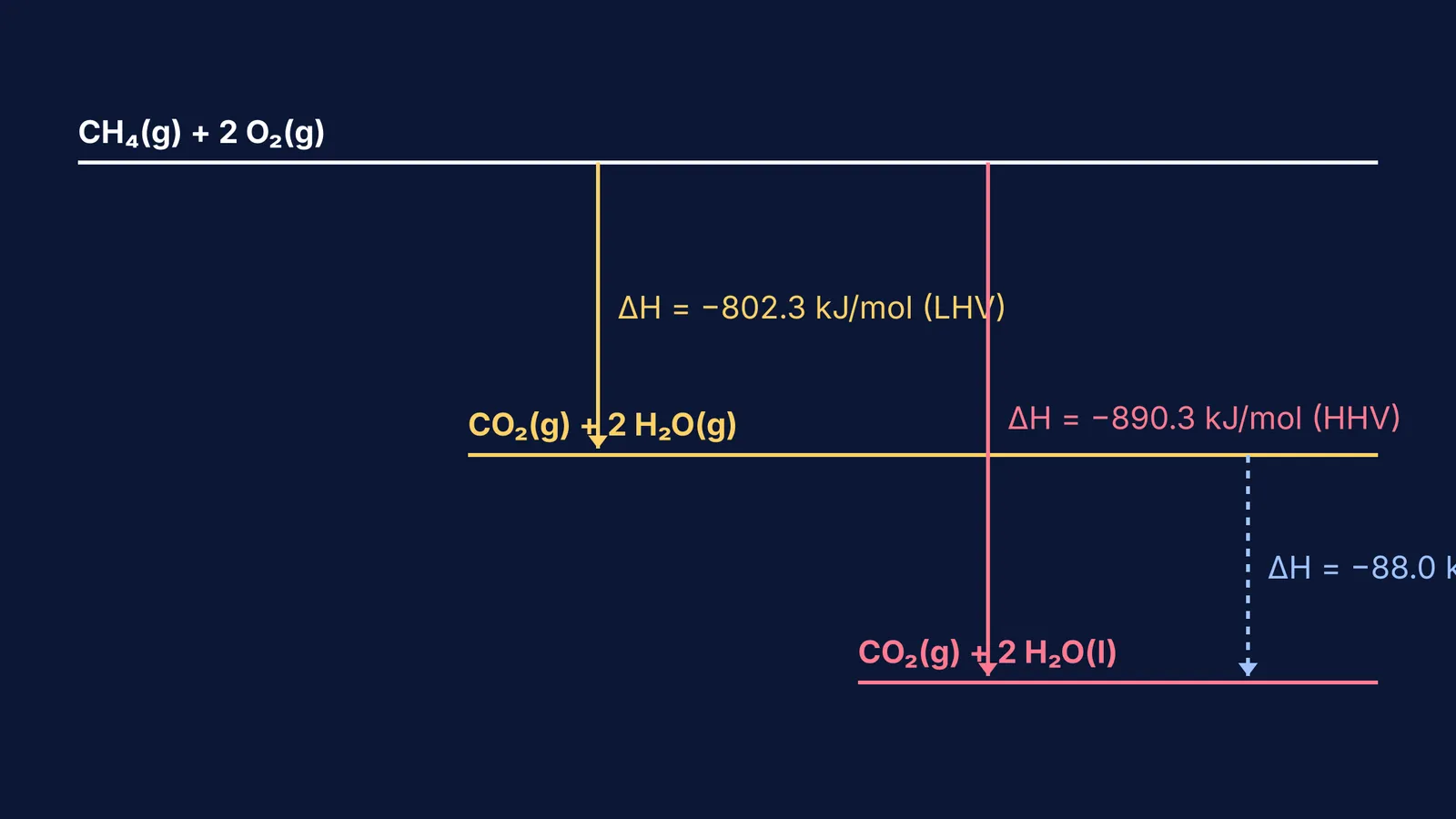
When you calculate or measure the enthalpy of combustion for a fuel, the state of the water produced changes the final answer. Burning a mole of methane (CH₄) releases 890.3 kJ of heat if the water condenses to a liquid, but only 802.3 kJ if it remains a vapour, based on standard NIST thermochemistry data.
This happens because condensation is exothermic. As water vapour cools to liquid water at 25 °C (298 K), it releases its latent heat of vaporisation.
Higher Heating Value (HHV): The total heat released when the products are cooled down and water condenses to a liquid.
Lower Heating Value (LHV): The heat released when the water produced escapes as a gas, taking its latent heat with it.
Engineers often use the LHV for car engines and power plants, because the exhaust leaves the tailpipe hot and the water never condenses. But in standard thermodynamics problems, such as those you solve for the JEE or NEET, the standard state of water at 298 K is liquid. If an exam question asks for the standard enthalpy of combustion without specifying the phase, it expects the HHV.
Why does the enthalpy of combustion differ for liquid water and water vapour?
The difference between the two combustion values is exactly the heat of vaporisation of the water produced.
According to the NIST Chemistry WebBook, the standard enthalpy of formation for liquid water is −285.83 kJ/mol, while for water vapour it is −241.83 kJ/mol. The difference between them is exactly 44.0 kJ/mol.
So, for every mole of water produced in a combustion reaction, the HHV will be 44.0 kJ/mol more exothermic (more negative) than the LHV.
How do you calculate the difference for methane?
Let's calculate both values for the combustion of methane using standard enthalpies of formation. Methane forms carbon dioxide and two moles of water:
CH₄(g) + 2 O₂(g) → CO₂(g) + 2 H₂O
The standard enthalpies of formation from the NIST Chemistry WebBook are −74.87 kJ/mol for methane and −393.51 kJ/mol for carbon dioxide.
Case 1: Liquid water (HHV) ΔH = [−393.51 + 2(−285.83)] − [−74.87 + 0] ΔH = −393.51 − 571.66 + 74.87 ΔH = −890.30 kJ/mol
Case 2: Water vapour (LHV) ΔH = [−393.51 + 2(−241.83)] − [−74.87 + 0] ΔH = −393.51 − 483.66 + 74.87 ΔH = −802.30 kJ/mol
The difference is 88.0 kJ/mol. Because methane produces two moles of water, the gap is exactly 2 × 44.0 kJ/mol.
Why is the phase difference dramatic for hydrogen fuel?
The phase of water becomes even more significant when we look at hydrogen, which is often praised as the ultimate clean fuel. Its combustion produces only water:
H₂(g) + ½ O₂(g) → H₂O
For hydrogen, the standard enthalpy of combustion is identical to the standard enthalpy of formation of water. The HHV is simply the value for liquid water (−285.83 kJ/mol), while the LHV is the value for water vapour (−241.83 kJ/mol).
Because hydrogen is so light, this 44.0 kJ/mol gap makes a massive difference when calculated by mass. The HHV of hydrogen is about 141.8 MJ/kg, while the LHV is 120.0 MJ/kg. This massive difference dictates how much useful work an engineer can actually extract from a hydrogen fuel cell or a rocket engine. In aerospace applications where the exhaust is superheated steam, the lower value represents the reality of the engine's thrust.
Why do bond enthalpies give you the wrong answer?
A common way students lose marks is by calculating the enthalpy of combustion using mean bond enthalpies.
Bond enthalpies measure the energy required to break bonds in the gaseous state. When you use them to calculate the heat of a reaction, you are implicitly assuming that all reactants and products are gases. For methane, the calculation using bond enthalpies will naturally yield the Lower Heating Value (LHV), with H₂O(g) as the product.
However, if an exam asks for the standard enthalpy of combustion, it expects the Higher Heating Value (HHV) with H₂O(l). To fix your bond enthalpy calculation, you must subtract an extra 44.0 kJ for every mole of water formed to account for the condensation step. Phase states also matter when estimating reaction enthalpy in this way, since forgetting the latent heat leaves your final answer artificially low.
How can you avoid phase mistakes in exams?
If you mix up the phase of water, your calculation will be off by a multiple of 44.0 kJ/mol. This is a deliberate trap in multiple-choice questions.
Read the products: If the equation explicitly says H₂O(g), use the data for vapour.
Standard means liquid: If a question asks for the "standard enthalpy of combustion" of a hydrocarbon at 298 K, assume H₂O(l) unless told otherwise.
Use Hess's Law to switch: If you know the enthalpy of combustion for liquid water but need the vapour value, just add 44.0 kJ for every mole of water produced. You can use Hess's law and enthalpy calculations to link the two states.
If you are dealing with solid or gaseous salts, the physical state is equally critical. For example, lattice enthalpy and the Born-Haber cycle rely on precise phase transitions from solid to gas and gas to ions.
If you are prone to mixing up the phases, the Fermi Problem Library has a step-by-step solver that explains the reasoning for Hess's Law problems, helping you catch subscript mistakes before you calculate the final sum. You can also review standard state reactions in the Fermi Concept Library.


