

On this page
In December 1990, geneticist Mary-Claire King and her team published a paper in Science called Linkage of early-onset familial breast cancer to chromosome 17q21. It showed that in families where breast cancer strikes young women, the disease is passed down the generations together with one small stretch of chromosome 17. The gene in that stretch is now called BRCA1.
Who is Mary-Claire King?
King is an American geneticist who was a professor at the University of California, Berkeley when she found BRCA1, according to the Lasker Foundation's account of her work. Her PhD work, published in 1975, showed that human and chimpanzee proteins are more than 99 percent identical. She began hunting for a breast cancer gene in 1974. A 1988 study by her group, of more than 1,500 families, suggested that 4 percent of them carry a single gene that predisposes them to the disease. She received the 2014 Lasker~Koshland Special Achievement Award.
How did Mary-Claire King find the BRCA1 gene?
King did not know what the gene looked like or where it was, so she used genetic linkage. If a disease gene sits close to a known DNA marker, crossing over rarely separates them, so they are inherited together.
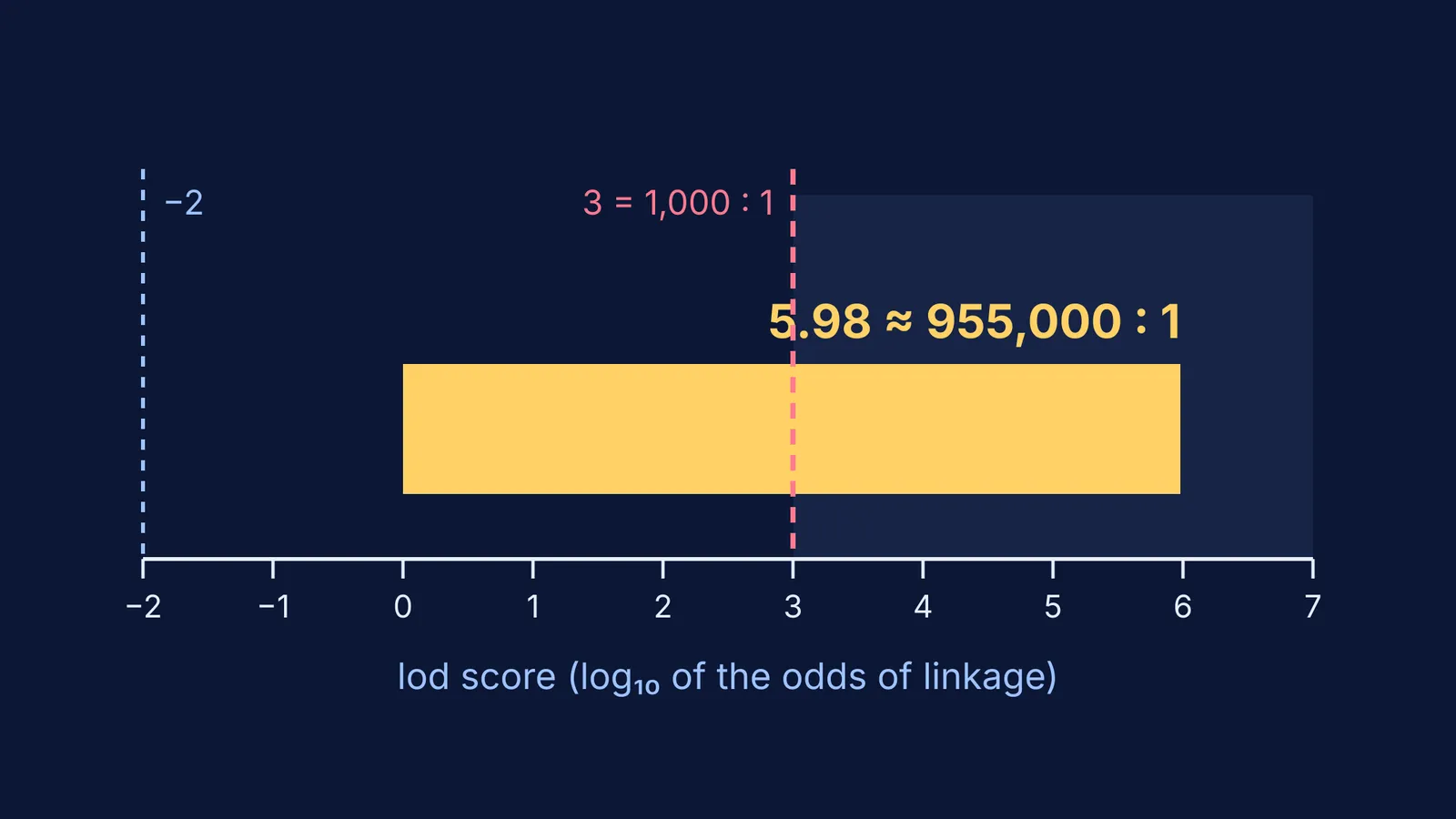
According to a 2014 Journal of Clinical Investigation profile, her team recruited 23 extended families with 329 relatives and 146 cases of invasive breast cancer, and genotyped 173 different markers, mostly by Southern blotting. The decisive step was sorting the families by the age at which women were diagnosed. In early-onset families the Science paper reports a lod score of 5.98 for linkage to the marker D17S74 on 17q21, while families with late-onset disease gave negative lod scores.
To practise the family-tree reasoning she relied on, see our guide on how to tell whether a pedigree chart is dominant or recessive.
What does a lod score of 5.98 mean?
A lod score is the base-10 logarithm of how much more likely the family data are if a marker and a disease gene are linked than if they are not. A lod score of 3 means the odds of linkage are 1,000 times greater than the odds against, and a score above 3 has traditionally been taken as significant, as Dale Nyholt explains in the American Journal of Human Genetics.
Here is how to read King's number, as a worked example:
Undo the logarithm: 10 raised to 5.98 is about 955,000, so the data were nearly a million times more likely under linkage.
Compare it with the threshold: 5.98 minus 3 is 2.98, and 10 raised to 2.98 is about 955. King's result was close to a thousand times stronger than the minimum usually accepted.
Read the negative scores: a lod below 0 means odds under 1, so the late-onset families pointed away from linkage.
Keep the caveat: Nyholt notes that once you allow for the prior odds that two markers picked at random are unlinked, a lod of 3 is closer to 20 to 1 odds.
Linkage rests on recombination, covered in our explainer on mutation vs recombination. If logarithms or crossing over still feel shaky, the Fermi Concept Library has a lesson for every concept in biology and mathematics, each with its place in the map.
What happened to BRCA1 after 1990?
The finding set off an international race to isolate the gene itself, the Lasker Foundation notes. In October 1994 a team led by Mark Skolnick at Myriad Genetics and the University of Utah reported a strong candidate for BRCA1 in Science, with probable disease-causing mutations in five of eight families studied and a predicted protein 1,863 amino acids long.
Today, the US National Cancer Institute's BRCA fact sheet says BRCA1 and BRCA2 make proteins that help repair damaged DNA. It states that about 13% of women in the general population will develop breast cancer in their lifetime, compared with more than 60% of women who inherit a harmful change in BRCA1 or BRCA2.
Who should ask about BRCA1 testing?
That is a question for a doctor or genetic counsellor. The NCI fact sheet says anyone worried they may have inherited a harmful change should discuss it with their health care provider or a genetic counsellor. It lists signs such as a personal or family history of breast cancer at age 50 or younger, or of ovarian, male breast or pancreatic cancer. NCI also notes that everyone has two copies of each BRCA gene, one inherited from each parent, so both sides of the family matter.
What you can do at home is gather the same raw material King's study started from: a written family history. A useful sheet has, for each relative:
relationship to you, and whether on your mother's or father's side
the type of cancer, not just "cancer"
the age at diagnosis
whether they are living, and any genetic test results already known
Take it to the appointment so the doctor or counsellor can decide what, if anything, comes next. For another chromosome story, read about how Joe Hin Tjio found that humans have 46 chromosomes.