

On this page
In early 1934, at the Cavendish Laboratory in Cambridge, the Australian physicist Mark Oliphant and the Austrian physical chemist Paul Harteck fired fast deuterons (nuclei of heavy hydrogen) at targets that also contained deuterium. Two light nuclei joined, and the products included a new nucleus: tritium (hydrogen-3). They also proposed a second outcome that gives helium-3. Historian Helge Kragh's history of the heavy hydrogen isotopes says the experiments were "principally due to Oliphant and Harteck", with Ernest Rutherford's contribution "largely limited to discussion and interpretation of the results."
Oliphant was born in Adelaide in 1901, studied at the University of Adelaide and then went to Cambridge to work under Rutherford, according to his Wikipedia biography, which credits him as the first to experimentally demonstrate nuclear fusion. His 1934 result is a real example of an idea in your syllabus: when light nuclei fuse, a little mass disappears as energy.
What did Oliphant, Harteck and Rutherford find in 1934?
The team reported first in a short letter, Transmutation effects observed with heavy hydrogen, in Nature on 17 March 1934. A full paper with the same title followed in the Proceedings of the Royal Society A, volume 144, pages 692-703. Its abstract says the DC voltage available to their accelerator had been raised from 200,000 to 400,000 volts.
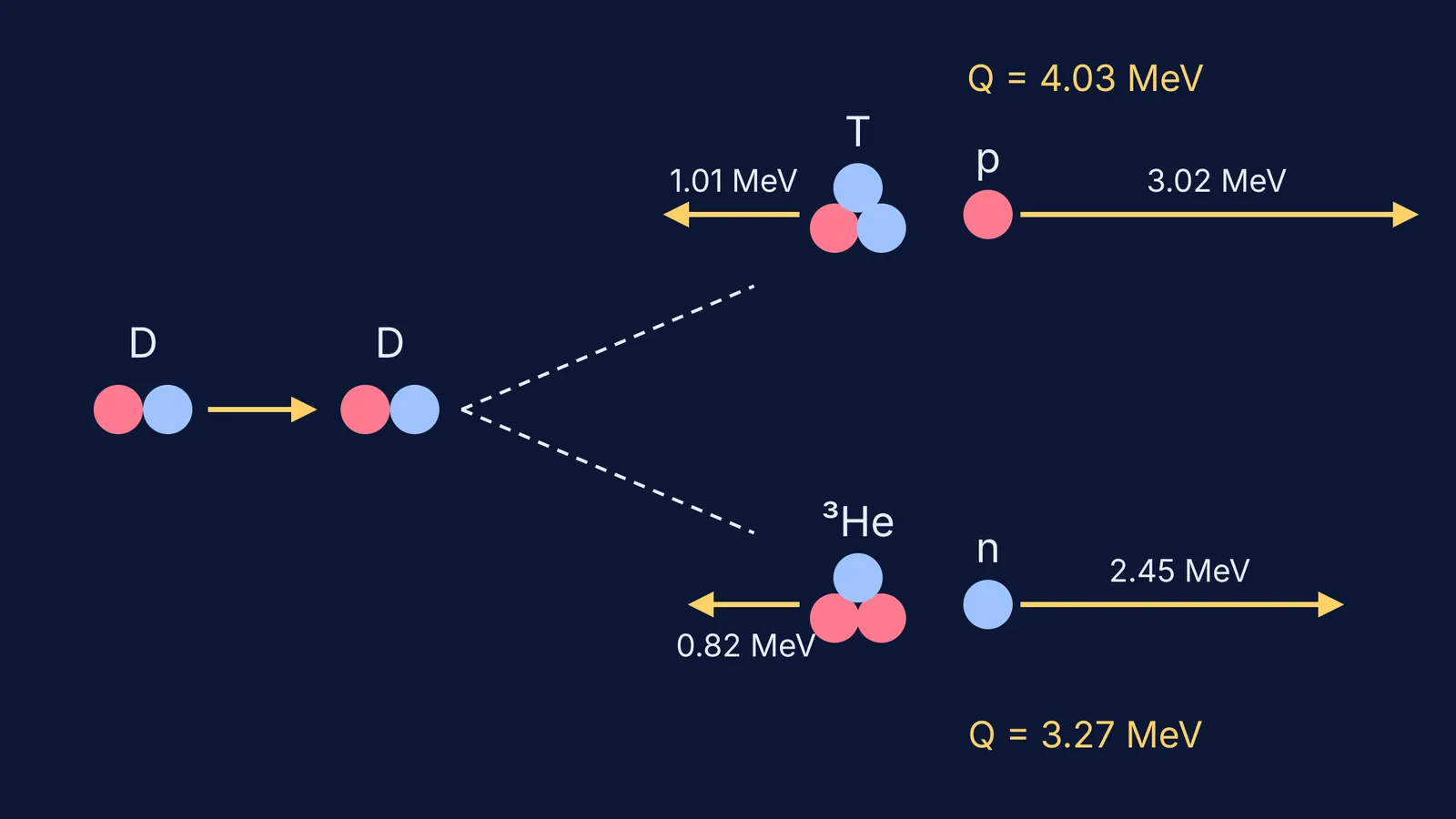
As Kragh's account sets out, the team proposed two ways that two deuterons (D) could combine:
D + D → ¹H + ³H, a proton plus tritium, releasing 4.0 MeV
D + D → ³He + n, helium-3 plus a neutron, releasing 3.2 MeV
They were confident about tritium and more careful about helium-3. In the Royal Society paper they wrote: "While we have not yet detected the ₂He³ particles which we believe to be present, we have not yet obtained any evidence that they do not exist" (quoted by Kragh). Kragh concludes that priority for discovering tritium belongs to Rutherford and his Cavendish group.
Why does fusing deuterium release energy?
The particles flying out carried far more energy than the deuterons brought in. Add up the product masses and the total is slightly less than the mass of the two deuterons. That missing mass is the mass defect, and Einstein's E = mc² turns it into energy.
The conversion you need is that 1 atomic mass unit (u) is equivalent to 931.494 MeV, according to the NIST value of the atomic mass constant energy equivalent.
What stays the same is the count of particles. Protons and neutrons are only rearranged, which is why mass number is conserved but mass is not.
How do you calculate the energy of D-D fusion?
Check the 1934 numbers yourself. The atomic masses below are from NIST's tables for hydrogen isotopes and helium isotopes, with the neutron mass from CODATA: D = 2.014101778 u, ³H = 3.016049278 u, ¹H = 1.007825032 u, ³He = 3.016029320 u, n = 1.008664916 u.
Branch 1, D + D → ³H + ¹H:
Mass before: 2 × 2.014101778 = 4.028203556 u
Mass after: 3.016049278 + 1.007825032 = 4.023874310 u
Mass defect: 4.028203556 − 4.023874310 = 0.004329246 u
Energy: 0.004329246 × 931.494 ≈ 4.03 MeV
Branch 2, D + D → ³He + n:
Mass after: 3.016029320 + 1.008664916 = 4.024694236 u
Mass defect: 4.028203556 − 4.024694236 = 0.003509320 u
Energy: 0.003509320 × 931.494 ≈ 3.27 MeV
Both are close to the 4.0 MeV and 3.2 MeV given in Kragh's history. The missing mass is about 0.11% and 0.09% of the starting mass. For the general method, see our guide on how to calculate the Q value of a nuclear reaction.
One more step makes a good exam question. The two products fly apart with equal and opposite momentum. Kinetic energy is p²/2m, so the lighter particle takes the larger share. In branch 1 the proton carries about 3.02 MeV and the triton about 1.01 MeV. In branch 2 the neutron carries about 2.45 MeV and the helium-3 nucleus about 0.82 MeV.
What can students learn from Oliphant's experiment?
Use this checklist on any fusion or fission question:
Balance the mass numbers and charges first.
Add the atomic masses on each side and subtract to get the mass defect.
Multiply by 931.494 MeV per u. A positive answer means energy is released.
Share the energy using momentum conservation if the question asks for the energy of each particle.
Remember why fusion needs a push: two positive nuclei repel, so Oliphant needed an accelerator. See why nuclear fusion needs very high temperatures.
If you get stuck on a step like the energy sharing, the Fermi Problem Library has worked problems with a step-by-step solver that explains the reasoning rather than printing an answer. If two nuclei pushing against their repulsion is hard to picture, the Fermi Simulation Lab has interactive simulations for ideas that are easier to see than to read.
Work through both branches once with the NIST numbers, and Oliphant's 1934 result becomes something you have checked yourself.


