On this page
Mark Dean is a computer engineer whose work defines how modern computers operate. From his early days designing the IBM Personal Computer to breaking speed barriers in processor development, his work provided the foundation for expandable, high-speed digital systems. If you have ever plugged a printer or a graphics card into a computer, you have used technology derived from his inventions.
Who is Mark Dean and what did he invent?
Born in 1957 in Jefferson City, Tennessee, Dean showed an early interest in engineering by building a tractor from scratch with his father Wikipedia). He joined IBM in 1979 in Boca Raton, Florida, where he became a key member of the "Project Chess" team IBM. This was the engineering group that developed the first IBM Personal Computer, introduced in 1981.
Dean holds three of the original nine patents for the IBM PC IBM. He was promoted to chief engineer of PC design at age 25 Wikipedia). Among his many projects, he developed the adapters for monochrome and color graphics, which led to the first color PC monitor Invent.org.
What is the ISA bus and how did it change the IBM PC?
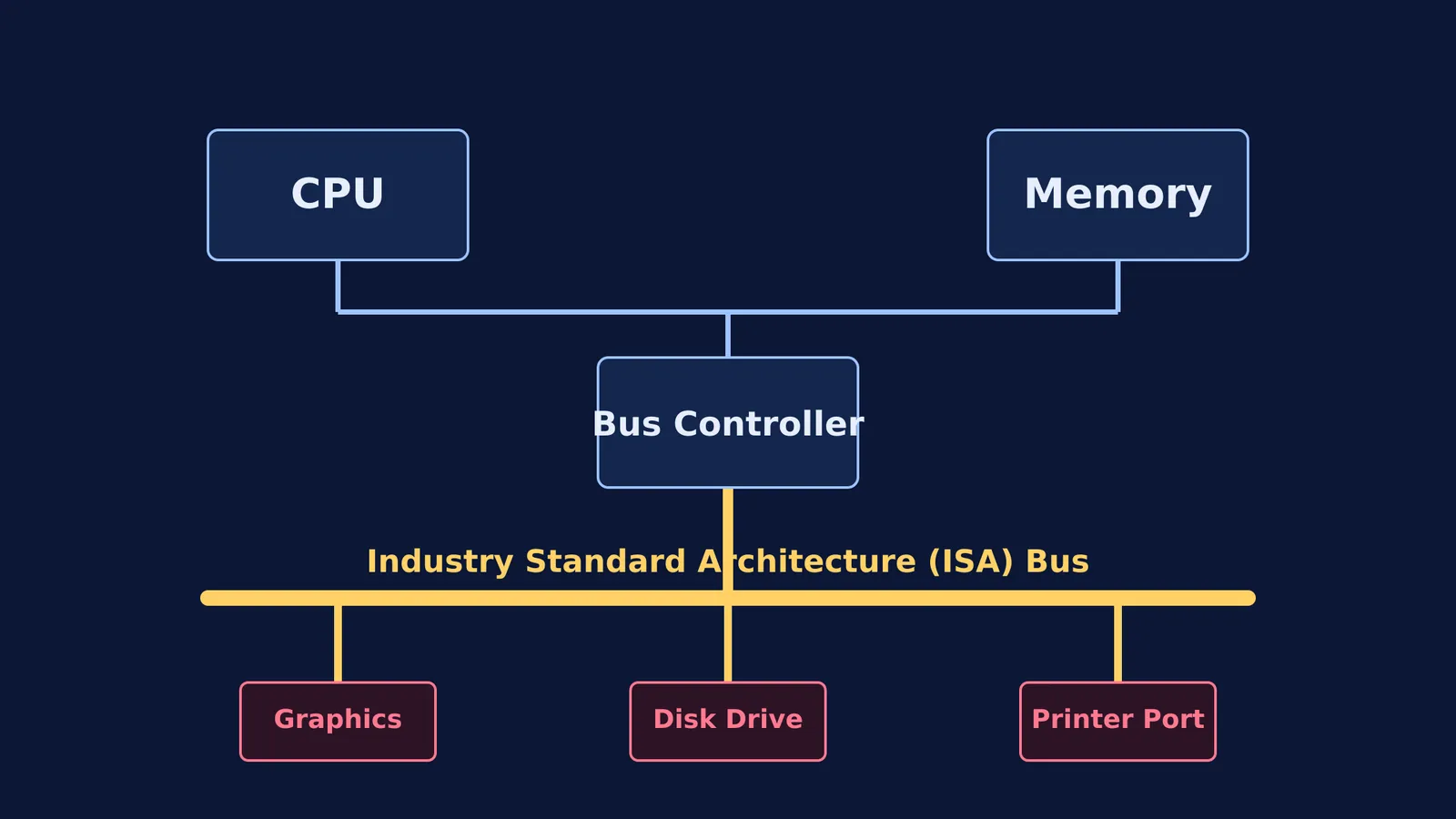
Before the early 1980s, connecting a new device to a computer was difficult and often required custom hardware. Mark Dean and his colleague Dennis Moeller solved this by co-inventing the Industry Standard Architecture (ISA) bus, originally known as the AT bus IBM.
The ISA bus was a standardized communication system that allowed peripheral devices to plug directly into the computer and communicate with the central processing unit IBM. This ecosystem meant that anyone could manufacture a compatible printer, disk drive, or monitor. For this invention, Dean and Moeller received U.S. Patent 4,528,626 and were inducted into the National Inventors Hall of Fame in 1997 Invent.org.
To see how other early computer interfaces were built, read about Douglas Engelbart and the computer mouse: how a pointer finds x and y.
Who built the first 1 GHz computer chip?
As computers grew more complex, they needed faster processors. In 1998, Dean was the director of IBM’s Austin Research Laboratory. There, he led the engineering team that created the first experimental CMOS microprocessor capable of operating at 1 gigahertz (1,000 MHz) IBM.
At the time, typical fast processors operated at speeds below 300 MHz IBM. Reaching 1 GHz was a significant achievement in physics and engineering, demonstrating that a chip could perform one billion cycles per second.
You can read more about the early days of computing hardware in our post on Konrad Zuse and the Z3: a programmable computer built from relays.
How did Mark Dean build his career?
Dean backed up his practical inventions with rigorous academic training. He earned a B.S. in Electrical Engineering from the University of Tennessee in 1979, an M.S. from Florida Atlantic University, and eventually a Ph.D. in Electrical Engineering from Stanford University in 1992 Wikipedia). He returned to school for his doctorate while already a successful engineer at IBM.
In 1995, he became the first Black American to be named an IBM Fellow, the company's highest technical honor IBM. He later led the Blue Gene supercomputer project, which produced the fastest computer in the world in 2004 IBM.
A framework for solving system-level problems
Mark Dean’s work on the ISA bus shows the power of system-level thinking. When you face a complex engineering or physics challenge, try this approach:
Define the interface: Just as the ISA bus created a standard way for a printer to talk to a CPU, figure out exactly how the different parts of your problem interact. What information does step A pass to step B?
Master the fundamentals: Breaking the 1 GHz barrier IBM required a deep understanding of semiconductor physics and heat dissipation. The Concept Library contains detailed lessons for every concept in physics and computing to help you review the basics.
Build step by step: When tackling a long, multi-stage problem, do not rush to the final answer. If you get stuck on the logic, Fermi's AI tutor can work out what you already know and build a plan for the session, teaching you through the process while checking your understanding as it goes.
Dean retired from IBM in 2013 and became a professor at the University of Tennessee IBM. His career proves that the best engineers do not just build faster machines; they build the foundations that let everyone else create something new.