

On this page
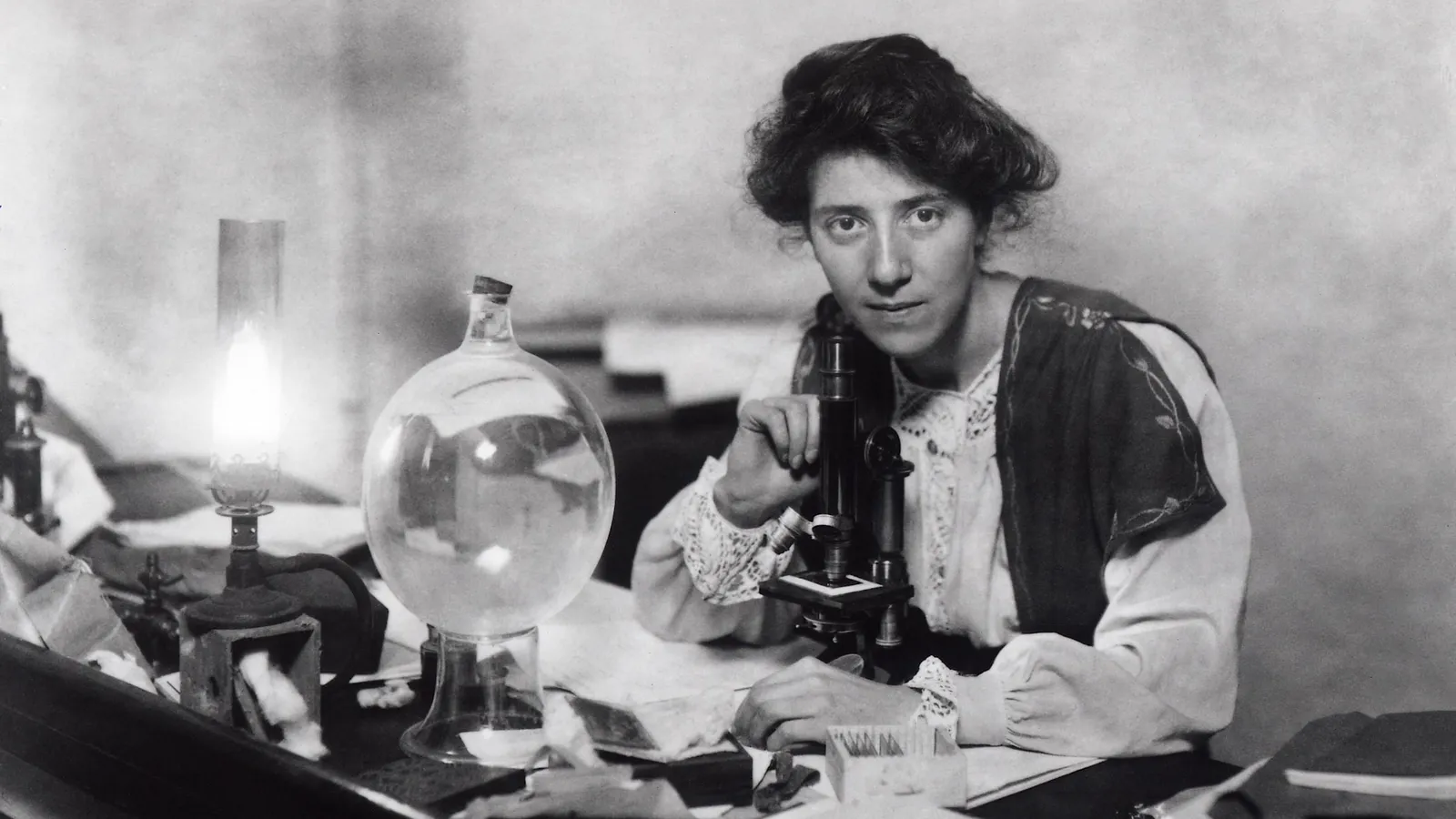
Most people know Marie Stopes (1880-1958) for her later campaigns on birth control. Her first career was in fossil plants. Palaeobotanist Howard Falcon-Lang, in a 2008 lecture printed in the Mercian Geologist, says she spent nearly two decades as a palaeobotanist and coal geologist. He also records what she told the young palaeobotanist Bill Chaloner when they met in 1952: "Of course, palaeobotany was my first love!"
Who was Marie Stopes before birth control?
Stopes read geology and botany at University College London from 1900 to 1902 and spent a year as research assistant to her botany tutor, Francis Oliver. In 1903 she went to Munich to study for a PhD with Karl Goebel, according to Falcon-Lang's lecture. She finished her doctorate on the reproduction of living cycads in ten months.
In 1904 she became the first woman appointed to the science staff of the University of Manchester, says the AIM25 archive record of her papers.
What are coal balls, and what did Stopes prove about them?
Coal balls are hard, lime-rich lumps embedded in some coal seams. They hold plant tissues so perfectly petrified that you can work out the structure of the plants under a microscope. That is how Stopes and David Watson described them in their 1909 paper in the Philosophical Transactions of the Royal Society (volume 200, pages 167-218). They warned that coal balls were "being daily destroyed" as mines were worked, so they set out to record where the nodules occurred and how they formed.
The paper named the two main theories of the time: the plants that make up coal grew where the coal now lies, or they drifted there. Falcon-Lang explains that, against popular opinion, Stopes showed the Lancashire coal balls were mineralised peat, formed as seawater flooded Carboniferous coal swamps from time to time. Her co-worker Watson was a nineteen-year-old undergraduate at the time.
Why did Marie Stopes go to Japan?
Stopes wanted to find the earliest remains of flowering plants. In 1907 she persuaded the Royal Society to fund an 18-month trip to Japan, according to Falcon-Lang. She worked at the Imperial University in Tokyo and explored the country for fossils, as the AIM25 record notes.
On Hokkaido, the northern island, she found petrified plants in Cretaceous nodules. With the botanist Kenjiro Fujii she described 18 plants from this "extraordinarily rich" material in a 1909 Royal Society paper. The full account followed in a 90-page 1911 monograph, which said the nodules appeared to be the only known structures of Mesozoic age in which such petrified plants occur. She found what were then the earliest known flowers and deposited her fossils at the Manchester Museum on her return in 1909, says Falcon-Lang.
What did she add to the science of coal?
In 1910 Reginald Brock, director of the Geological Survey of Canada, asked her to date disputed rocks in Atlantic Canada from their fossil plants. After a month of fieldwork in Saint John, New Brunswick, in 1911, she gave her verdict. Falcon-Lang writes that the monograph from this work showed the rocks were Carboniferous, not Devonian or Silurian.
Her last major work was about coal as a rock. In a 1919 paper in the Proceedings of the Royal Society, drawing on joint research with R. V. Wheeler, she described the four visible ingredients of banded bituminous coal. Falcon-Lang calls the names she coined, vitrain, clarain, durain and fusain, "now familiar terms" for the bands you can see in a lump of coal.
By then her life had turned. She published Married Love in 1918, and later embraced eugenics, views Falcon-Lang describes plainly and that are widely rejected today. Remembering her science does not mean excusing that.
How can you read evidence the way Stopes did?
The coal-ball question is a good model for any "how did this form?" problem in biology or geography. Try these four steps, using coal balls as the worked example:
Name the object exactly: a mineral nodule inside a coal seam, full of plant cells.
Write two rival explanations: the plants grew here, or they drifted here.
Ask what each one predicts: plants that grew in place should look like a swamp floor, with roots and stems together; drifted plants should be mixed, broken fragments.
Check the evidence against both, then commit to one and say why.
You can use the same steps for a fossil in your textbook or a Class 8 question on how coal formed. If the word "fossil" still feels vague, the evidence from fossils and radioactive dating is a good next read, and the Fermi Concept Library gives every concept in biology its own lesson and place in the map.
For an Indian scientist who also read the past from fossil plants, see Birbal Sahni and palaeobotany.


