

On this page
Norethisterone, one of the hormones that made the contraceptive pill possible, has a student's name on its patent. This is the story of Luis Miramontes, what he actually made, and how you can read his molecule like a chemist.
Who was Luis Miramontes?
Luis Ernesto Miramontes Cárdenas was born on 16 March 1925 in Tepic, Nayarit, Mexico, and did his undergraduate studies in chemistry and chemical engineering at the National Autonomous University of Mexico (UNAM) from 1945 to 1949, according to this Visionlearning profile. In 1950 the chance came to do his undergraduate thesis research in the laboratories of Syntex, a Mexico City chemical company.
He later completed a doctorate, was among the founding researchers of UNAM's Institute of Chemistry, and served as deputy director of research at the Mexican Institute of Petroleum, working on petrochemistry and atmospheric chemistry, the same profile records. He won Mexico's National Prize in Chemistry in 1986 and died in 2004. UNAM's Gaceta reports that the Mexican Academy of Sciences judged the synthesis of norethisterone to be Mexico's greatest scientific contribution.
What did Miramontes synthesise in 1951?
On 15 October 1951, working under the direction of Carl Djerassi and George Rosenkranz, Miramontes worked out the final step in making norethisterone (also called norethindrone), Visionlearning reports. He was 26 and had not yet finished his undergraduate degree. Natural progesterone had to be injected; the new compound kept its potency when taken by mouth, and the profile describes it as eight times more potent than natural progesterone.
US patent 2,744,122, assigned to Syntex and granted on 1 May 1956, names Carl Djerassi, Luis Miramontes and George Rosenkranz as inventors, with a priority date of 22 November 1951. It describes the route: start from 3-methoxyestrone, reduce it with lithium metal in liquid ammonia, protect the ketone as an enol ether, then add acetylene at carbon 17.
The full chemistry appeared in the Journal of the American Chemical Society in 1954, volume 76, pages 4092 to 4094, by Djerassi, Miramontes, Rosenkranz and Franz Sondheimer.
How is norethisterone different from progesterone?
All three hormones below share the same four-ring steroid skeleton. Here are their molecular formulas from PubChem:
Progesterone: C21H30O2
Testosterone: C19H28O2
Norethisterone: C20H26O2
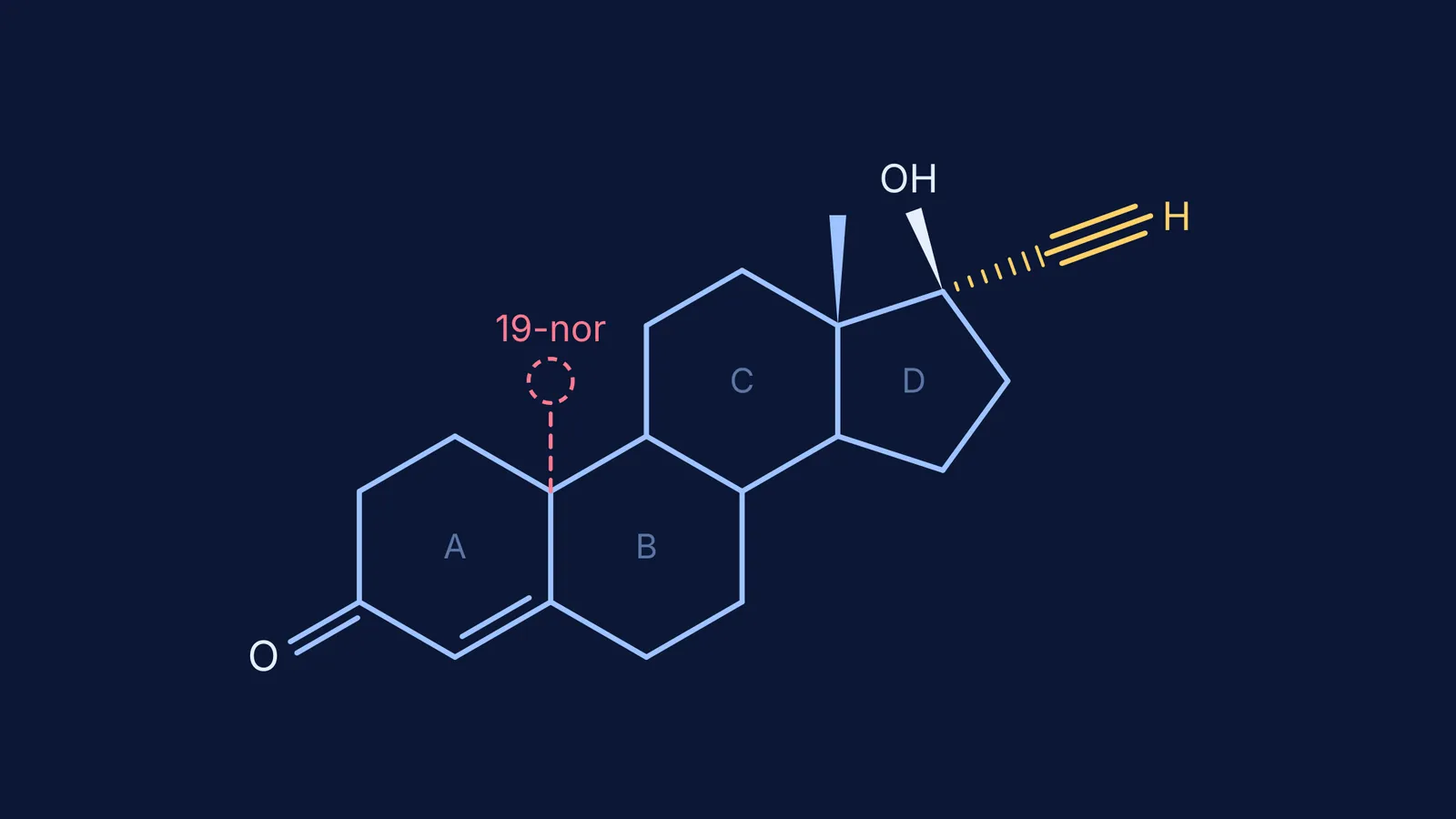
Norethisterone is built from the testosterone skeleton, not the progesterone one, which is why its chemical name, 19-nor-17α-ethynyltestosterone, ends in "testosterone". You can check the formula yourself in three steps:
Start with testosterone, C19H28O2.
"19-nor" means the methyl group at carbon 19 is replaced by a hydrogen atom. Remove CH3, add H: C19H28O2 becomes C18H26O2.
"17α-ethynyl" means a hydrogen at carbon 17 is replaced by an ethynyl group, C≡CH. Remove H, add C2H: C18H26O2 becomes C20H26O2.
That matches PubChem's formula for norethisterone exactly. The hero diagram above shows both changes: the dashed pink circle is the missing carbon 19, and the gold group is the ethynyl.
If names like these trip you up in organic chemistry, the Fermi Concept Library gives every chemistry concept its own lesson, so you can go back to functional groups and nomenclature before trying the next one.
Why did a swallowable progestin matter for the pill?
Progestins are compounds that act like progesterone, one of the hormones that rises and falls across the menstrual cycle. Our day-by-day guide to the menstrual cycle hormone graph shows where progesterone fits.
A hormone that has to be injected is hard to use every day. A potent one that survives being swallowed can go into a tablet. Visionlearning notes that norethindrone became a prime component of the first oral contraceptive pills and is still used in many contraceptive formulations today. The biology and clinical trials that turned progestins into a pill are a separate story, told in our post on Gregory Pincus and the first oral contraceptive. Which medicine suits a particular person is a question for a doctor, not an article.
For another chemist who turned steroid chemistry into medicines, read how Percy Julian made medicines from soybeans.
What can a student take from his story?
Three habits from his path are worth copying:
Get into a real lab early. His thesis was done inside an industrial research lab, not only in a classroom. In India, summer research fellowships and college project work are the nearest equivalent.
Master the basics that the big result rests on. The patent's steps are a reduction, protecting a group and adding acetylene to a ketone: reaction types covered in undergraduate organic chemistry.
Keep records of your work. Careful lab records are what patents and papers are built on, and his name appears on both.
When a multistep organic problem goes wrong at one step, the Fermi Problem Library has worked problems with a step-by-step solver that explains the reasoning rather than printing an answer.


