

On this page
Every JEE student writes F = ma and F = GMm/r² and cancels the m. That step assumes the mass that resists being pushed equals the mass gravity pulls on. The Hungarian physicist Loránd Eötvös tested that assumption with a rod, two weights and a thin fibre.
What is the difference between gravitational and inertial mass?
Inertial mass is the m in F = ma: how hard an object is to accelerate. Gravitational mass is the m in Newton's law of gravitation: how strongly gravity pulls on it. If the two are equal, every object falls with the same acceleration whatever it is made of.
As Anna Nobili and Alberto Anselmi explain in their review of equivalence-principle tests (Physics Letters A, 2017), Newton stated this equivalence in the opening paragraph of the Principia in 1687. Galileo's pendulum tests checked it to about 1 part in 1,000, and later pendulum tests reached a few parts in 100,000.
How did Eötvös's torsion balance compare the two masses?
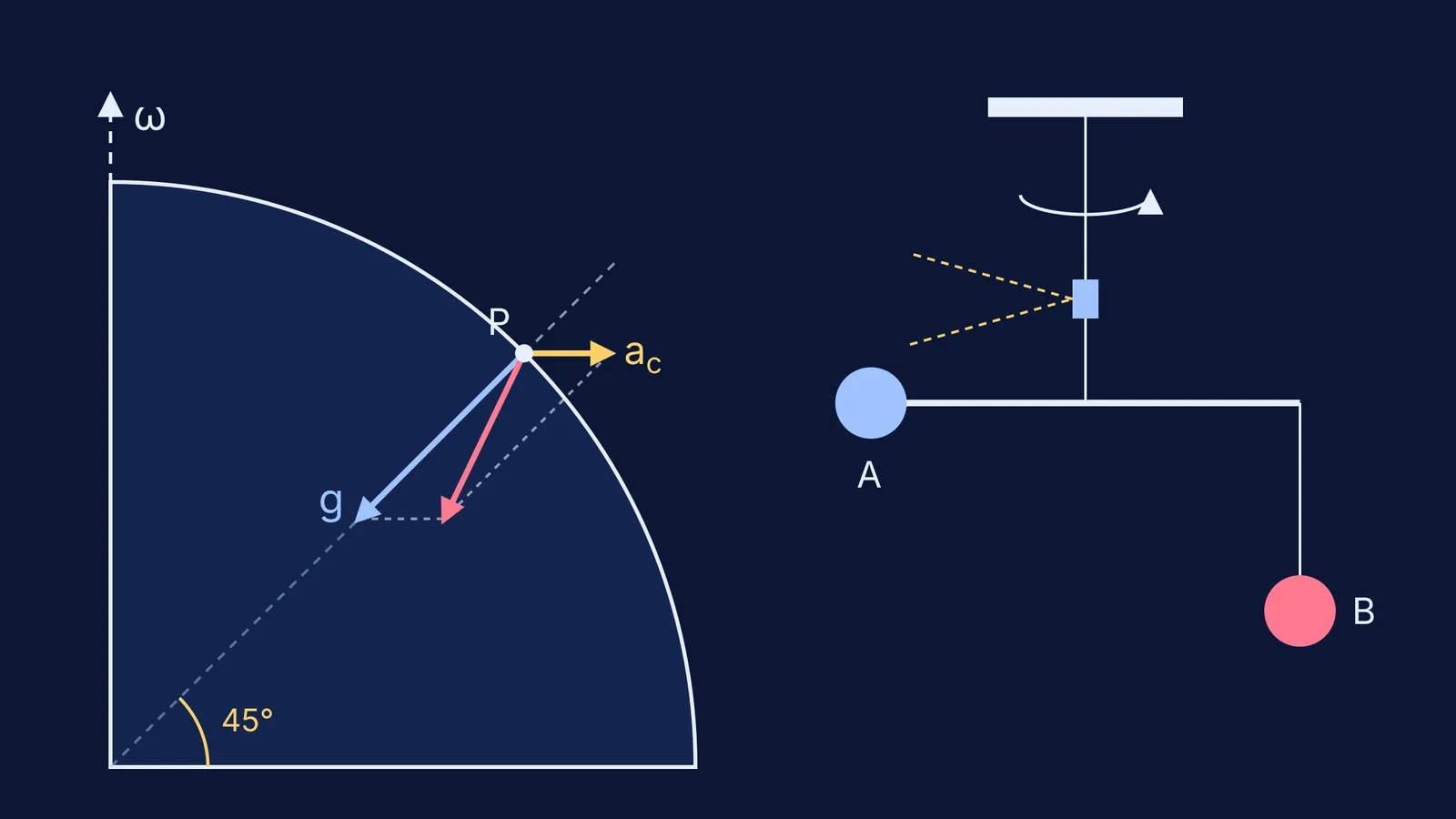
A torsion balance is a horizontal rod hung at its middle from a thin fibre, so that the smallest sideways force twists it. In Eötvös's device, a mirror on the rod or fibre reflected light into a small telescope to show the twist (Eötvös experiment overview).
Eötvös's trick was to use the Earth's rotation. In Einstein's words, as translated in Nobili and Anselmi's review: "The gravitational mass is the determining factor for the first force, and the inertial mass for the second one." The first force is gravity; the second is the centrifugal force from Earth's spin. If the ratio of the two masses differed between two materials, the two weights on the rod would feel pulls in very slightly different directions, and the rod would twist.
The Eöt-Wash group at the University of Washington, which runs modern torsion-balance experiments, notes that torsion balances can measure at the part in 10^13 level even though no part of the balance is itself that precise. Eötvös's balance could not rotate on its own, so he flipped it by hand through 180°. A real violation would reverse the twist; a nearby lump of mass would not (Nobili and Anselmi).
A worked example: how small was the signal?
You can estimate it with Class 11 circular motion, using the numbers in Nobili and Anselmi's review, where ω²R for Earth comes to about 0.034 m/s².
At latitude 45°, the distance from Earth's axis is R cos 45°, so the centrifugal acceleration is 0.034 × 0.707 ≈ 0.024 m/s².
Only the part perpendicular to the local plumb line tilts it: 0.024 × sin 45° ≈ 0.017 m/s².
Divide by g ≈ 9.8 m/s²: a plumb line tilts by about 1.7 × 10⁻³ rad, which is the maximum deflection the review gives at 45°.
Now suppose one material's gravitational mass were larger than its inertial mass by 1 part in 100 million. Its plumb line would differ from another material's by 10⁻⁸ of that tilt, about 1.7 × 10⁻¹¹ rad.
That tiny angle is what Eötvös was hunting. His first results, published in 1890, found no difference down to 5 × 10⁻⁸, and work completed by 1909 pushed this to about 10⁻⁸ (Nobili and Anselmi). The later series with Dezső Pekár and Jenő Fekete took about 4,000 hours of measurement (overview) and was published in full in 1922, three years after Eötvös died, as "Beiträge zum Gesetze der Proportionalität von Trägheit und Gravität" in Annalen der Physik.
Related reading: Galileo's odd-number rule for free-fall distances and the time period of a torsional pendulum.
Why did Einstein care about the Eötvös experiment?
In 1907, Einstein made the equivalence principle a basic element of what became general relativity, as Clifford Will records in his Living Reviews survey of tests of relativity. Einstein pointed to Eötvös's torsion balance as the experimental evidence (Nobili and Anselmi), and our post on Einstein's general relativity of 1915 picks up the story from there.
How precise are tests of the equivalence principle today?
Rotating torsion balances from the Eöt-Wash group have found no violation to about 1 part in 10^13 (Nobili and Anselmi). The MICROSCOPE satellite compared titanium and platinum test masses in orbit and reported no violation at the 10⁻¹⁵ level (Physical Review Letters, 2022). That is roughly ten million times tighter than Eötvös's 10⁻⁸, testing the same question: do different materials fall alike?
How can you use this in your own physics?
When you cancel m in a gravity problem, say to yourself which m is which.
Redo the four-step estimate above for your own city's latitude.
Draw the force diagram yourself: gravity towards Earth's centre, centrifugal force away from the axis, and their sum. If you find it hard to picture rotating frames, the Fermi Simulation Lab has interactive simulations for ideas that are easier to see than to read.
If a rotating-frame numerical keeps going wrong, the Fermi Problem Library has worked problems with a step-by-step solver that explains the reasoning rather than printing an answer.


